

 Candice Horbacz
In recent years, the global economic landscape has seen an unprecedented debate regarding significant reforms to international tax rules governing multinational companies (MNCs). The impetus for this overhaul stemmed from long-standing concerns about base erosion and profit shifting (BEPS), where large corporations leveraged discrepancies and loopholes in national tax systems to minimize their tax liabilities, often paying little to no tax on profits generated in various jurisdictions. The advent of the digital economy further exacerbated these challenges, as traditional nexus rules struggled to capture value created by highly digitalized businesses without a significant physical presence. This intricate web of issues prompted the Organisation for Economic Co-operation and Development (OECD), alongside the G20, to launch the Inclusive Framework on BEPS, bringing together over 140 countries and jurisdictions to address these profound challenges.
The Genesis of Pillar Two: A Global Consensus for Fair Taxation
The culmination of years of intense negotiations and technical work arrived in October 2021, when more than 130 member jurisdictions of the OECD/G20 Inclusive Framework reached a landmark agreement on an outline for new international tax rules. This two-pillar solution aims to ensure that large multinational enterprises pay their fair share of tax wherever they operate and generate profits. Pillar One, focused on the reallocation of taxing rights to market jurisdictions, addresses the challenges of taxing highly digitalized businesses. However, it is Pillar Two, which introduces a global minimum corporate tax, that has seen more immediate and widespread movement towards implementation.
Pillar Two establishes a global minimum effective tax rate of 15 percent for large multinational groups with annual revenues exceeding €750 million. This groundbreaking initiative is projected to significantly increase global tax revenues, with estimates ranging from $91 billion to $155 billion annually. This represents a substantial boost to public coffers, equivalent to 6.5 to 8.1 percent of global corporate income tax revenue, signaling a major shift in how corporate profits are taxed worldwide. The underlying principle is to curb the "race to the bottom" in corporate tax rates, where countries competed to attract investment by offering increasingly lower rates, often to the detriment of their own revenue bases.
Understanding the Mechanics: The Three Pillars of Pillar Two
Pillar Two is not a single tax but rather a framework composed of three interlocking rules designed to ensure that the 15 percent minimum effective tax rate is met globally. These rules are:
-
Qualified Domestic Minimum Top-up Tax (QDMTT): This rule grants the primary right to tax undertaxed profits to the jurisdiction where those profits originate. If a multinational company’s profits in a particular country are taxed below the 15 percent minimum effective rate, that country can impose a domestic "top-up tax" to bring the effective rate up to 15 percent. This allows countries to capture the additional tax revenue themselves, rather than seeing it claimed by another jurisdiction under the other Pillar Two rules. It incentivizes countries to implement the QDMTT to protect their tax base and avoid revenue leakage.
-
Income Inclusion Rule (IIR): The IIR is the primary mechanism through which the global minimum tax is applied. Under this rule, a parent company in one jurisdiction is required to pay a "top-up tax" on the low-taxed profits of its subsidiary entities located in other jurisdictions. If the effective tax rate of a foreign subsidiary falls below 15 percent, the parent company’s home jurisdiction can collect the additional tax needed to reach the minimum rate. This rule essentially makes the ultimate parent entity responsible for ensuring its entire group meets the 15 percent threshold, creating a strong incentive for compliance across the multinational structure.
-
Undertaxed Profits Rule (UTPR): The UTPR acts as a backstop to the IIR. If the IIR has not been fully applied (e.g., because the ultimate parent entity is in a jurisdiction that has not implemented Pillar Two, or if the parent entity itself is exempt), the UTPR allows other jurisdictions where the multinational group operates to impose a top-up tax. This rule reallocates taxing rights for undertaxed profits to other group entities, based on a formula linked to the location of tangible assets and employees. This ensures that even if a parent jurisdiction opts out or delays implementation, the undertaxed profits can still be brought up to the 15 percent minimum by other countries in which the MNE operates. If multiple countries apply a similar top-up tax, the taxable profit would be divided based on the location of tangible assets and employees to prevent double taxation.
Collectively, these three rules create a robust system designed to capture undertaxed profits, whether they arise from domestic operations or through complex cross-border structures. They are all intrinsically linked to the 15 percent minimum effective rate and apply on a jurisdiction-by-jurisdiction basis, meaning a company’s effective tax rate is calculated for each country it operates in, not on a blended global average. This granular approach is critical to preventing companies from offsetting low-taxed income in one jurisdiction with high-taxed income in another.
A Chronology of Implementation: EU Leadership and National Divergences
The European Union has been a significant driver in the implementation of Pillar Two. Following the OECD agreement, the EU swiftly moved to enshrine the principles into law. The EU Directive on Pillar Two, adopted in December 2022, legally obliges Member States to implement these rules. Specifically, the Directive mandated that Member States with more than 12 in-scope multinational groups implement the IIR starting 31 December 2023, and the UTPR starting 31 December 2024. This aggressive timeline underscored the EU’s commitment to tackling tax avoidance and ensuring a level playing field within its single market.
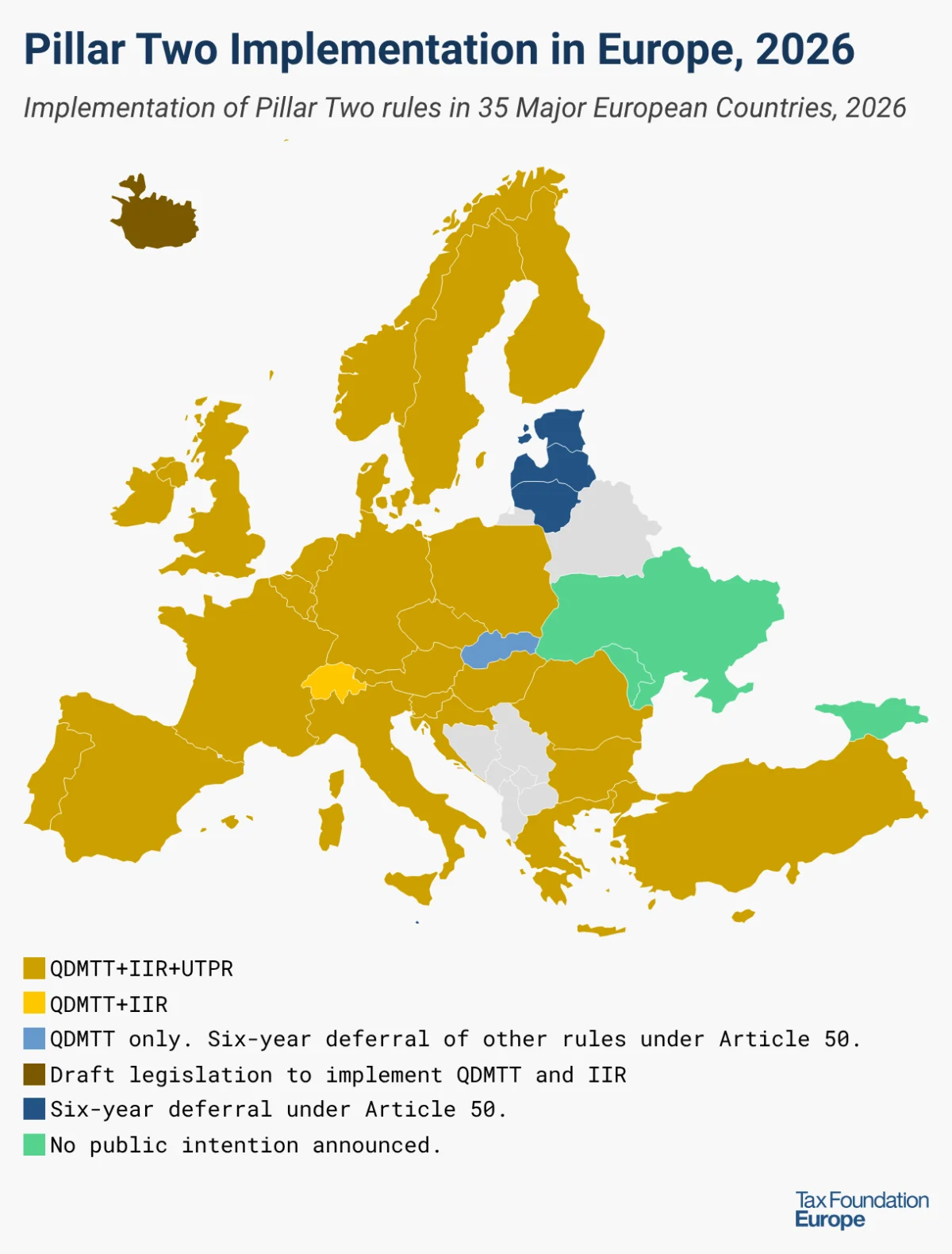
However, the implementation journey across the EU has not been uniform. While 22 of the 27 Member States have implemented the QDMTT, IIR, and UTPR by the target year of 2026, a notable five Member States opted for a six-year deferral under Article 50 of the Directive. This deferral option was available to countries with no more than 12 in-scope multinational groups, often smaller economies or those with unique domestic tax systems. Estonia, Latvia, Lithuania, and Malta have all chosen to defer the implementation of all Pillar Two rules until 2029. This decision reflects their distinct corporate tax regimes, particularly in Estonia and Latvia, which operate distribution-based corporate tax systems. Under these systems, corporate profits are taxed only when distributed, rather than when earned. Implementing Pillar Two by 2030 would fundamentally compromise these design features, obliging in-scope companies to distribute sufficient earnings to meet the 15 percent minimum effective tax rate, thereby altering their long-standing tax policy frameworks. Slovakia, another country eligible for deferral, selectively implemented only a domestic top-up tax in 2024, indicating a nuanced approach to compliance.
Further complicating the EU landscape, four Member States—Cyprus, Poland, Portugal, and Spain—implemented Pillar Two rules with significant delays, despite their obligations under the EU Directive. The European Commission has taken a firm stance on these delays, initiating infringement procedures and even suing these countries for failing to transpose the Directive into national law on time. In these countries, the rules are being applied retroactively for 2024, creating additional compliance challenges for affected businesses. This underscores the legal and political pressure within the EU to ensure consistent application of the global minimum tax framework.
Beyond the EU, other major European countries have shown varying degrees of commitment. Among eight major European countries outside the European Union, only Norway, Turkey, and the United Kingdom have implemented the full suite of Pillar Two rules (QDMTT, IIR, and UTPR) by 2025. Switzerland, a significant hub for multinational companies, implemented a QDMTT in 2024 and an IIR in 2025, but has not yet announced plans for a UTPR, indicating a cautious, phased approach. Iceland is currently undergoing public consultation to implement a QDMTT and an IIR in 2026, also without explicit statements regarding a UTPR. Meanwhile, Georgia, Moldova, and Ukraine—all recent candidates for EU accession—have not publicly announced intentions to implement any Pillar Two rules. Their future alignment with the EU tax framework, particularly concerning Pillar Two, will be a critical aspect of their integration process.
The American Exception: A Divergent Path
In stark contrast to the widespread adoption across Europe, the United States has chosen not to implement Pillar Two directly. This divergence stems from several factors, including the existing US cross-border tax framework, political considerations, and a desire to maintain sovereignty over its tax policy. In June 2025, the G7 announced a political agreement on a global minimum tax "side-by-side" solution, specifically designed to exclude US-parented groups from Pillar Two’s IIR and UTPR. This unique arrangement aims to prevent conflicts between the OECD framework and the US system, particularly its Global Intangible Low-Taxed Income (GILTI) rules.
Instead of adopting Pillar Two, the US has continued to evolve its own cross-border tax framework. Recent changes introduced in the "One Big Beautiful Bill Act" (OBBBA) have produced an outcome that, while distinct in its mechanics, is functionally similar to Pillar Two in its objective of ensuring a minimum level of taxation on foreign income. The newly introduced Net CFC Tested Income (NCTI) acts as a minimum tax, effectively taxing foreign income of US companies at a rate between 12.6 and 14 percent. Crucially, NCTI uses a blended formula rather than a country-by-country approach, a key difference from Pillar Two.
Despite the slightly lower headline rate, the US system may, in some respects, be more stringent than Pillar Two. This is due to several factors: less generous foreign tax crediting rules, the removal of the substance exclusion (which allows for certain routine returns on tangible assets and payroll to be excluded from the minimum tax calculation under Pillar Two), a lack of loss carryovers, and restrictive interest deductibility rules. These features can result in a higher effective tax burden for some US multinational groups compared to what they might face under Pillar Two. The "side-by-side" approach represents a complex compromise, acknowledging the US’s existing robust international tax regime while seeking to prevent global tax fragmentation.
Broader Impact and Future Implications
The implementation of Pillar Two marks a paradigm shift in international taxation, with far-reaching implications for multinational corporations, national governments, and the global economy.
For multinational companies, the most immediate impact is a significant increase in compliance complexity and costs. Companies must now meticulously track their effective tax rates in every jurisdiction, necessitating sophisticated data collection, accounting systems, and tax planning strategies. The fragmented implementation timeline and the differing approaches (like the US "side-by-side" solution) add layers of complexity, requiring companies to navigate multiple, sometimes conflicting, sets of rules. While the aim is to reduce aggressive tax planning, MNEs will need to reassess their global corporate structures and supply chains to optimize their tax positions within the new framework, potentially leading to operational restructuring.
For governments, Pillar Two offers the promise of increased tax revenues and a more stable, predictable tax base. It reduces the incentive for harmful tax competition and provides a mechanism to counter profit shifting. However, it also presents significant administrative challenges, requiring substantial investment in tax administration capacity, technology, and trained personnel to effectively implement and enforce the new rules. Countries that defer or choose not to implement Pillar Two risk losing tax revenue to jurisdictions that do, as the IIR and UTPR allow other countries to claim the "top-up" tax. There are also ongoing debates about the impact on competitiveness, particularly for smaller economies that historically relied on lower tax rates to attract foreign direct investment.
The global economic landscape will also feel the ripple effects. While proponents argue that Pillar Two fosters greater fairness and stability, critics raise concerns about its potential to stifle investment and economic growth. The interaction between Pillar Two and the US’s GILTI/NCTI regime, in particular, will be a critical area to monitor, as any misalignment could lead to unintended double taxation or further complicate cross-border investment flows. The success of Pillar Two ultimately hinges on broad and consistent implementation, alongside ongoing international cooperation to resolve disputes and refine the rules as the global economy evolves.
The journey towards a truly harmonized international tax system is far from over. While Pillar Two represents a monumental step forward in addressing the tax challenges of a globalized and digitalized economy, its full impact will unfold over the coming years, shaping corporate behavior, government policies, and the very fabric of global economic governance. The ongoing dialogue, adaptation, and commitment to cooperation among nations will be crucial in navigating this new era of international taxation.