

 Candice Horbacz
When individuals or entities sell capital assets, such as real estate, stocks, or other investments, the net earnings derived from these sales—known as capital gains—are generally subject to taxation. Conversely, net losses incurred from such sales, or capital losses, can typically be deducted from income when calculating overall income tax liability, providing a measure of relief for investors. However, a significant flaw in the current tax policy across the United States lies in how these capital gains are calculated: the original purchase price, or tax basis, of an asset is subtracted from its selling price in nominal terms. This oversight, the absence of an inflation adjustment to the original purchase price, means that capital gains taxes are often levied on nominal increases in wealth rather than real economic gains. Consequently, taxpayers frequently find themselves taxed on what is a combination of genuine profit and "fictitious income," which merely reflects the erosion of purchasing power due to inflation. While the tax code offers limited accommodations, such as exemptions for qualifying sales of owner-occupied homes or inherited properties, these are insufficient to address the systemic issue. In extreme cases, this lack of inflation indexing can lead to taxpayers paying taxes on a paper gain that, in real terms, represents a net loss.
The Inflation Indexing Conundrum: A Closer Look at "Fictitious Income"
The concept of "fictitious income" is central to understanding the shortcomings of the current capital gains tax system. When an asset is purchased, its value is recorded at that specific point in time. If that asset is held for many years, the purchasing power of the currency changes due to inflation. For example, consider an individual who bought a piece of land for $100,000 in 1990. If they sell that land for $200,000 in 2020, the nominal capital gain is $100,000. However, if cumulative inflation over those 30 years was 100%, the purchasing power of $100,000 in 1990 is equivalent to $200,000 in 2020. In real terms, the investor has made no profit; their initial investment merely retained its original purchasing power. Yet, under the current system, they would be taxed on the entire $100,000 nominal gain. This effectively means they are paying taxes on the inflation itself, not on any actual increase in their wealth.
This problem becomes particularly acute during periods of high inflation. The United States experienced significant inflation spikes in the 1970s and early 1980s, and more recently, an uptick following the COVID-19 pandemic, demonstrating the ongoing relevance of this issue. Tax policy experts and economists have long argued for inflation indexing of the tax basis as a fundamental reform to ensure that capital gains taxes are applied only to real economic profits. Such an adjustment would maintain the integrity of the tax base and prevent the government from effectively taxing a phantom gain.
Federal Accommodations: An Imperfect Solution
The federal tax code does acknowledge this inherent flaw, albeit with what many consider an imperfect solution. Long-term capital gains, defined as net gains on assets held for more than one year, are taxed under a separate rate schedule that is generally lower than those applied to ordinary income. Specifically, depending on a taxpayer’s overall taxable income, rates of 0 percent, 15 percent, or 20 percent apply to long-term capital gains. For instance, in 2024, single filers with taxable income up to $47,025 typically face a 0% capital gains tax rate, while those earning between $47,026 and $581,850 pay 15%, and those above $581,850 are subject to 20%. These preferential rates are intended to partially offset the effects of inflation and encourage long-term investment, recognizing that holding assets for extended periods exposes investors more significantly to inflationary erosion of their basis. However, these lower rates are a broad concession rather than a precise inflation adjustment, meaning they don’t fully resolve the issue of taxing fictitious income, especially for assets held through periods of substantial inflation.
A Patchwork of Policies: State-Level Discrepancies
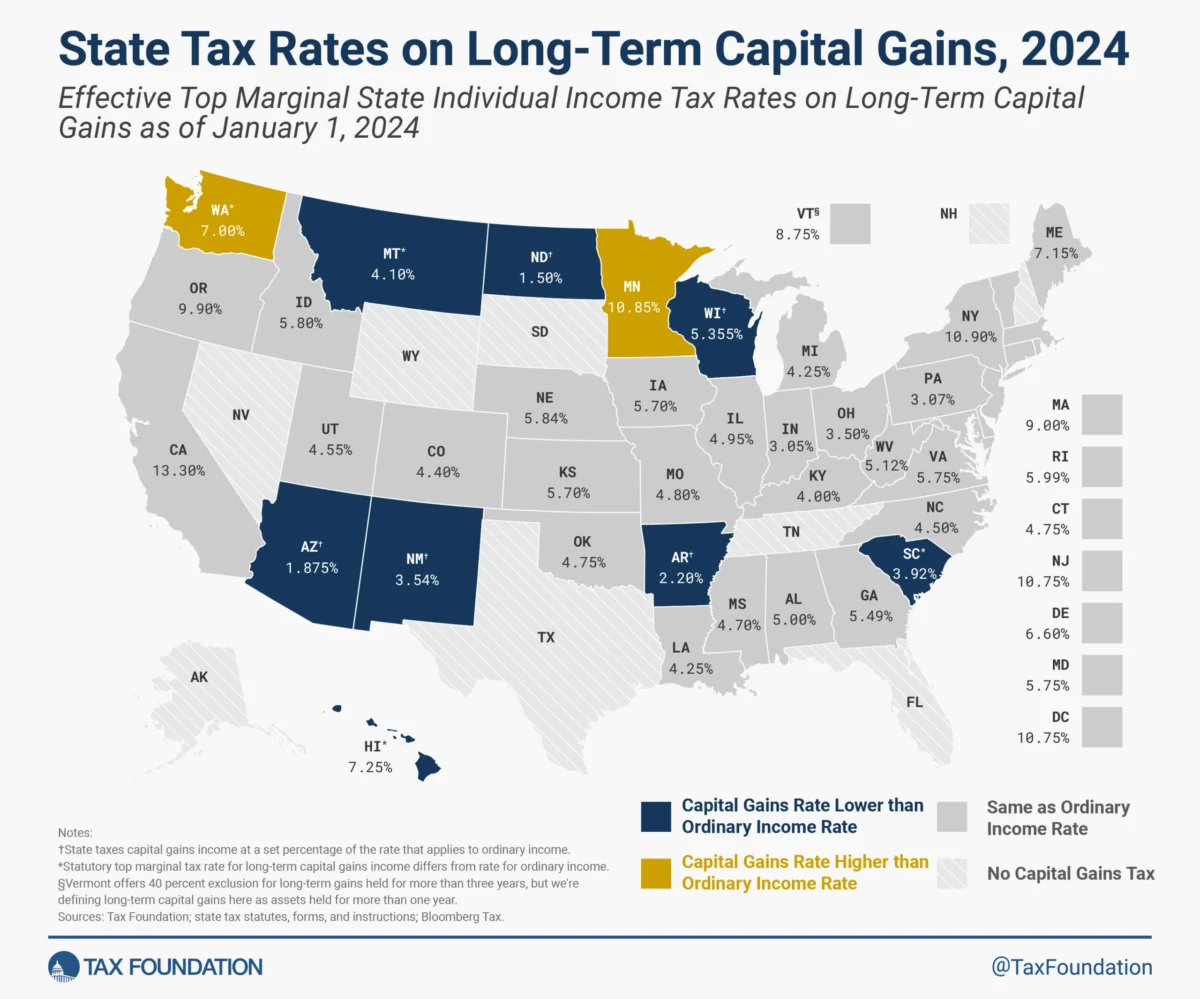
While the federal government offers some mitigation, similar accommodations for inflation’s effects are far less common at the state level, creating a complex and often inequitable tax landscape. A substantial majority—thirty-two states and the District of Columbia—simply subject capital gains income to the same rate schedule that applies to ordinary income. This means that in these jurisdictions, the problem of taxing nominal gains is exacerbated, as taxpayers receive no special consideration for long-term investments beyond what might be available for other income sources.
Furthermore, two states, Minnesota and Washington, stand out for imposing higher effective rates on certain capital gains than on ordinary income. Minnesota, for example, taxes most capital gains at its standard ordinary income rates but levies an additional 1 percentage point tax on net investment income exceeding $1 million, effectively pushing the top marginal rate on significant capital gains to 10.85% (as of 2024). Washington, uniquely, does not have a broad ordinary income tax but imposes a 7 percent tax on capital gains income exceeding $250,000, illustrating a targeted approach that effectively penalizes substantial investment gains in a state otherwise devoid of a general income tax. This creates a scenario where capital gains are singled out for taxation where other income is not, challenging traditional notions of tax equity and potentially deterring high-value investments within these states.
In contrast, only eight states, mirroring the federal approach, apply lower effective individual income tax rates to long-term gains than to ordinary income. These states achieve this either by implementing lower statutory rates specifically for capital gains or by offering an exclusion for a portion of otherwise taxable capital gains. For instance:
- Arizona allows a 25 percent exclusion of net long-term capital gains.
- Arkansas excludes 50 percent of net long-term capital gains, with an additional exemption for amounts exceeding $10 million.
- New Mexico currently excludes the greater of $1,000 or 40 percent of long-term capital gains, a figure set to increase to the greater of $2,500 or 40 percent of up to $1 million of gain starting in 2025.
- North Dakota provides a 40 percent exclusion.
- South Carolina excludes 44 percent of net long-term capital gains.
- Wisconsin allows a 30 percent deduction on net long-term capital gains, with an even more generous 60 percent deduction for farm assets.
These approaches, while varying in generosity, represent deliberate efforts to mitigate the issues of nominal taxation and promote investment.
Meanwhile, seven states—Alaska, Florida, Nevada, South Dakota, Tennessee, Texas, and Wyoming—sidestep the dilemma entirely by forgoing an individual income tax altogether. These states, often celebrated for their favorable tax environments, implicitly exempt capital gains from state-level income taxation, though federal taxes still apply. New Hampshire presents another unique case; while it historically taxed interest and dividends income, it does not tax ordinary income or capital gains income, offering a distinct approach to investment taxation.
This disparate state-level treatment creates a complex and often confusing environment for investors and businesses, potentially influencing investment decisions and capital allocation across state lines. The lack of uniformity also highlights the varying degrees to which states acknowledge the economic realities of inflation and its impact on investment returns.
Beyond Inflation: The Double Taxation Challenge
Even when lower rates or exclusions are granted, capital gains taxes frequently constitute a form of double taxation, a concept widely discussed among tax policy circles. To illustrate, consider an individual saving for retirement by purchasing stock in a company. Often, these shares are acquired through tax-advantaged accounts like 401(k)s or IRAs, where income is taxed only once (either upon contribution for Roth accounts or withdrawal for traditional accounts). However, many investors use ordinary wage or salary income, which has already been subjected to federal and state individual income taxes, to purchase these stocks.
Under favorable circumstances, this initial investment will grow over time. This growth is largely attributable to corporate profits. Before these profits can translate into increased stock value or dividends for the investor, the corporation itself is subject to federal and state corporate income taxes. Therefore, the returns that eventually reach the investor have already been reduced by this first layer of taxation at the corporate level. Years or decades later, when the investor sells their shares and realizes a capital gain, that income is taxed again—first on its nominal growth, as discussed, and second because it represents the distribution of profits that have already been subject to corporate income tax. This multiple layering of taxes—once on the individual’s income used for investment, once on the corporate profits, and then again on the capital gain—can significantly diminish the ultimate return on investment.
Economists often argue that double taxation discourages savings, investment, and capital formation. If a dollar of profit is taxed multiple times, the incentive to invest that dollar in productive enterprises is reduced, as the net return to the investor is lower. This can lead to less capital available for businesses to expand, innovate, and create jobs, potentially hindering overall economic growth.
Economic Ramifications and Policy Implications
The combined effects of taxing nominal gains and double taxation have profound economic implications. They can create a "capital lock-in" effect, where investors are reluctant to sell appreciated assets, even when it would be economically rational to do so, because of the substantial tax liability incurred upon realization of the nominal gain. This can lead to inefficient allocation of capital, as funds remain tied up in less productive assets rather than being redeployed to more promising ventures. Moreover, it can disadvantage long-term investors and retirees whose savings are meant to compound over decades, only to be eroded by taxes on inflationary gains.
For individuals and families, savings and investment are crucial for financial security, retirement planning, and wealth accumulation. For the national economy, robust capital formation is a cornerstone of innovation, productivity growth, and job creation. Therefore, policymakers face a critical challenge: how to structure capital gains taxation to generate necessary public revenue without unduly penalizing or discouraging these vital economic activities.
Tax reform advocates and many economic think tanks consistently recommend addressing these biases. The primary proposed solutions include:
- Inflation Indexing of the Tax Basis: This would be the most direct way to ensure that only real capital gains are taxed, aligning the tax system with economic reality. While it introduces some administrative complexity, proponents argue the fairness and economic efficiency benefits outweigh these challenges.
- Further Reducing Capital Gains Tax Rates: For states that currently tax capital gains at ordinary income rates, adopting lower rates or exclusions for long-term gains, similar to the federal approach or the eight proactive states, would be a significant step.
- Robust Capital Loss Deductions: Ensuring timely and comprehensive deductions for capital losses helps balance the risk for investors and provides a more equitable tax treatment.
- Revisiting Corporate and Individual Income Tax Interaction: A broader policy discussion around the corporate income tax and its interaction with capital gains taxation is essential to mitigate the effects of double taxation and encourage more efficient capital allocation.
Conclusion: A Call for Coherent Tax Policy
In evaluating the tax treatment of investment income, state policymakers, alongside their federal counterparts, must consider all layers of taxes on these earnings, including corporate income taxes. They must also fully grasp how the failure to inflation index the tax basis, coupled with most states’ reluctance to adjust rates accordingly, contributes to the widespread overtaxation of capital gains income across the United States.
The current landscape, characterized by significant federal-state divergence and a fundamental flaw in how gains are measured, presents a compelling case for reform. As savings and investment remain critical drivers of both individual prosperity and national economic health, policymakers have a responsibility to mitigate—rather than inadvertently exacerbate—the existing biases against these essential activities within the tax code. A coherent, economically sound approach to capital gains taxation is not merely a technical adjustment; it is an investment in the nation’s future economic vitality.