Layla Zulfa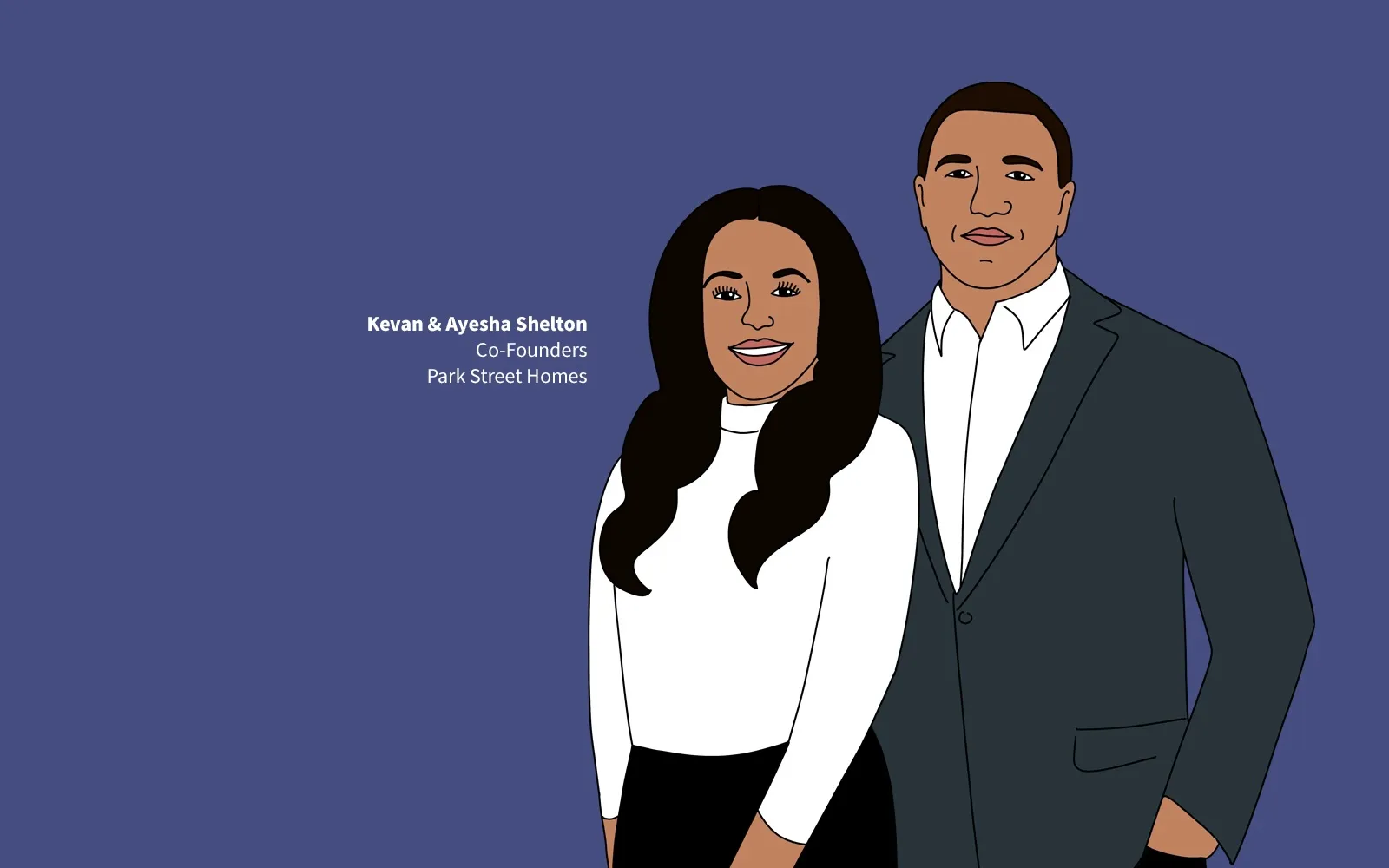
The prevailing image of homebuilding scale today often conjures vast tracts of land visible only through satellite GPS imagery or drone-generated aerial perspectives. This scale is characterized by thousands of lots under corporate control, sprawling master-planned communities, national purchasing agreements, and numerous operating divisions. Such immense production machinery, with its substantial annual closings and significant local market influence, drives down fixed costs across the entire operation.
However, Kevan and Ayesha Shelton are actively constructing a different paradigm at Park Street Homes. Their venture is predicated on the belief that the disciplined efficiencies of production homebuilding can be harnessed to achieve scale in environments where conventional production builders have historically struggled: established urban neighborhoods. These areas present unique challenges, including fragmented lot ownership, aging infrastructure, historically significant architecture, and a deeply invested resident population that cares profoundly about the future of their community.
For the past decade, the Sheltons have meticulously honed and proven this model in Houston, and increasingly, in surrounding regions. Now, despite a challenging homebuilding landscape marked by fragile demand, strained affordability, and the high cost of capital, Park Street Homes is poised for accelerated expansion. The company has identified approximately 15 additional urban markets as prime targets for growth and is actively seeking capital to fuel this ambitious push. While the scope of their ambition is significant, the unit of expansion remains deliberately granular: neighborhood by neighborhood, city by city.
"As we’ve grown and done more, I think we found the thread of a sweater," Kevan Shelton remarked in a recent interview. "We realize that our model is such a needed thing in almost every urban core around the country."
This distinctive approach positions Park Street Homes as the third company featured in HousingWire’s Built For This series to reach a similar destination from a sharply contrasting starting point. National Home Corp., for instance, employs a tightly disciplined, land-light production model to continue building attainable homes and navigate a difficult market. Similarly, StyleCraft Builders CEO Doug French is recommitting his organization to fundamental operational principles – schedules, purchase orders, variance management, customer delivery, and continuous learning – which become paramount when less favorable market conditions expose any organizational weaknesses.
Park Street Homes, however, cultivates its competitive moat from a different foundation. Their operating thesis asserts that overlooked urban neighborhoods can serve as fertile ground for growth, provided a builder approaches them with production discipline rather than treating them as interchangeable subdivisions.
Production Building, Reimagined for the Urban Fabric
When Park Street Homes was first profiled last year, its model stood out for its unique synthesis of two capabilities often perceived as mutually exclusive, even contradictory. The first element is rooted in traditional production homebuilding: standardized processes, rigorous purchasing discipline, replicability, stringent construction controls, and a foundational understanding that profitability hinges on transforming individual house construction into a cohesive, efficient production system.
The second, equally critical, element is an intensely local focus. Park Street Homes terms its design philosophy "reflective design." Instead of imposing a standardized suburban streetscape onto an established neighborhood, the company’s team undertakes a thorough study of the existing architecture and historical context. This deep understanding then informs the adaptation of their product to complement the neighborhood’s unique character. While the underlying house structure and floor plans can be repeated – with each iteration learning from the previous and achieving greater "first-time-right" velocity – the external appearance is carefully curated to echo the local historical aesthetic.
"We can take our same plans, kind of change the face to the neighborhood culture of where we are, but the core tenets of the plan work," Shelton explained. "The core tenets of the philosophy around the plan work." This strategy is driven by the distinct economic realities of urban infill development, which differ significantly from the conventional production model. A large builder seeking several hundred contiguous acres might dismiss a collection of smaller, scattered parcels within an established neighborhood. Park Street Homes, conversely, views precisely these conditions as a prime opportunity. Their competitive advantage stems not only from land acquisition but also from their expertise in operating within an environment where obtaining development permission requires a different, more nuanced approach. In an established neighborhood, the builder is not initiating a community from scratch; they are becoming an integrated part of an existing one.
Trust as Essential Operating Infrastructure
This localized approach fundamentally alters the definition of scale. Park Street Homes cannot simply replicate its Houston success in Birmingham, Dallas, or the dozen other markets on its expansion list without adaptation. The core operating system must be transferable, but the company’s relationship with each specific place must remain resolutely local. This dynamic forms the crux of their growth strategy.
"Every neighborhood ultimately has many of the same needs, features, and cultural aspects," Shelton observed. The opportunity, as he perceives it, lies in overlaying a repeatable operating model across diverse landscapes while preserving sufficient local knowledge and sensitivity to ensure that each new development resonates with the existing community.
Achieving this balance has significant business implications. Community trust can directly influence access to land, foster positive municipal relationships, streamline entitlement processes, facilitate nonprofit partnerships, enhance buyer acceptance, and ultimately accelerate the conversion of opportunities into completed sales. Within Park Street Homes’ model, these relationships are not peripheral to the production system; they are an integral component of it. In this manner, trust functions as essential infrastructure, akin to the "public works system" that facilitates the evolution of each neighborhood.
This approach challenges the conventional homebuilding notion that scale is primarily synonymous with sheer size. Park Street Homes requires repetition, purchasing power, capital efficiency, and standardized processes, much like any production builder. However, it also necessitates an intimate understanding of the subtle differences that distinguish one block from another. The Sheltons face the dual challenge of scaling both operational efficiency and local contextual understanding simultaneously.
Affordability: Meeting the Market Where It Is
The current economic climate has imbued Park Street Homes’ mission with added urgency. "What we found ourselves, especially in the affordable housing space, it seems like the market met us where we were," Shelton noted. "We were focused on affordability, and then everybody now is focused on affordability."
This shared focus on affordability, however, does not inherently simplify the sale of affordable homes. On the contrary, Shelton emphasizes, "In a market like this, demand is what really is more fragile. I think in 2022 you could throw a dart and sell a house, and now you have to do a lot more convincing."
Despite these challenges, Park Street Homes enters this period with a distinct advantage. Due to its land acquisition methods and the structure of its affordable housing projects, Shelton states the company can establish the economic parameters for some homes well in advance of their completion. "We’re essentially years out ahead of prices set on homes," he explained. "We know exactly what we’re going to charge for a home. We design for profitability when we initially take the land on."
This forward-looking approach provides visibility into projects with ramp-up periods of 12 to 24 months, where the economics are solidified before the homes reach potential buyers. In a volatile market, as has been evident in previous housing and economic downturns, this level of visibility is exceptionally valuable. It affords Park Street Homes ample time to collaborate with municipalities and community partners, gain a nuanced understanding of prospective buyers, and forge a clearer connection between the housing intended for production and the households it is designed to serve. This directly addresses a core tenet of the Park Street model: the customer is not an abstract entity hoped to eventually appear at a sales center; the customer is a fundamental consideration from the project’s inception.
A Distinctive Pathway to Scale
Park Street Homes’ expansion plans now subject this proposition to a more rigorous examination. The company is collaborating with a major investment bank on a capital raise to support its growth initiatives. Shelton characterizes the strategy as "two-handed," involving the combination of financial capital with a potential strategic homebuilding partner already operating in some of Park Street’s target markets. This partnership structure itself hints at the next phase of development. Park Street Homes need not evolve into a conventional national production builder to leverage the capabilities of one. Conversely, a larger builder might not need to replicate Park Street’s intricate neighborhood expertise internally if a partnership can provide direct access to it.
This opens another avenue for conceptualizing scale within an industry increasingly preoccupied with consolidation. National homebuilders possess undeniable advantages in purchasing power, capital access, technological adoption, and overhead leverage. Yet, their sheer size often creates a threshold below which many opportunities are deemed too small or inefficient to pursue. Park Street Homes is deliberately building a business that capitalizes on these very opportunities. A fragmented collection of lots that might be a logistical challenge for one company represents a robust pipeline for another. A neighborhood requiring years of dedicated relationship-building could appear inefficient under one operating model but highly defensible under another. Scale, therefore, is intrinsically linked to the nature of what one seeks to repeat.
The Invaluable Element That Must Not Be Lost
This duality presents perhaps the most significant leadership challenge facing Kevan and Ayesha Shelton. The company has identified a replicable model that they believe can be successfully transplanted into more than a dozen new metropolitan areas. Their production processes, construction plans, land acquisition strategies, affordability frameworks, and partnership approaches are all designed for transferability.
However, the fundamental success of their business hinges on elements that cannot be standardized or replicated mechanically. Neighborhood history is specific. Trust is earned and unique to each community. Relationships with city officials, residents, and community organizations are deeply contextual. The architectural cues that signal a new home belongs within a particular block are nuanced and locally derived.
The next stage of Park Street Homes’ evolution will depend on the Sheltons’ ability to rigorously discern between the components of their business that should be standardized for efficiency and those that should never be diluted or compromised. This represents a different leadership imperative compared to the challenges faced by National Home Corp. and StyleCraft Builders, yet a clear familial resemblance in their strategic adaptation to market conditions is emerging.
None of these companies can influence national mortgage rates or control the broader economic climate. None can anticipate a swift restoration of easily accessible affordability or abundant, inexpensive capital. What their leaders can do, however, is refine their understanding of their unique competitive advantages, define their organizational identity, and chart a clear path toward their desired future.
For National Home Corp., this translates to an unwavering commitment to a disciplined operating playbook meticulously crafted backward from an attainable home price point. For StyleCraft, it means establishing basic execution – on-time construction, effective variance control, quality finishing, and continuous learning from repetition – as an organizational standard.
For Park Street Homes, the path forward involves harmonizing production capacity with a far more complex and less mass-producible asset: profound local knowledge, access to overlooked land opportunities, and established trust within communities where housing development has historically occurred with insufficient regard for existing residents. Shelton expresses confidence that this integrated approach will travel successfully.
"We’ve identified…about 15 additional markets other than the markets that we’re in that we have on our list to expand to," he stated. "It is on that neighborhood-by-neighborhood, kind of city-by-city scale." This represents both their growth opportunity and their ultimate test. Park Street Homes must expand without sacrificing its local intimacy, become more standardized without becoming generic, and increase efficiency without eroding the foundational relationships that created its initial market access. This critical conversation will be a central theme at the HousingWire Homebuilder Summit in Dallas, October 19-21. It offers another vital insight into the question driving our Built For This series: What can a homebuilding business achieve when the market itself offers minimal external assistance? The answer, it appears, lies in identifying what one can do that others cannot, or will not, and then systematically amplifying that capability.