Nila Kartika Wati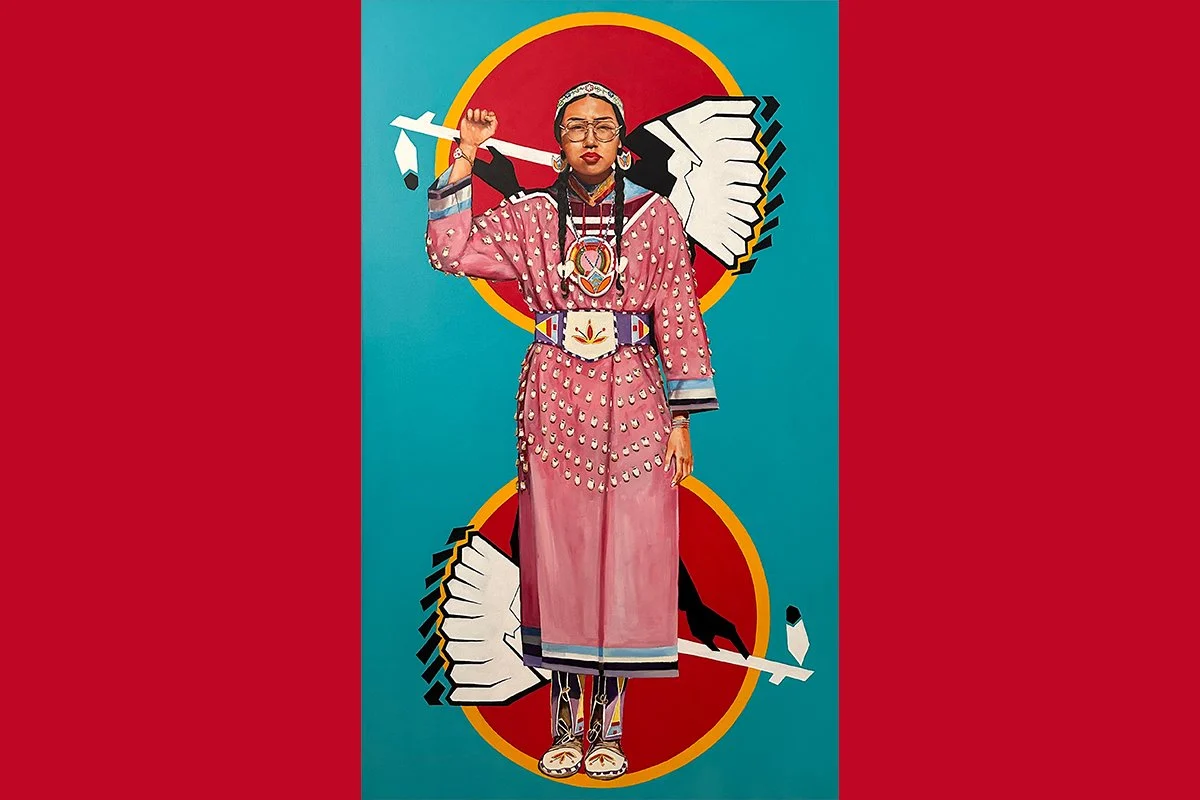
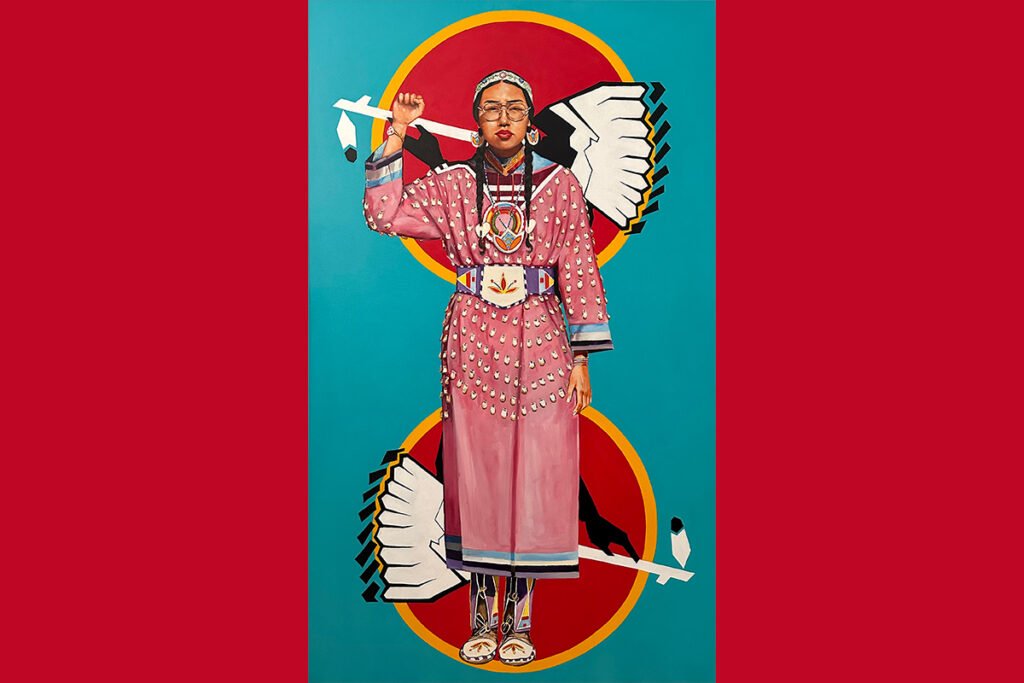
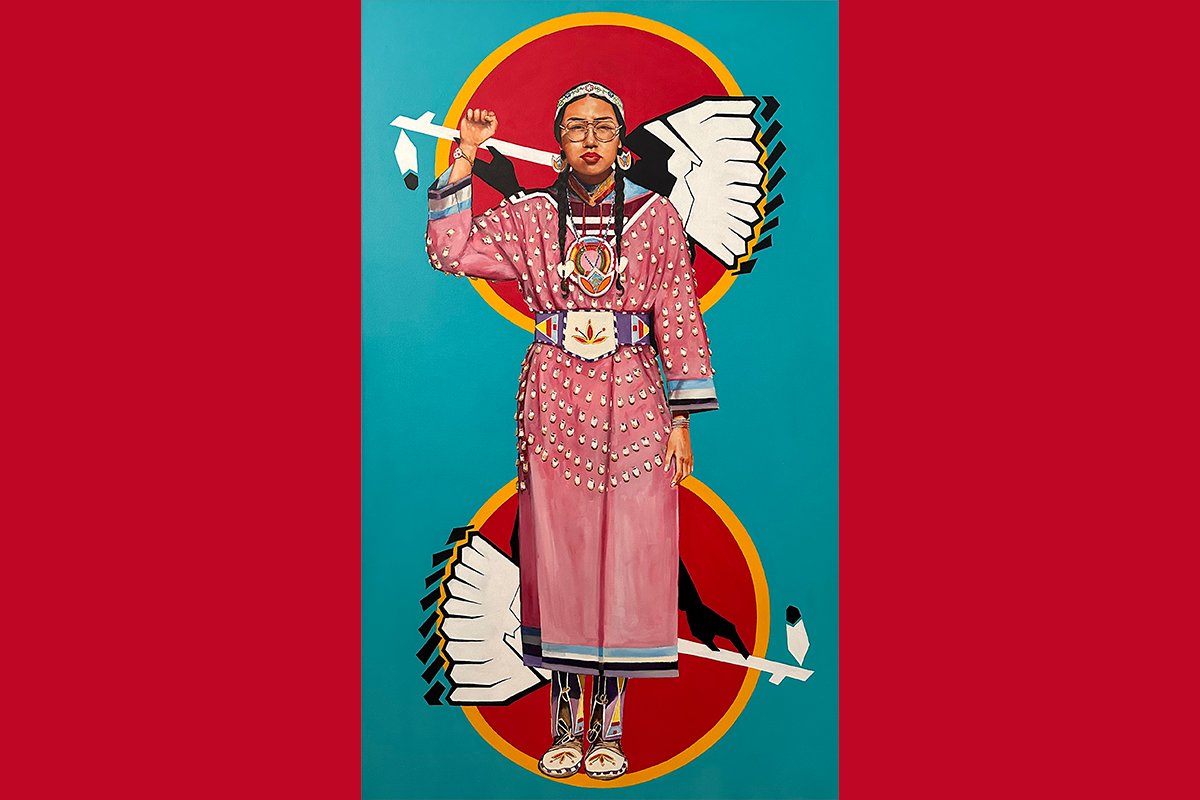
The contemporary art world is witnessing a transformative shift as Indigenous artists reclaim the narrative of their own communities, moving away from historical tropes of the "vanishing Indian" toward a vibrant, living representation of sovereignty. At the forefront of this movement is the painting Power of the People, a significant work by Apsáalooke (Crow) artist D.C. Allen, also known as Del Curfman. The piece centers on Kamijo Whiteclay, a member of the Crow Tribe of Montana and a student at the Institute of American Indian Arts (IAIA). Through this portrait, Allen encapsulates a pivotal moment in Indigenous activism, where traditional knowledge and contemporary political resistance intersect. Whiteclay is depicted in traditional Crow regalia, her fist raised in a gesture of solidarity and defiance, symbolizing a generation of Indigenous youth who refuse to let their heritage be relegated to the past.
The Artist and the Faces of Our Land Project
D.C. Allen, born in 1993 and raised in Montana, has established himself as a critical voice in contemporary Native American art. Now based in Santa Fe, New Mexico—a global epicenter for Indigenous creativity—Allen’s work is characterized by its large-scale figurative focus and its commitment to "Indigenous presence." Allen’s academic background is rooted in the Institute of American Indian Arts, where he earned a Bachelor of Fine Arts in Studio Arts and a Bachelor of Fine Arts in Museum Studies in 2017. This dual focus has allowed him to not only create art but also to critique the ways in which Indigenous people have been historically curated and displayed in Western institutions.
Power of the People is a cornerstone of Allen’s ongoing community-centered project, "Faces of Our Land." This initiative seeks to bridge the gap between portraiture, documentary practice, and oral history. Unlike traditional ethnographic portraiture, which often captured Indigenous subjects without their consent or input, Allen’s process is inherently collaborative. He works closely with his subjects to ensure their personal narratives and cultural identities are foregrounded. By doing so, Allen actively counters centuries of misrepresentation and appropriation, providing a platform for self-representation that emphasizes the lived experiences of contemporary Native people.
The Subject: Kamijo Whiteclay and the Next Generation
The subject of the painting, Kamijo Whiteclay, represents the "emerging Indigenous leader" archetype. As an IAIA student and cultural advocate, her life is dedicated to the protection and continuation of Crow culture. In Allen’s composition, Whiteclay stands as a bridge between the ancestors and the future. Her unwavering gaze and confident stance are not merely aesthetic choices; they are statements of political and cultural intent.
The portrayal of Whiteclay with a raised fist draws upon the global visual language of protest, specifically linking Indigenous struggles to broader movements for civil rights and self-determination. However, the context remains uniquely Crow. By wearing traditional regalia, Whiteclay asserts that Indigenous identity is not a costume, but a living, breathing reality that informs her leadership. The painting serves as a reminder that for many Native youth, education and cultural preservation are forms of resistance against the historical pressures of assimilation.
Addressing the Dichotomy of Tobacco: Sacred vs. Commercial
One of the most complex layers of Power of the People is its exploration of the relationship between Indigenous peoples and tobacco. The painting features an emblem of a Native American chief smoking ceremonial tobacco, a visual element that invites a discussion on the exploitation of Indigenous symbols by the commercial tobacco industry.
In many Native American traditions, including those of the Plains tribes, tobacco is a sacred medicine used for prayer, offerings, and sealing agreements. It is a conduit for communication with the spiritual realm. However, the commercial tobacco industry has a long history of targeting Native American communities through predatory marketing and the misappropriation of sacred imagery. According to data from the Centers for Disease Control and Prevention (CDC), American Indian and Alaska Native (AI/AN) populations have the highest prevalence of commercial cigarette smoking among any racial or ethnic group in the United States.
Research indicates that tobacco companies have historically exploited tribal sovereignty and cultural symbols to promote their products. Brands like "Natural American Spirit" have faced criticism and legal challenges for using Indigenous imagery to suggest that their products are "healthier" or more "authentic." Allen’s painting addresses this complicated history by positioning Whiteclay as a challenger to these practices. The work emphasizes the distinction between "sacred tobacco"—which is used in a controlled, ritualistic manner—and "commercial tobacco," which is an addictive product marketed for profit. By reclaiming the image of the pipe-smoking chief within a contemporary context, Allen strips away the commercial veneer and returns the symbol to its cultural roots.
Historical Context and the Crow Tribe of Montana
To fully appreciate the significance of Power of the People, one must understand the historical resilience of the Apsáalooke people. The Crow Tribe, based in present-day Montana, has a rich history of maintaining their language, social structures, and ceremonial life despite the upheavals of the 19th and 20th centuries. The Crow are known for their distinct aesthetic traditions, particularly their intricate beadwork and the grandeur of their traditional dress, which are prominently featured in Allen’s work.
In the mid-20th century, the Crow Tribe was instrumental in navigating the complexities of federal Indian policy, often using their diplomatic skills to protect their land base and resources. Today, the tribe continues to face challenges related to economic development, environmental protection, and healthcare. The emergence of young leaders like Kamijo Whiteclay is a testament to the tribe’s enduring strength. Allen’s painting captures this historical trajectory, showing that the power of the Apsáalooke is not found in history books alone, but in the active engagement of its people with the modern world.
The Role of the Institute of American Indian Arts
The Institute of American Indian Arts (IAIA) serves as the backdrop for the development of both the artist and the subject. Founded in 1962, IAIA has been the birthplace of the Contemporary Native American Art movement. It has provided a space where Indigenous artists can experiment with Western mediums—like large-scale oil painting—while staying rooted in their tribal identities.
Allen’s tenure at IAIA during the mid-2010s coincided with a period of renewed Indigenous activism, most notably the Standing Rock protests against the Dakota Access Pipeline. This era saw a surge in "artivism," where visual art became a primary tool for mobilizing communities and communicating Indigenous perspectives to a global audience. Power of the People is an evolution of this tradition, blending the formal qualities of fine art portraiture with the urgency of social advocacy.
Analysis of Visual Symbolism and Impact
Visually, Power of the People utilizes a bold color palette and dynamic composition to command attention. The background emblem of the chief functions as a "ghostly" presence, suggesting that the ancestors are watching over and supporting the actions of the youth. This layering of time—past, present, and future—is a hallmark of Allen’s style.
The painting also challenges the "museum gaze." For centuries, portraits of Native Americans were created by non-Native artists like George Catlin or Edward Curtis, who often romanticized their subjects or depicted them as a "dying race." Allen’s work is a direct rebuttal to this history. By placing a contemporary Crow woman at the center of the canvas, Allen asserts that Indigenous people are the masters of their own images. The painting is not an artifact; it is a living document of sovereignty.
The implications of this work extend beyond the gallery walls. As Allen’s "Faces of Our Land" project gains visibility, it contributes to a broader effort to decolonize public spaces and museum collections. By emphasizing collaboration and lived experience, Allen provides a model for how institutions can engage with Indigenous communities in a way that is respectful and empowering.
Conclusion: Art as a Catalyst for Change
Power of the People is more than a portrait; it is a manifesto for Indigenous self-determination. Through the figure of Kamijo Whiteclay, D.C. Allen honors the collective action and cultural knowledge that fuel meaningful change across generations. The work serves as a critical intervention in the ongoing dialogue regarding tobacco exploitation, cultural preservation, and the role of youth in tribal leadership.
As the painting finds its place in the contemporary art canon, it stands as a reminder that the "power of the people" is rooted in the ability to tell one’s own story. For the Apsáalooke and for Indigenous communities across North America, Allen’s work is a celebration of resilience—a vibrant, defiant, and unwavering look into a future shaped by Indigenous voices. Through his brush, Allen ensures that the strength of the Crow Tribe and the brilliance of its youth are recognized not as relics of the past, but as the architects of tomorrow.