Lana Rhoades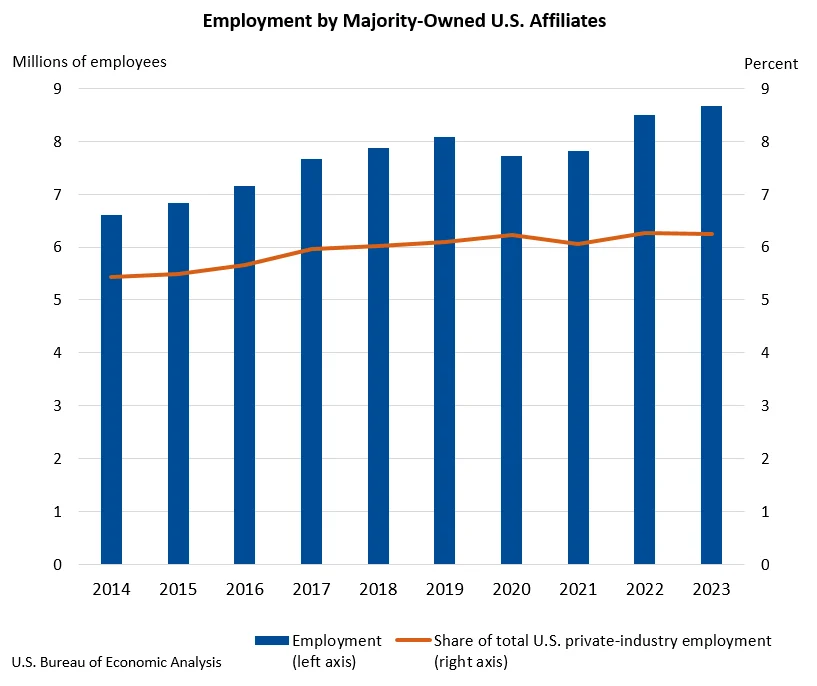
The United States continues to be a significant destination for foreign investment, with majority-owned U.S. affiliates of foreign multinational enterprises (MNEs) demonstrating robust growth in employment and economic contributions in 2023. According to newly released statistics from the U.S. Bureau of Economic Analysis (BEA), these affiliates employed a record 8.66 million workers across the nation, marking a 1.9 percent increase from the 8.5 million workers employed in 2022. This sustained expansion underscores the vital role foreign direct investment plays in the American economy, bolstering job creation and injecting substantial capital into various sectors.
The BEA data, released today, paints a picture of a dynamic and growing sector within the U.S. economy. The increase in employment signifies a positive trend for the American workforce, with foreign-owned companies continuing to expand their operations and hiring initiatives. This growth is particularly noteworthy given the evolving global economic landscape, highlighting the enduring appeal of the U.S. market for international businesses seeking to establish or expand their presence.
While the number of jobs created by these affiliates saw a healthy increase, their overall share of total private-industry employment in the United States experienced a slight dip, moving from 6.3 percent in 2022 to 6.2 percent in 2023. This marginal decrease, despite absolute job growth, suggests that the broader U.S. private sector may have also experienced growth, albeit at a potentially different pace. Nevertheless, the sheer volume of employment provided by these foreign-affiliated companies remains a substantial component of the nation’s labor market.
Economic Impact Beyond Employment
The influence of majority-owned U.S. affiliates extends far beyond direct employment figures. Their contribution to the U.S. gross domestic product (GDP) saw a significant uptick in 2023. The current-dollar value added by these affiliates, a key measure of their direct economic contribution, surged by 6.3 percent, reaching an impressive $1.47 trillion. This substantial increase reflects not only the growing workforce but also enhanced productivity, increased output, and greater overall economic activity generated by these entities. This growth in value added is a strong indicator of the deepening integration and economic significance of foreign MNEs within the U.S. economic framework.
Further demonstrating their commitment to the U.S. economy, expenditures on property, plant, and equipment by these majority-owned affiliates also saw a considerable rise. In 2023, these investments climbed by 6.3 percent, totaling $322.7 billion. This significant investment in physical assets signals a long-term outlook by foreign companies, indicating confidence in the stability and future growth prospects of the U.S. market. Such capital expenditures are crucial for fostering innovation, enhancing infrastructure, and creating a more competitive economic environment. These investments can lead to the development of new facilities, upgrades to existing ones, and the adoption of advanced technologies, all of which contribute to increased productivity and economic dynamism.
Innovation and research are also key areas where these foreign-affiliated companies are making their mark. The data reveals that research and development (R&D) performed by majority-owned U.S. affiliates increased by 1.1 percent, reaching $87.8 billion in 2023. While this represents a more modest growth rate compared to other metrics, it still signifies a sustained commitment to R&D activities within the United States. This investment in innovation is vital for driving technological advancements, developing new products and services, and maintaining a competitive edge in the global marketplace. The R&D performed by these affiliates contributes to the U.S. knowledge base and can lead to significant spillover effects across various industries.
Historical Context and Data Revisions
The statistics released by the BEA are part of a comprehensive effort to track the activities of U.S. affiliates of foreign multinational enterprises. These data are crucial for policymakers, economists, and businesses to understand the intricate web of global economic interactions and their impact on the domestic economy. The BEA regularly updates its statistics to incorporate newly available and revised source data, ensuring the highest degree of accuracy and relevance.
Notably, the BEA has also released revised statistics for 2022, incorporating updated information that refines previous preliminary estimates. The preliminary statistics for 2022, initially released in November 2024 and highlighted in the December 2024 issue of the Survey of Current Business in an article titled "Activities of U.S. Affiliates of Foreign Multinational Enterprises in 2022," have undergone revisions. These revisions show a notable upward adjustment in several key areas. For instance, the number of employees for 2022 was revised from a preliminary estimate of 8.351 million to 8.5031 million, an increase of over 150,000 jobs. Similarly, value added for 2022 was revised from $1.350.1 billion to $1.382.1 billion, reflecting a more substantial economic contribution than initially reported. Expenditures for property, plant, and equipment also saw an upward revision, from $299.1 billion to $303.5 billion. Perhaps most significantly, R&D expenditures for 2022 were revised from $80.3 billion to $86.8 billion, indicating a more robust investment in innovation than previously estimated. These revisions underscore the dynamic nature of data collection and analysis and highlight the BEA’s commitment to providing the most accurate economic picture possible.
Trends and Future Outlook
The consistent growth in employment and economic contribution from majority-owned U.S. affiliates of foreign MNEs suggests a positive and stable trend. This performance can be attributed to several factors, including the U.S.’s large consumer market, a skilled workforce, a stable legal and regulatory environment, and access to advanced technologies and capital markets. The continued investment in physical assets and R&D further indicates a long-term strategic commitment by these companies to their U.S. operations.
While the BEA provides extensive data, it is important to note that some data tables previously released alongside these news releases have been discontinued as of December 5, 2025. This includes certain statistics related to U.S. affiliates with 50 percent or less foreign ownership and supplemental industry statistics. The BEA has archived these impacted tables, making them accessible for historical reference. This streamlining of data dissemination aims to focus on the most impactful and relevant data points for current analysis.
The BEA’s commitment to providing comprehensive data on foreign direct investment and its impact on the U.S. economy is invaluable. The ongoing release of statistics on the activities of U.S. affiliates of foreign multinationals, covering areas such as sales, balance sheets, income statements, employee compensation, and trade, allows for a detailed understanding of these entities’ operations. The availability of industry-, country-, and state-level details further enhances the granularity of the data, enabling more targeted analysis and informed decision-making.
Broader Economic Implications
The robust performance of foreign-affiliated companies has several broader implications for the U.S. economy.
-
Job Creation and Economic Stability: The 8.66 million jobs provided by these affiliates are a significant pillar of the U.S. labor market. Continued growth in this sector contributes to lower unemployment rates and provides economic stability for millions of American families. The diversity of industries employing these workers, from manufacturing and technology to services and finance, means the impact is widespread.
-
Technological Advancement and Innovation: Investment in R&D by foreign-affiliated companies fuels innovation within the U.S. This can lead to the development of new technologies, processes, and products, enhancing U.S. competitiveness on a global scale and creating high-skilled job opportunities. The spillover effects of this R&D can benefit domestic companies as well, fostering a more dynamic and technologically advanced economy.
-
Capital Inflow and Investment: The substantial expenditures on property, plant, and equipment represent a significant inflow of capital into the U.S. economy. This investment not only creates jobs directly related to construction and installation but also enhances the productive capacity of the nation, leading to increased output and economic growth. It also signals confidence in the U.S. economic outlook from international investors.
-
Trade Balance and Global Integration: The activities of these affiliates also influence U.S. trade. Their operations can lead to increased exports of U.S.-produced goods and services, as well as imports of components and raw materials. Understanding these trade flows is crucial for managing the nation’s balance of payments and its position in the global economy.
-
Tax Revenue: The economic activity generated by these foreign-affiliated companies, including their profits and employee wages, contributes significantly to U.S. tax revenues at federal, state, and local levels. This revenue is essential for funding public services and infrastructure projects.
Looking Ahead
The data released today by the BEA provides a clear indication of the sustained and growing importance of foreign multinational enterprises to the health and vitality of the U.S. economy. As these companies continue to invest, expand, and employ, their contributions are likely to remain a critical factor in shaping the nation’s economic landscape. The next release of statistics, scheduled for July 10, 2026, will cover the 2024 activities of U.S. affiliates of foreign multinational enterprises, offering further insights into the evolving dynamics of global investment in the United States. The consistent growth trajectory observed in the latest report suggests that this sector will continue to be a significant engine of economic progress for the foreseeable future. The BEA’s ongoing commitment to providing timely and comprehensive data will be instrumental in navigating and understanding these complex economic interactions.