Julia Chirkova

PwC announced on Monday its record-breaking global revenue for the fiscal year ending June 30, 2026, reaching an impressive $60.2 billion. This figure represents a 5.7% increase in U.S. dollar terms and a 3.5% rise in local currency terms compared to the previous fiscal year. The sustained growth underscores the firm’s resilience and strategic adaptability amidst a dynamic global economic and geopolitical landscape.
A Trajectory of Consistent Growth
The fiscal year 2026 results build upon a strong foundation laid in FY 2025, when PwC reported a global revenue of $56.9 billion. During that preceding year, the firm experienced a year-over-year revenue increase of 2.7% in local currency and 2.9% in U.S. dollar terms. The latest figures demonstrate an acceleration in growth, signaling a robust performance across the network.
PwC Global Chairman Mohamed Kande expressed his satisfaction with the financial outcomes, stating in a press release on October 19, "Our financial results show the strength and resilience of our business. We achieved robust growth, even in the face of geopolitical and economic uncertainty. As a network, we will continue to invest in new ways of delivering value to our clients as we transform today to build the PwC of tomorrow." This sentiment highlights a forward-looking strategy focused on innovation and client-centric value creation, even as the firm celebrates its current achievements.

Competitive Landscape: PwC’s Position Among the Big Four
The latest revenue figures solidify PwC’s standing as the second-largest accounting firm globally by revenue. The competitive landscape among the Big Four accounting firms remains intense, with each entity vying for market share and demonstrating significant financial scale.
Deloitte, the largest of the Big Four, reported its FY 2026 global revenue for the year ending May 31, totaling $74.5 billion. This represents a 3.8% increase in local currency and a 5.7% increase in U.S. dollar terms from FY 2025. Meanwhile, EY announced its FY 2026 global revenue for the year ending June 30, reaching $57 billion, an increase of 7% in U.S. dollars and 4.7% in local currency terms. KPMG is scheduled to release its FY 2026 global revenue results later this year, adding another key data point to the industry’s performance metrics.
Drivers of Growth: Geographic and Service Line Performance
PwC’s impressive revenue growth was not confined to specific areas but was a widespread phenomenon, with increases reported across all three of its major geographic regions and its distinct lines of service.
Geographic Performance:
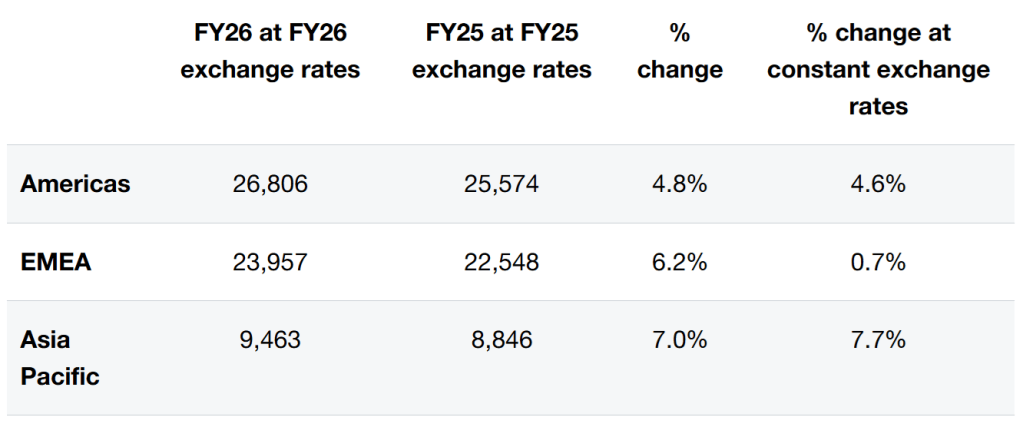
At constant exchange rates, the Asia Pacific region emerged as the strongest performer, with revenue growing by an impressive 7.7%. This surge indicates a strong demand for PwC’s services in one of the world’s fastest-growing economic zones. Following closely, the Americas region saw a 4.6% increase in revenue. The Europe, Middle East, and Africa (EMEA) region, while experiencing more moderate growth, still contributed positively with a 0.7% increase in revenue at constant exchange rates. This balanced performance across diverse economic environments speaks to the firm’s global reach and its ability to cater to varied market needs.

Service Line Performance:
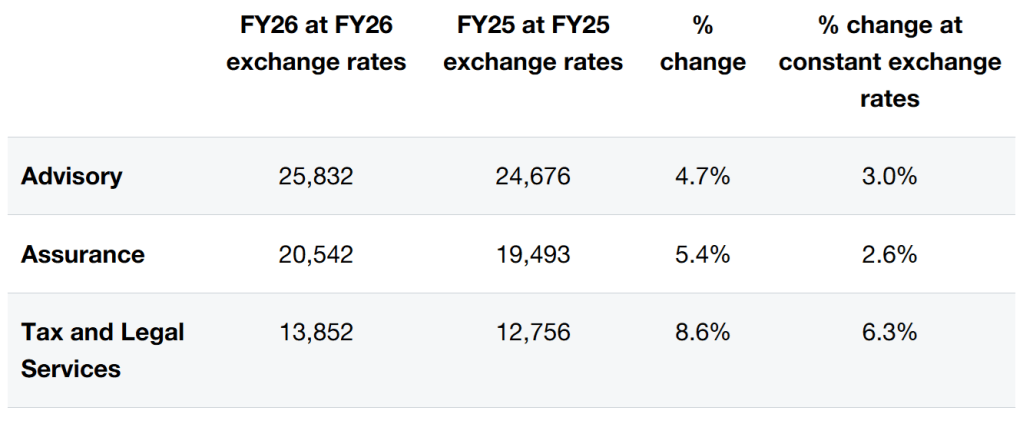
Delving into the specifics of service lines, Tax and legal services recorded the highest growth rate, with like-for-like revenue increasing by 6.3% at constant exchange rates. This robust performance suggests a strong demand for tax advisory, compliance, and legal services, likely driven by complex regulatory environments and evolving global tax landscapes. Advisory services followed with a commendable 3% increase in revenue, reflecting the ongoing need for strategic, operational, and digital transformation consulting. Assurance services, the firm’s foundational practice, also saw steady growth, with a 2.6% increase in revenue at constant exchange rates, underscoring the continued importance of trust and transparency in financial reporting and business operations.
Strategic Investments in the Future: AI and Technology
A significant factor contributing to PwC’s forward momentum and future growth strategy is its substantial investment in artificial intelligence (AI) and technology. The firm reported investing $3 billion across its global network to enhance capabilities in these critical areas. This investment is crucial for staying ahead in an increasingly digitized business world and for meeting the evolving needs of clients.
Key initiatives funded by this investment include the initial rollout of the PwC One AI platform, a comprehensive solution designed to leverage AI across various client engagements. Furthermore, the firm has continued its commitment to developing its AI-native assurance platform, a testament to its focus on integrating advanced technology into core service offerings. Investments have also been directed towards its tax data aggregation and project management platform, as well as other agentic and data-driven delivery models. These technological advancements are poised to enhance efficiency, improve service quality, and unlock new value propositions for PwC’s clients.
The firm’s commitment to AI extends to its workforce. PwC reports that over 330,000 individuals have undergone AI training, demonstrating a proactive approach to upskilling its employees and embedding AI proficiency throughout the organization. This focus on human capital development in tandem with technological investment is a strategic imperative for future success.
Workforce Dynamics and Regional Distribution
As of June 30, 2026, PwC’s global headcount stood at 369,945 professionals, an increase from 364,000 at the end of FY 2025. This growth in personnel reflects the expansion of the firm’s operations and its capacity to serve a growing client base.
The distribution of this workforce highlights key strategic focuses. Forty percent of PwC’s professionals are located in the Asia Pacific region, underscoring the firm’s significant presence and investment in this dynamic market. The EMEA region accounts for 38% of the workforce, indicating a strong and established presence in these mature and emerging economies. The Americas region comprises 22% of the global headcount, representing a substantial operational footprint.
Within the firm’s service lines, advisory roles constitute the largest segment, with 37% of professionals dedicated to this area. This aligns with the strong revenue growth reported in advisory services and reflects the increasing demand for strategic and transformation-related consulting. Assurance services account for 33% of the workforce, maintaining its significant presence as a core service. Tax and legal services employ 16% of professionals, reflecting the specialized expertise required in this growing field. Internal firm services make up the remaining 14%, supporting the operational backbone of the global network.
Broader Implications and Future Outlook
PwC’s record revenue and strategic investments in AI and technology signal a clear direction for the professional services industry. The emphasis on data-driven solutions and AI integration is not merely a trend but a fundamental shift in how services are delivered and value is created. The firm’s proactive approach to upskilling its workforce in AI further positions it to navigate the complexities of digital transformation and to offer cutting-edge solutions to its clients.
The sustained growth across diverse geographic regions and service lines indicates a well-diversified and resilient business model. As global businesses continue to face economic volatility, regulatory shifts, and the imperative to innovate, the demand for the comprehensive expertise offered by firms like PwC is likely to remain strong. The firm’s ability to adapt and invest in emerging technologies, particularly AI, will be crucial in maintaining its competitive edge and driving future growth. The reported figures suggest that PwC is not only reacting to market changes but actively shaping the future of professional services, reinforcing its commitment to its long-term vision of transforming to build "the PwC of tomorrow."