Dwi Wanna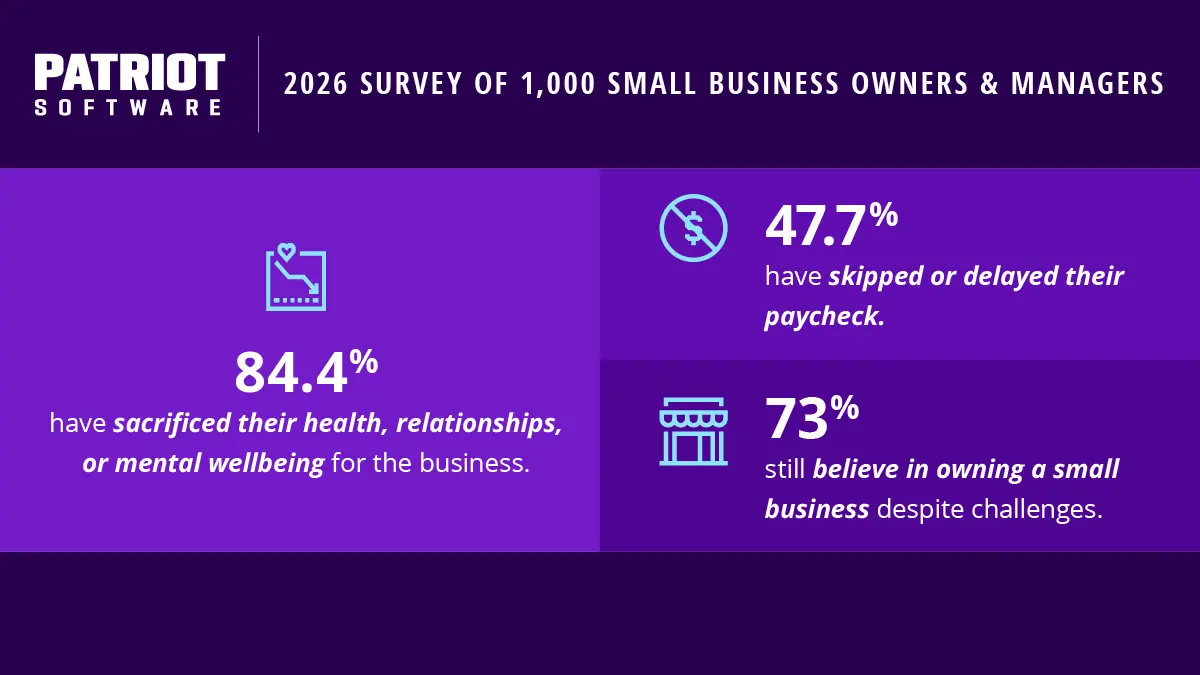
CANTON, Ohio — In an exhaustive study highlighting the personal and financial tolls of entrepreneurship, Patriot Software has released new research indicating that the vast majority of U.S. small business owners are prioritizing the survival of their companies over their own physical, mental, and financial well-being. The survey, which polled 1,000 current and former small business owners and managers, reveals a stark reality: 47.7% of respondents have skipped or delayed their own paychecks to keep their operations afloat, while a staggering 84.4% reported sacrificing their health, personal relationships, or mental health for the sake of their businesses.
The findings come at a critical juncture for the American economy. As the Small Business Administration (SBA) reports that small businesses represent nearly 46% of the entire private sector workforce, the stability of these enterprises is inextricably linked to national economic health. However, the Patriot Software data suggests that this stability is being bought at a high personal cost to the individuals behind the "Open" signs.
The Financial Reality of the "Last to Be Paid" Mentality
For many entrepreneurs, the concept of being their own boss comes with the caveat of being the last person in the building to receive a salary. The Patriot Software survey quantifies this phenomenon, showing that nearly half of all small business owners (SBOs) have faced periods where they could not draw a regular income. This financial instability often stems from the volatile nature of cash flow in small-scale operations, where a single late-paying client or an unexpected equipment failure can necessitate a choice between paying staff or paying the owner.
Economic analysts suggest that this trend has been exacerbated by the inflationary pressures of the early 2020s. As the costs of raw materials, rent, and utilities have climbed, many SBOs have absorbed these costs personally rather than passing them entirely to consumers or reducing their employee headcount. By delaying their own compensation, these owners act as a human shock absorber for the economy, preventing immediate job losses at the expense of their personal savings and household stability.
The survey further explores the "chronic stress" associated with these financial decisions. Unlike corporate executives who may have substantial severance packages or diversified investments, the typical small business owner often has their entire net worth tied up in their enterprise. When the business struggles, the owner’s personal credit and future retirement security are immediately at risk.
A Crisis of Well-being: The 84.4% Statistic
While financial sacrifices are quantifiable, the toll on human health and social connectivity is often more difficult to measure. Patriot’s research finds that 84.4% of SBOs have experienced significant declines in their mental health or personal relationships due to the demands of their work. This figure suggests that burnout is not merely a risk for entrepreneurs but an almost universal experience.
The nature of the "always-on" culture inherent in running a small business means that many owners find it impossible to disconnect. The survey data indicates that these individuals frequently lose sleep and skip medical appointments to address business emergencies. The psychological burden of being responsible for the livelihoods of their employees—who number 62.3 million across the United States—adds a layer of moral obligation that contributes to high levels of anxiety and chronic stress.
Healthcare access remains a significant hurdle. Many SBOs operate with thin margins that make providing—or even purchasing for themselves—robust health insurance difficult. When faced with the choice between investing in new inventory or paying high premiums for a private health plan, the data suggests many owners choose the former, further endangering their long-term physical health.
Chronology of the Small Business Landscape (2020–2026)
To understand the current state of small business burnout, it is necessary to look at the timeline of economic pressures that have shaped the last several years.
- 2020–2021: The Pandemic Disruption. Small businesses faced unprecedented lockdowns and supply chain collapses. While government aid provided a temporary lifeline, the period introduced a baseline level of high-intensity survival mode that many owners never truly exited.
- 2022–2023: The Inflationary Spike. As the economy reopened, SBOs were hit with the highest inflation rates in 40 years. Labor shortages forced owners to work longer hours themselves to cover gaps in staffing, marking the beginning of the "Great Exhaustion" in the entrepreneurial sector.
- 2024–2025: High Interest Rates and Debt Servicing. To combat inflation, the Federal Reserve maintained high interest rates, making the cost of capital significantly more expensive. Small businesses, which often rely on lines of credit for operational expenses, saw their margins tighten further.
- 2026 and Beyond: The New Normal. Current SBA projections for 2026 suggest there are now over 36 million small businesses in the U.S. While the sheer number of businesses indicates a persistent spirit of entrepreneurship, the Patriot Software survey reflects the "scar tissue" left behind by years of navigating these compounding crises.
Supporting Data: The Small Business Engine
The scale of the small business sector is often underestimated in general economic discourse. According to the SBA data cited in the report, small businesses employ nearly half of all private-sector workers in America. This means that the 62.3 million people employed by these entities are directly dependent on the stamina and resilience of the owners who, as Patriot’s survey shows, are increasingly reaching their breaking points.
Key data points from the broader economic context include:
- Employment Share: Small businesses have accounted for roughly 63% of net new job creation over the past 25 years.
- GDP Contribution: These enterprises contribute approximately 44% of the U.S. Gross Domestic Product (GDP).
- Innovation: Small firms produce 14 times more patents per employee than large patenting firms, highlighting their role as the primary driver of American innovation.
The Patriot Software survey highlights the irony that while these businesses are the "engine" of the economy, the "engineers" are frequently operating on empty.
Industry Reactions and Inferred Implications
Market analysts and advocacy groups have begun to react to the growing evidence of owner burnout. While organizations like the SBA provide resources for financial planning and disaster recovery, there is a growing call for more comprehensive support systems addressing the mental health and healthcare needs of the self-employed.
"The data from Patriot Software confirms what many of us have seen on the ground," says an inferred consensus of economic observers. "We are seeing a generation of entrepreneurs who are ‘rich’ in revenue but ‘poor’ in time and health. If the current trend of 84% burnout continues, we may see a significant decline in the number of people willing to take the risk of starting a business, which would have devastating long-term effects on American innovation and employment."
Furthermore, the fact that nearly 48% of owners skip paychecks suggests a need for better financial management tools and more accessible low-interest credit. When an owner skips a paycheck, it is a signal that the business’s financial health is being propped up by personal debt, a situation that is unsustainable over a long-term horizon.
Analysis: The Role of Technology in Mitigating Burnout
One potential solution highlighted by the context of the survey is the role of administrative automation. Patriot Software, as a provider of accounting and payroll solutions, notes that many small business owners are bogged down by "administrative tasks" that could be simplified through technology.
The survey methodology, which included current managers and former owners, suggests that the "administrative burden"—including tax compliance, payroll processing, and HR management—is a primary contributor to the "chronic stress" reported by participants. By reducing the number of hours an owner must spend on back-office operations, cloud-based software solutions may offer a path toward restoring some semblance of work-life balance. However, technology alone cannot solve the systemic issues of rising costs and healthcare accessibility.
Broader Economic and Social Implications
The implications of the Patriot Software study extend beyond the individual business owner. If 84.4% of the people running nearly half of the U.S. economy are sacrificing their mental and physical health, the risk of a "leadership vacuum" in the small business sector is high.
- Succession Challenges: With high burnout rates, fewer owners may be inclined to keep their businesses running for decades or pass them on to the next generation, potentially leading to a wave of small business closures or consolidations into larger corporations.
- Community Impact: Small businesses are often the primary sponsors of local events, youth sports, and community initiatives. A stressed, financially strained owner is less likely to have the resources to invest back into their local community.
- Healthcare System Strain: The "sacrificed health" reported by 84.4% of SBOs represents a future burden on the healthcare system. Chronic stress is a known precursor to cardiovascular issues, depression, and other long-term ailments that will eventually require intensive medical intervention.
Conclusion and Methodology
The Patriot Software survey serves as a sobering reminder of the human cost of the American Dream. While the 36 million small businesses in the U.S. continue to drive the economy forward, the individuals at the helm are doing so at a significant personal loss.
Methodology: Patriot Software surveyed 1,000 U.S. adults who are current small business owners, managers, or recent former owners. Participants answered questions about financial pressure, mental health, personal sacrifices, healthcare access, and their overall outlook on entrepreneurship. The survey was designed to capture a representative cross-section of the American small business landscape, accounting for various industries and business sizes up to 500 employees.
About Patriot Software:
Based in Canton, Ohio, Patriot Software provides cloud-based accounting, payroll, HR, and time and attendance solutions. Since 2002, the company has focused on simplifying administrative tasks for American businesses with up to 500 employees, aiming to reduce the very burdens that contribute to the burnout documented in their latest research.