Nila Kartika Wati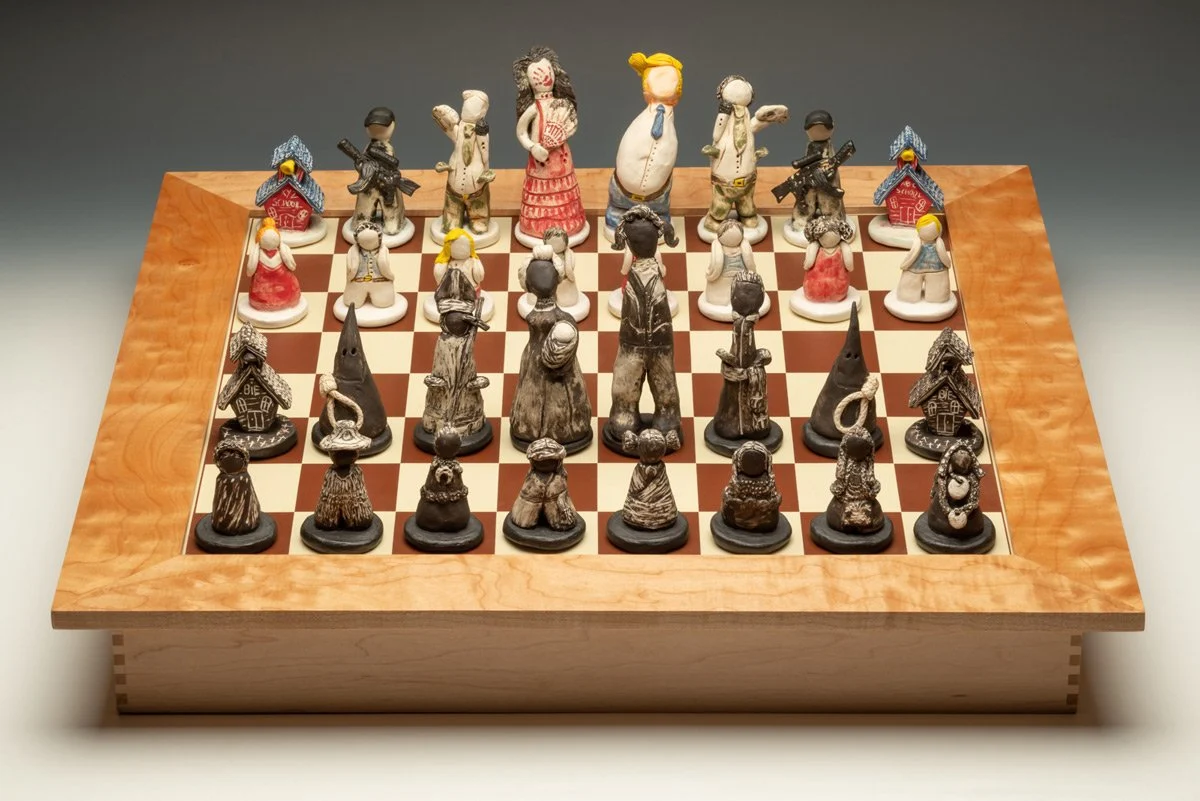
The convergence of historical atrocities and contemporary social crises has found a visceral expression in the contemporary sculpture of Karen Sixkiller, a Cherokee Nation citizen whose latest work serves as a stark commentary on the systemic forces shaping American society. Triggered by the recurring discovery of unidentified remains at former Bureau of Indian Education (BIE) boarding schools and the persistent epidemic of school shootings across the United States, Sixkiller’s work, a meticulously crafted chess set, symbolizes what she describes as the "game" of American avarice. The artwork features a haunting array of figures: armed gunmen, members of the Ku Klux Klan, kneeling children, and religious figures with pockets overflowing with currency. Through this medium, Sixkiller explores the thesis that the tragedies befalling American children—both historically and in the present day—are not isolated incidents but are instead moves on a board controlled by the invisible hand of systemic greed.
The Historical Context of Federal Indian Boarding Schools
To understand the impetus behind Sixkiller’s work, one must examine the legacy of the Federal Indian Boarding School system. Established in the late 19th century and persisting well into the 20th, these institutions were designed with the explicit goal of "civilizing" Native American children by forcibly removing them from their families, cultures, and languages. According to the Federal Indian Boarding School Initiative Investigative Report, released by the U.S. Department of the Interior in May 2022, the U.S. government operated or supported 408 boarding schools across 37 states between 1819 and 1969.
The investigation, led by Secretary of the Interior Deb Haaland, the first Native American to serve as a cabinet secretary, revealed that the system was characterized by systematic militarized identity-alteration and often brutal conditions. The report identified marked or unmarked burial sites at approximately 53 of these schools, though the Department expects the number of identified burial sites to increase as the investigation continues. The discovery of remains at sites like the Carlisle Indian Industrial School in Pennsylvania and various locations in the Pacific Northwest has reopened deep wounds within Indigenous communities, providing physical evidence of a history long discussed in oral traditions but often omitted from standard American history curricula.
Sixkiller’s sculpture draws a direct line from these historical graves to the "faceless Native children" represented on her chessboard. The use of "facelessness" reflects the erasure of individual identity that was a hallmark of the boarding school experience, where children were often assigned numbers and forbidden from speaking their names or native tongues.
The Contemporary Crisis of School Violence
While the bones of the past are being unearthed, the present is marked by a different form of violence against children. Sixkiller’s work was also heavily influenced by the "rash of school shootings" that continues to plague the American educational landscape. According to data from the K-12 School Shooting Database, the number of incidents involving firearms on school grounds has seen a dramatic increase over the last decade. In 2023 alone, hundreds of incidents were recorded, ranging from brandishing a weapon to active shooter situations resulting in mass casualties.
The juxtaposition of the boarding school remains and modern school shootings in Sixkiller’s art suggests a continuity of trauma. In her view, the children in both scenarios are "pawns" in a larger societal structure that fails to prioritize their safety over political or economic interests. The "armed gunman" piece on the chessboard serves as a contemporary counterpart to the "KKK members," representing different eras of violence that share a common thread of systemic failure and ideological extremism.

A Chronology of Policy and Discovery
The timeline of these events illustrates the slow progression of institutional accountability compared to the rapid pace of recurring violence.
- 1819: The Civilization Fund Act is passed, laying the groundwork for the federal Indian boarding school system.
- 1879: The Carlisle Indian Industrial School opens, serving as the model for "forced assimilation."
- 1969: The Kennedy Report, titled "Indian Education: A National Tragedy—A National Challenge," highlights the failures and abuses of the system, leading to gradual policy shifts.
- 1990: The Native American Graves Protection and Repatration Act (NAGPRA) is passed, providing a legal framework for the return of human remains.
- 1999: The Columbine High School massacre occurs, marking a turning point in the public perception of school safety and gun violence.
- 2021: The discovery of 215 unmarked graves at the Kamloops Indian Residential School in Canada prompts the U.S. Department of the Interior to launch a comprehensive review of its own boarding school legacy.
- 2022-2024: The U.S. Department of the Interior releases Volumes I and II of the Federal Indian Boarding School Initiative Investigative Report, confirming at least 973 student deaths and the existence of at least 74 marked and unmarked burial sites.
This chronology highlights the long gap between the commission of historical harms and the beginning of formal truth-telling processes, a period during which new forms of violence, such as mass school shootings, began to take root.
Economic Incentives and Systemic Greed
A central theme in Sixkiller’s analysis is the role of "avarice and greed" as the primary drivers of American policy. In her sculpture, the "bishops" are depicted with wads of money spilling from their pockets. This is a reference to the historical partnership between the federal government and various religious denominations in the operation of boarding schools. For decades, the government provided funding to religious organizations to manage these schools, effectively outsourcing the "civilization" process. This entanglement of financial gain and institutionalized indoctrination is, in Sixkiller’s view, a primary reason for the system’s longevity despite its known abuses.
Furthermore, the "mysterious hand" that moves the king on the chessboard represents the faceless nature of corporate and political interests. Journalistic and economic analyses of the American education and defense sectors often point to the influence of lobbying and the "military-industrial-congressional complex" in shaping policies that prioritize profit—whether through the privatization of services or the resistance to firearm regulations—over humanitarian outcomes. Sixkiller’s work posits that no single individual is "controlling" the board; rather, the collective drive for wealth and power creates a self-sustaining cycle where children’s lives are treated as expendable resources.
Institutional Responses and Public Reaction
The response to the unearthing of boarding school remains has been a mixture of official remorse and calls for substantive reparations. Secretary Deb Haaland’s "Road to Healing" tour, which concluded in late 2023, allowed survivors of the boarding school system to share their stories in public forums across the country. In her statements, Haaland has emphasized that "the federal government has never before accounted for its role in the atrocities of the federal Indian boarding school system," and that the current investigation is a "priority for the Department and for the Biden-Harris administration."
Conversely, the response to school shootings has remained deeply polarized. While advocacy groups like Everytown for Gun Safety and Moms Demand Action call for stricter legislative measures, opposition from gun rights organizations and certain political factions often results in a legislative stalemate. This paralysis is what Sixkiller refers to as the "mysterious hand" at work—a systemic inability to change course despite the evident human cost.
Tribal leaders have also voiced their perspectives on these dual crises. Many have noted that the trauma of the boarding schools has had a multi-generational impact, contributing to higher rates of poverty, substance abuse, and mental health challenges in Indigenous communities today. The discovery of the remains is seen not just as a historical finding, but as a current event that requires immediate spiritual and political redress.
Analysis of Broader Implications
The work of Karen Sixkiller signifies a growing movement within the arts to use traditional and contemporary media as tools for social psychology and public health advocacy. With a background in public health and social psychology, Sixkiller applies a "scientific research" discipline to her creative process. Her art does not merely seek to evoke emotion; it seeks to diagnose a systemic pathology.
The implication of her "Chess Set" is that American society cannot move toward "checkmate" or a resolution of its internal conflicts without first identifying the players and the rules of the game. By identifying "avarice" as the primary mover, the artwork suggests that incremental policy changes may be insufficient if the underlying economic and social incentives remain unchanged.
For the nonprofit sector and civil society, this analysis underscores the importance of addressing the root causes of violence and historical trauma. Programs focused on "truth and reconciliation" must account for the economic motivations that historically drove the boarding school system, just as modern efforts to ensure school safety must navigate the complex web of financial and political interests that define the current era.
The Role of Art in National Reconciliation
As Karen Sixkiller’s sculptures are displayed in official buildings of the Cherokee Nation and in public installations across the Pacific Northwest, they serve as permanent reminders of the work yet to be done. Her transition from working within the Indian Health Service and at tribally owned residential schools to becoming a full-time sculptor reflects a belief that art can communicate perspectives that data and policy papers cannot.
In the context of a "multiracial democracy under attack," as described by various social commentators, the ability of Indigenous artists to reclaim the narrative of American history is a critical component of national healing. By placing the "faceless Native children" on the same board as the symbols of modern capitalism and violence, Sixkiller forces a confrontation with the reality that the past is never truly past. It is, instead, a series of moves in a continuing game, the stakes of which remain the lives and futures of the nation’s children.
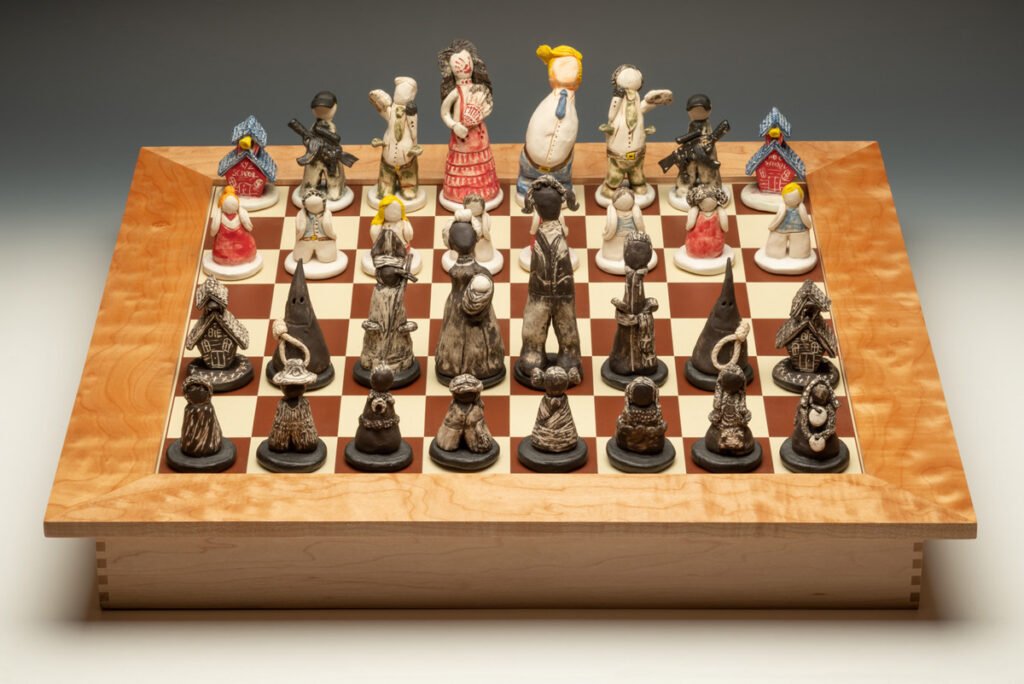
The "Chess Set" remains a haunting visual record of this reality—a call to recognize that as long as greed remains the "mysterious hand" at the board, the game will continue to claim pawns from the most vulnerable populations. Professional journalistic accounts and historical records now align with the artistic vision: the story of America is inextricably linked to the stories of those it has historically sought to erase, and the path forward requires a full accounting of both the bones in the ground and the bullets in the classroom.