Nila Kartika Wati
The visual landscape of autumn in North America is frequently defined by the appearance of "ornamental corn" in retail spaces and home decorations. These multicolored bundles of flint corn, characterized by their hard, vitreous kernels and vibrant hues, are marketed as seasonal curiosities rather than the nutritional staples they were engineered to be by Indigenous agriculturalists over millennia. For many Native American communities, this commodification of a sacred crop serves as a stark reminder of a broader historical trajectory where food was systematically transformed from a source of life into a tool of colonial control. The transition from diverse, self-sustained hunter-gatherer and agriculturalist diets to the restrictive, government-managed "commodity food" programs represented a decisive shift in the subjugation of Indigenous populations, often described by historians and activists as a "nail in the coffin" for traditional tribal autonomy.
The Systematic Eradication of Traditional Foodways
The restriction of Indigenous peoples to the confines of reservations during the 19th and early 20th centuries was not merely a geographic relocation; it was a deliberate dismantling of nutritional sovereignty. Prior to European contact and the subsequent westward expansion of the United States, Indigenous diets were characterized by a high degree of biodiversity. Hunter-gatherer societies relied on seasonal cycles of wild game, fish, berries, and nuts, while agricultural societies like the Seneca and Maidu—tribes represented in the heritage of contemporary artist Brandon S. Copley—cultivated sophisticated polyculture systems, such as the "Three Sisters" (corn, beans, and squash).
The reservation system effectively severed the connection between these communities and their ancestral lands, rendering traditional hunting and gathering impossible. This forced dependency was a calculated administrative strategy. When Indigenous nations could no longer feed themselves through traditional means, the federal government assumed the role of provider, utilizing institutional charities and government agencies to disburse rations. These rations, which eventually became known as "commodity foods," were largely composed of shelf-stable starches and fats, including bleached flour, sugar, lard, and canned meats. This shift lacked the nutritional complexity of indigenous diets and introduced systemic health issues that persist in Native communities today.
Historical Precedents of Food as a Weapon
The use of food restriction as a mechanism of state control is well-documented throughout the history of North American colonization. In the Great Plains, the mass slaughter of the American bison (buffalo) during the 1870s serves as one of the most egregious examples of ecological and nutritional warfare. Military leaders and government officials recognized that the bison were the primary sustenance for the Plains Tribes, including the Sioux, Cheyenne, and Comanche. By encouraging the industrial-scale killing of these animals—often leaving the carcasses to rot while taking only the hides—the U.S. government effectively starved these nations into submission, forcing them to accept reservation life in exchange for meager food supplies.
A similar tactic was employed centuries earlier during the Spanish conquest of Mexico. The Conquistadors, led by Hernán Cortés, targeted the cultivation of amaranth, a nutrient-dense grain that held deep spiritual and nutritional significance for the Aztec (Mexica) people. Because amaranth was used in religious ceremonies—often ground and mixed with honey or blood to form effigies—the Spanish authorities viewed it as a "pagan" obstacle to Christianization. They ordered the burning of amaranth fields and prohibited its cultivation under penalty of death. This act of "civilizing" the population through the destruction of their primary food source mirrored the later tactics used in the United States, illustrating a long-standing colonial pattern of using dietary suppression to achieve cultural and religious assimilation.
The Rise of Commodity Foods and the Health Crisis
The introduction of government-issued rations marked the beginning of a public health crisis within Indigenous territories. The foods provided were often of the lowest quality, high in sodium and refined carbohydrates. Frybread, which is now often associated with Native American culture and gatherings, originated from this period of scarcity; it was a food born of necessity, created from the limited ingredients of flour, sugar, and lard provided by the government.
Statistical data from the Indian Health Service (IHS) and the Centers for Disease Control and Prevention (CDC) highlight the long-term consequences of this forced dietary shift. Native American and Alaska Native adults are approximately twice as likely as white adults to have diagnosed diabetes. Furthermore, Indigenous populations face significantly higher rates of obesity and cardiovascular disease compared to the general U.S. population. These health disparities are not biological predispositions but are widely recognized by sociologists and medical professionals as "social determinants of health" rooted in the historical trauma of food insecurity and the loss of traditional land rights.
Artistic Reflection and the Legacy of Residential Schools
The intersection of food, religion, and state control is a central theme in the work of Brandon S. Copley, a two-spirit assemblage artist of Seneca and Maidu descent. Copley’s work often utilizes found objects and symbolism to navigate the complexities of Indigenous history. His recent focus on the discovery of child remains at Indian residential school grounds has brought a renewed urgency to the conversation surrounding colonial trauma.
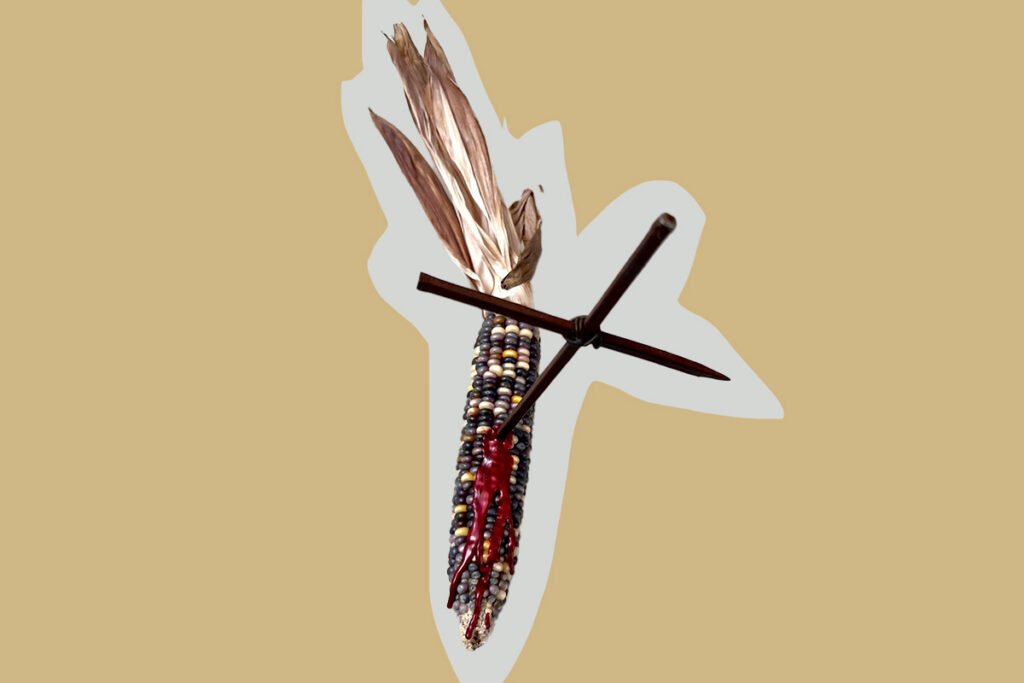
In one of his poignant works, an ear of colorful maize is depicted pierced by a metal cross, with blood seeping from the kernels. This imagery serves as a powerful metaphor for the "civilizing" mission that utilized both religion and food to suppress Indigenous identity. The cross represents the institutionalized efforts to "kill the Indian, save the man," a philosophy that underpinned the residential school system and the reservation ration programs. Copley, who grew up off the reservation in California’s Bay Area, describes himself as a "cultural sponge," drawing inspiration from the boundary-pushing work of Betye Saar to redefine stereotypes and process grief through creative assemblage.
The residential school system played a critical role in the loss of food knowledge. Children were removed from their families, preventing the intergenerational transfer of knowledge regarding how to hunt, fish, and farm traditional crops. In many of these schools, children were subjected to nutritional experiments and faced chronic malnutrition, further cementing the role of food as a tool of institutional violence.
The Movement for Food Sovereignty
In response to this history of suppression, a robust movement for "Food Sovereignty" has emerged across Indian Country. This movement seeks to restore the rights of Indigenous peoples to define their own food and agriculture systems. Rather than relying on government-subsidized commodity programs, tribal nations are increasingly investing in the revitalization of heirloom seeds, the restoration of bison herds, and the protection of water rights necessary for traditional fishing and farming.

Organizations such as the Native American Agriculture Fund (NAAF) and the First Nations Development Institute are providing resources for tribes to build sustainable food economies. This includes the development of tribal ranches, community gardens, and educational programs that teach youth about the nutritional and spiritual value of traditional foods. The goal is to move beyond "food security"—which merely ensures that people have enough to eat—toward "food sovereignty," which ensures that the food is culturally appropriate and produced through ecologically sound and sustainable methods.
Broader Implications and Analysis
The history of food suppression in North America serves as a case study in how state power can be exercised through the control of basic biological needs. The transition from the diverse diets of hunter-gatherers to the "ornamental" and "commodity" status of Indigenous crops reflects a broader attempt to erase Native identity and foster a state of permanent dependency.
Analysis of modern policy suggests that while the era of mass buffalo slaughter has ended, the struggle for land and water rights continues to impact Indigenous food systems. Encroachment by extractive industries, such as mining and pipeline construction, often threatens the integrity of the soil and water required for traditional food production. Furthermore, the legal battles over "Land Back" initiatives are intrinsically tied to food sovereignty; without access to ancestral lands, the full restoration of Indigenous foodways remains a challenge.
The work of artists like Brandon S. Copley and the advocacy of tribal leaders underscore that the "nail in the coffin" was not the end of the story. Instead, it was a catalyst for a long-term struggle for survival and reclamation. As the colorful corn bundles appear in stores each autumn, they remain a symbol of resilience—a reminder of a nutritional heritage that survived centuries of attempts at eradication and is currently being reclaimed by a new generation of Indigenous leaders and creators.