Lana Rhoades
The U.S. current-account deficit, a key indicator of a nation’s economic interactions with the rest of the world, experienced a substantial widening in the second quarter of 2026, expanding by $33.4 billion or 15.7 percent to reach $246.0 billion. This marks an acceleration from the revised first-quarter deficit of $212.6 billion. The latest figures, released today by the U.S. Bureau of Economic Analysis (BEA), indicate that this deficit now represents 3.0 percent of current-dollar gross domestic product (GDP), an increase from 2.7 percent in the preceding quarter.
Deep Dive into the Widening Deficit
The $33.4 billion expansion of the current-account deficit in the second quarter was primarily driven by a larger deficit in goods, a category encompassing the trade of tangible products. This increase in the goods deficit was partially mitigated by reductions in deficits related to primary income, which includes earnings on investments, and secondary income, comprising current transfers.
Key Components of the Current Account in Q2 2026:
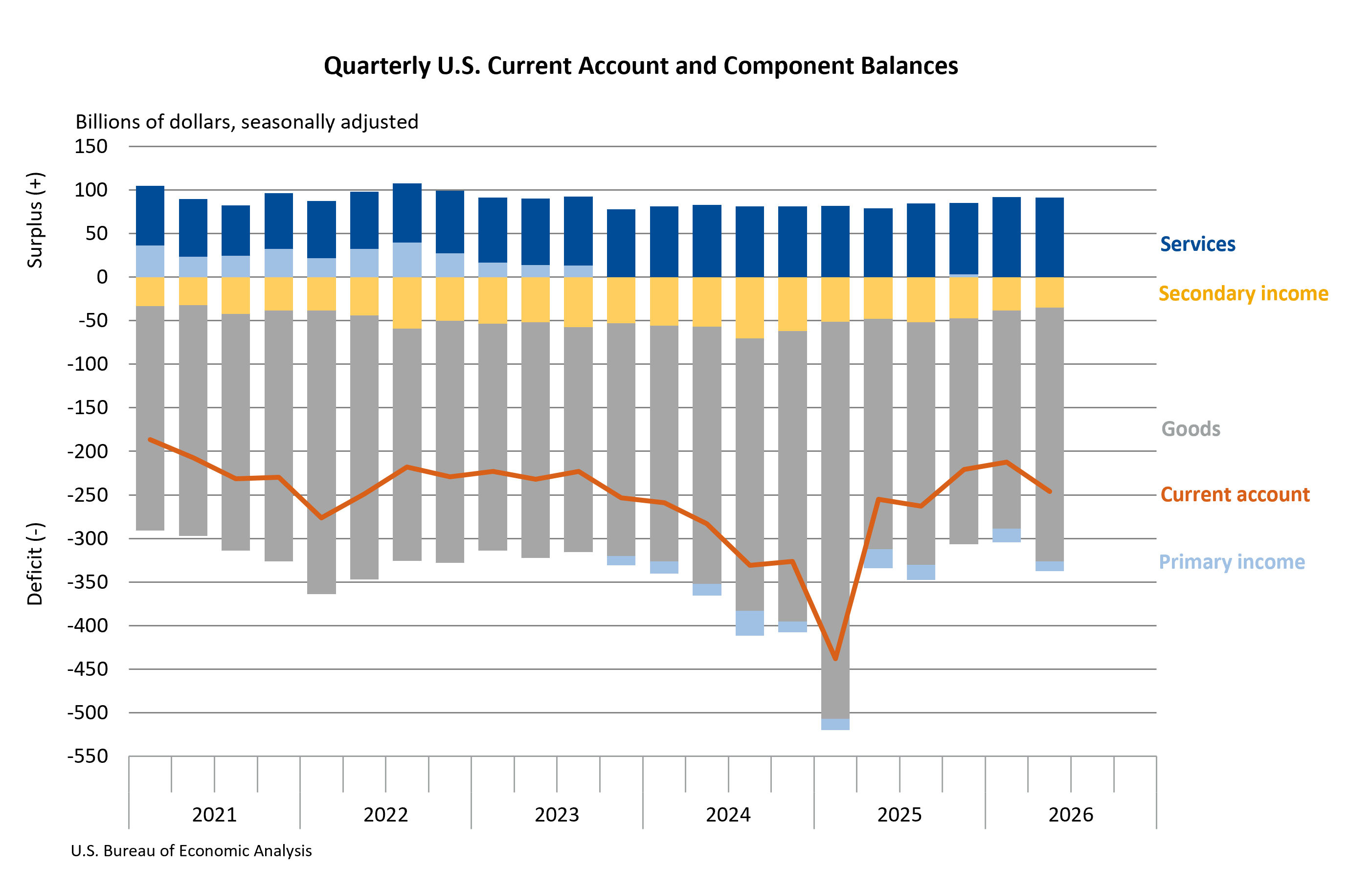
- Goods Deficit: The primary driver of the widening deficit, indicating that the value of imported goods exceeded the value of exported goods by a greater margin in the second quarter.
- Services Balance: While not explicitly detailed as a driver of the widening, the services balance typically includes trade in services like tourism, financial services, and intellectual property. Changes in this area can influence the overall current account.
- Primary Income: A reduction in the deficit here suggests that either U.S. residents earned more income from foreign investments, or foreign residents earned less income from their investments in the U.S., or a combination of both.
- Secondary Income: A reduced deficit in secondary income implies that net current transfers from the U.S. to foreign countries decreased, or transfers from foreign countries to the U.S. increased.
Trade Dynamics: Exports and Imports
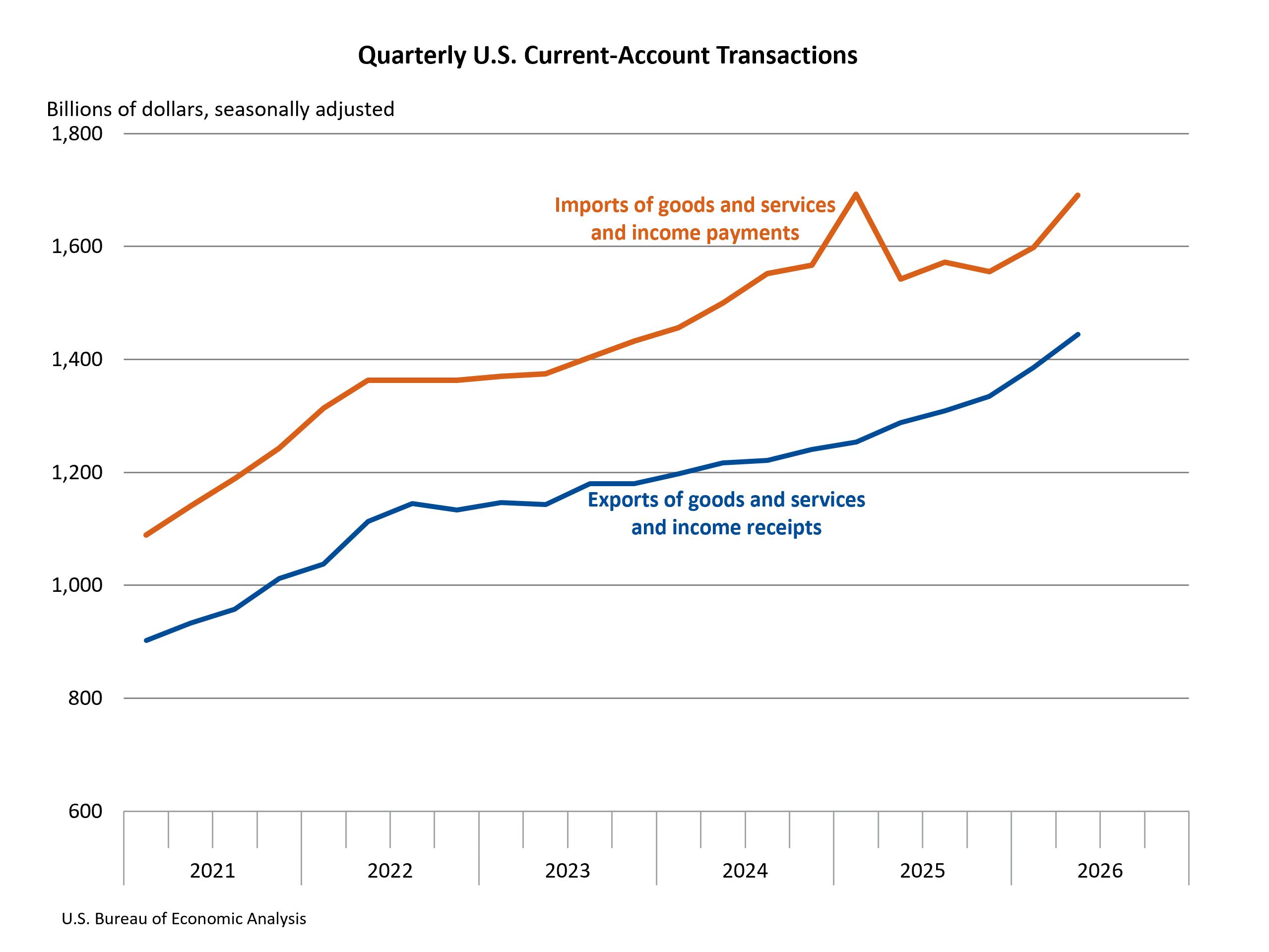
Overall, exports of goods and services to, and income received from, foreign residents saw a notable increase of $58.8 billion, reaching a total of $1.44 trillion in the second quarter. This surge was fueled by robust growth in goods exports and a rise in primary income receipts.
Conversely, imports of goods and services from, and income paid to, foreign residents escalated more significantly, climbing by $92.2 billion to a substantial $1.69 trillion. This increase was predominantly attributable to higher imports of goods and a greater outflow of primary income payments.
This disparity between the growth rates of exports and imports of goods underscores the central role of merchandise trade in the widening current-account deficit. While the U.S. economy is experiencing growth in its international sales, its appetite for foreign goods has grown even faster, leading to a larger trade imbalance.
Capital Transfers and Financial Account
Beyond the current account, the BEA report also provided insights into capital transfers and the financial account. Capital-transfer receipts, which involve the transfer of ownership of fixed assets or the forgiveness of liabilities without any exchange of goods or services, decreased by $1.1 billion to $2.3 billion. Similarly, capital-transfer payments declined by $0.9 billion to $1.0 billion. These movements represent relatively minor components of the overall international economic transactions.
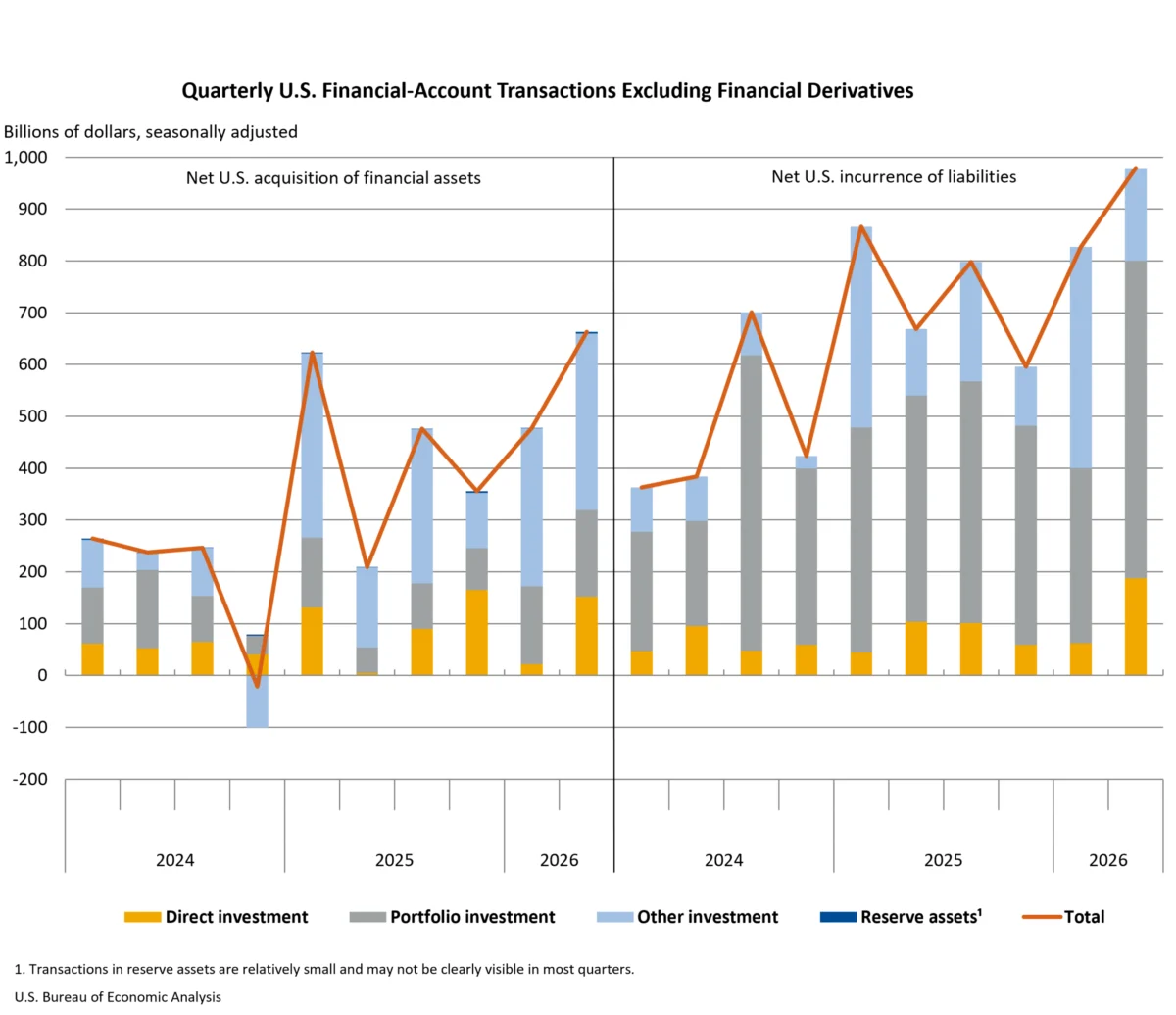
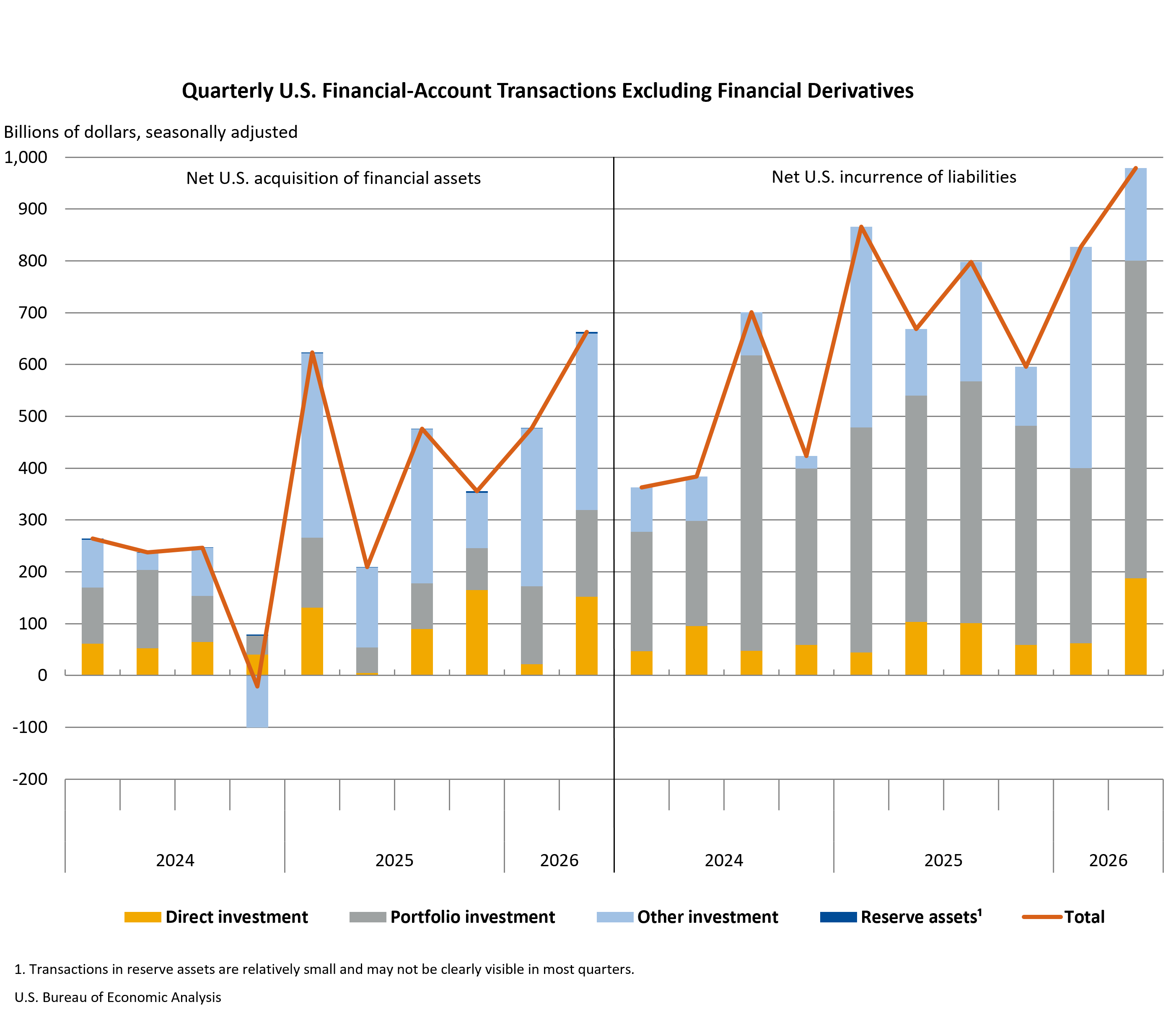
The financial account, which tracks the net flow of financial assets and liabilities, presented a significant deficit of -$369.7 billion in the second quarter. This figure signifies net U.S. borrowing from foreign residents. During the quarter, U.S. residents’ foreign financial assets increased by $663.3 billion, while U.S. liabilities to foreign residents surged by $978.9 billion. This substantial increase in foreign liabilities indicates a growing reliance on foreign capital to finance domestic activities and investments.
U.S. Net International Investment Position
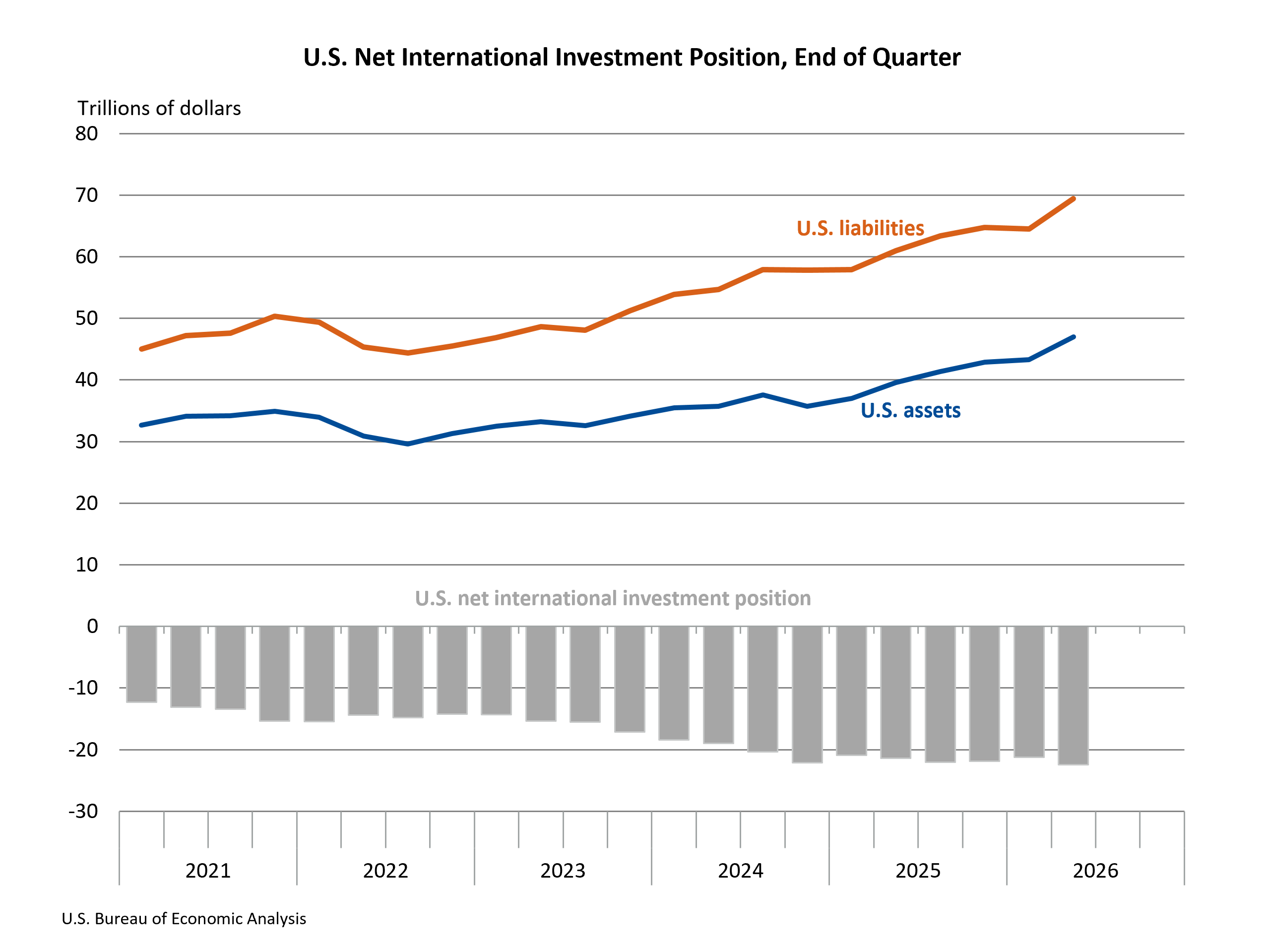
The nation’s overall financial standing with the rest of the world, as reflected in the U.S. net international investment position, remained in a significant deficit. At the close of the second quarter of 2026, this position stood at -$22.42 trillion. This represents the difference between the value of U.S. residents’ foreign financial assets ($46.97 trillion) and U.S. liabilities to foreign residents ($69.39 trillion). The net investment position widened from a revised -$21.27 trillion at the end of the first quarter of 2026, reflecting the net borrowing activity and potentially valuation changes in assets and liabilities.
Drivers of Asset and Liability Changes
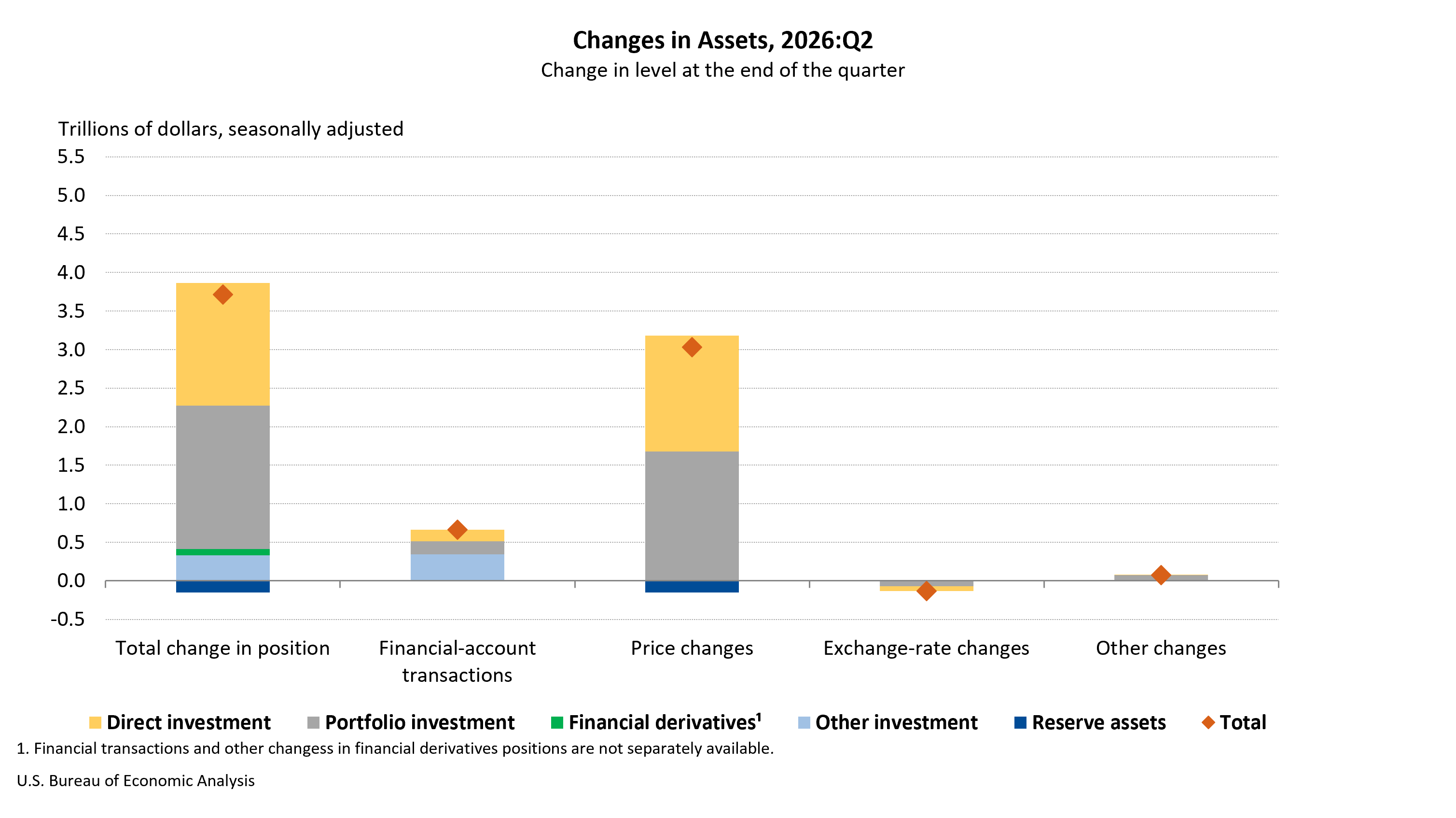
The increase in U.S. assets during the second quarter was substantial, rising by $3.72 trillion. This growth was broadly distributed across major investment categories, with the exception of reserve assets. The overall increase was predominantly driven by price appreciation, accounting for $3.03 trillion, alongside financial transactions totaling $663.3 billion. This suggests that the value of U.S.-held foreign investments has appreciated significantly, likely due to market performance in foreign economies.
U.S. liabilities also experienced a considerable expansion, increasing by $4.87 trillion. This rise was evident across all major investment categories, with portfolio investment being a particularly significant contributor. Similar to assets, price changes played a crucial role, contributing $3.95 trillion to the increase in liabilities, while financial transactions accounted for the remaining $978.9 billion. This indicates that foreign holdings of U.S. assets have also grown in value, influenced by market forces and increased foreign investment into the U.S.
Background and Historical Context
The current account deficit is a long-standing feature of the U.S. economy. For decades, the United States has consistently imported more goods and services than it exports, financed by inflows of foreign capital. This pattern has been attributed to various factors, including the U.S. dollar’s role as the world’s primary reserve currency, relatively strong domestic demand, and attractive investment opportunities in the U.S. market.
However, persistent and widening current account deficits can raise concerns about long-term economic sustainability. They imply that a nation is spending more than it is producing and must borrow from abroad to cover the difference. While foreign investment can fuel domestic growth and productivity, an over-reliance on external financing can make an economy vulnerable to shifts in global capital flows and can lead to an accumulation of debt.
The BEA’s International Transactions Accounts (ITA) and International Investment Position (IIP) are critical for monitoring these economic relationships. The ITA provides a quarterly record of U.S. international economic transactions, while the IIP presents a stock measure of the value of U.S. foreign financial assets and liabilities at a specific point in time. These statistics are essential for policymakers, businesses, and researchers to understand the U.S. economy’s integration into the global marketplace.
Revisions to First-Quarter Data
The BEA also provided revised estimates for the first quarter of 2026, offering a clearer picture of prior-quarter trends. The current-account balance for the first quarter was revised upward to a deficit of -$212.6 billion, from a preliminary estimate of -$226.8 billion. This revision was primarily due to adjustments in the services balance and secondary income balance. The goods balance remained unchanged, indicating the primary driver of the current account’s trajectory.
The net financial-account transactions for the first quarter were also significantly revised, from a preliminary estimate of -$209.0 billion to -$295.2 billion. This substantial revision highlights the dynamic nature of financial flows and the importance of updated data.
In terms of the International Investment Position, the preliminary and revised estimates for the first quarter of 2026 were identical at -$21.27 trillion. U.S. assets were revised slightly to $43.25 trillion from $43.37 trillion, and U.S. liabilities were revised to $64.52 trillion from $64.64 trillion.
Potential Implications and Analysis
The widening current-account deficit in the second quarter of 2026 suggests several potential implications for the U.S. economy:
- Increased Foreign Debt: A larger deficit implies that the U.S. is accumulating more debt relative to its foreign counterparts. This could lead to higher interest payments abroad in the future, further straining the current account.
- Exchange Rate Pressures: Persistent large deficits can, under certain conditions, put downward pressure on the U.S. dollar. However, the dollar’s status as a global reserve currency often mitigates these pressures.
- Dependence on Foreign Capital: The economy’s continued reliance on foreign capital inflows to finance its deficit can make it more susceptible to global financial market volatility and shifts in investor sentiment.
- Impact on Domestic Investment: While foreign capital can support domestic investment, a large and growing deficit might also signal that domestic savings are insufficient to fund domestic investment needs, necessitating external funding.
The BEA’s release is a routine update, but the magnitude of the widening deficit warrants attention. Economists will likely be scrutinizing the specific drivers within the goods trade to understand if this trend is a temporary fluctuation or indicative of a more sustained shift in trade patterns. Factors such as global demand for U.S. exports, domestic consumer spending on imported goods, and exchange rate dynamics will be key to watch in subsequent quarters.
Looking Ahead
The next release of U.S. International Transactions and Investment Position statistics, covering the third quarter of 2026, is scheduled for December 18, 2026. This upcoming report will provide updated figures for the second quarter and reveal the trajectory of the current account and financial flows in the subsequent period. Policymakers and market participants will be closely observing these releases for further insights into the health and global financial standing of the U.S. economy.
The BEA’s commitment to providing timely and comprehensive data on international economic transactions is crucial for informed decision-making and for understanding the complex interplay between the U.S. economy and the global financial system. The detailed breakdowns within these reports allow for a nuanced understanding of the forces shaping the nation’s economic engagement with the world.