Lana Rhoades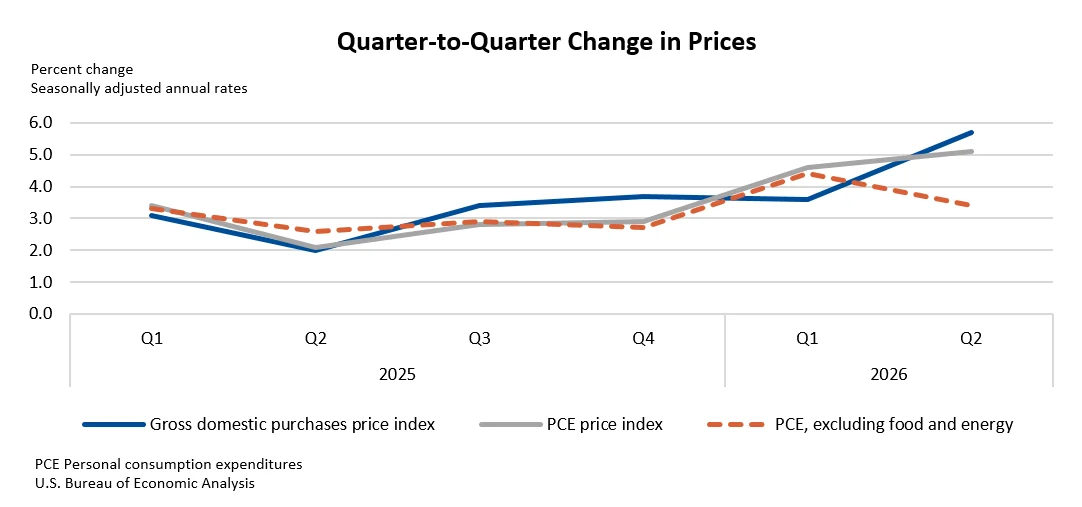
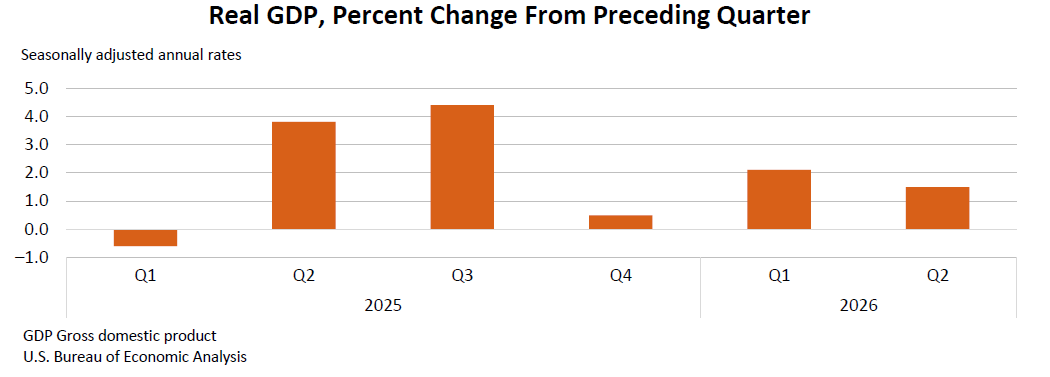
The United States economy experienced a notable slowdown in the second quarter of 2026, with real gross domestic product (GDP) expanding at an annualized rate of 1.5 percent. This deceleration from the 2.1 percent growth recorded in the first quarter signals a shift in economic momentum, according to the advance estimate released by the U.S. Bureau of Economic Analysis (BEA). The latest figures paint a complex picture of an economy buoyed by robust consumer spending and investment, yet constrained by a contraction in government expenditure and rising import costs.
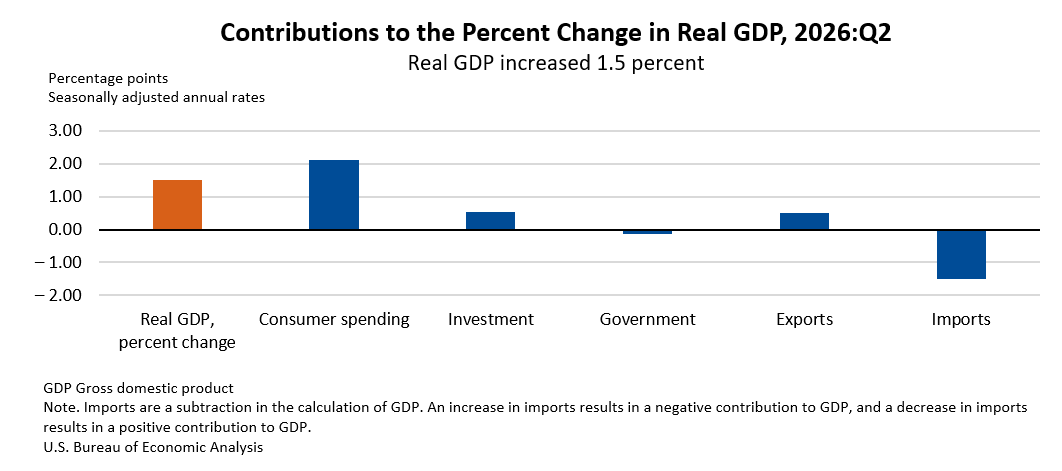
The primary drivers behind the second-quarter GDP increase were significant gains in consumer spending, investment, and exports. However, these positive contributions were partially counteracted by a decline in government spending. Furthermore, imports, which are treated as a subtraction in GDP calculations, saw an increase, further moderating the overall growth rate. This dynamic suggests an economy where private sector activity is performing strongly, but public sector contributions are diminishing, and the nation is importing more goods and services relative to its exports.
A deeper dive into the components of economic activity reveals a more nuanced narrative. The slowdown in real GDP growth compared to the first quarter was primarily attributed to a downturn in government spending, a deceleration in the pace of investment, and a less robust expansion of exports. These factors were partially offset by an acceleration in consumer spending, indicating that household demand remains a resilient engine of economic growth. The BEA also noted that imports increased at a greater rate in the second quarter than in the first, contributing to the moderation of GDP growth.
Key Economic Indicators: A Closer Look
The BEA’s advance estimate highlights several critical economic metrics:
- Real GDP: Increased at an annual rate of 1.5 percent in the second quarter of 2026, down from 2.1 percent in the first quarter.
- Current-Dollar GDP: This measure, which reflects nominal economic activity, saw a more substantial increase of 7.9 percent. The significant difference between real and current-dollar GDP growth points to a notable acceleration in inflation during the second quarter.
- Real Final Sales to Private Domestic Purchasers: This crucial indicator, representing the sum of consumer spending and gross private fixed investment, demonstrated robust growth, rising by 3.9 percent in the second quarter. This figure represents an acceleration from the 1.7 percent increase observed in the first quarter, underscoring the strength of private domestic demand.
- Gross Domestic Purchases Price Index: This index, which measures the prices of goods and services purchased by U.S. residents, surged by 5.7 percent in the second quarter. This represents a significant acceleration from the 3.6 percent increase in the first quarter, signaling inflationary pressures across a broad range of domestically purchased goods and services.
- Personal Consumption Expenditures (PCE) Price Index: A key inflation gauge closely watched by the Federal Reserve, the PCE price index rose by 5.1 percent. This is an increase from the 4.6 percent rise in the first quarter.
- PCE Price Index Excluding Food and Energy: This "core" PCE inflation measure, which strips out volatile food and energy prices, increased by 3.4 percent. This marks a deceleration from the 4.4 percent increase in the first quarter, suggesting that while overall inflation is accelerating, the underlying trend in core inflation may be moderating slightly.
Underlying Economic Forces and Their Impact
The divergence between the growth in real GDP and the acceleration in inflation is a central theme of the second-quarter economic report. While consumers and businesses are spending and investing at a healthy pace, the cost of those goods and services is rising more rapidly. This inflationary environment presents a complex challenge for policymakers and consumers alike.
The strong performance of real final sales to private domestic purchasers is a testament to the continued resilience of American households and businesses. Consumer spending, which accounts for a significant portion of U.S. economic activity, likely benefited from a strong labor market and potentially pent-up demand from earlier periods. Investment, encompassing business spending on equipment, structures, and intellectual property, also contributed positively, suggesting ongoing confidence in future economic prospects.
However, the contraction in government spending is a notable factor. While not specified in the advance estimate, such a decline could stem from various sources, including reduced federal stimulus programs, adjustments in state and local government budgets, or a shift in spending priorities. This reduction in public sector contribution represents a headwind for overall GDP growth.
The increase in imports, while contributing to the availability of goods and services, acts as a drag on GDP calculation because GDP measures domestic production. A rise in imports signifies that a larger portion of domestic demand is being met by foreign producers, rather than by U.S. businesses. This could be driven by a variety of factors, including supply chain dynamics, exchange rates, or comparative cost advantages for foreign producers.
The acceleration in the Gross Domestic Purchases price index and the PCE price index indicates that inflationary pressures are broadening and intensifying across the economy. While the core PCE inflation shows some signs of deceleration, the overall picture suggests that price stability remains a significant concern. This trend could influence monetary policy decisions by the Federal Reserve, potentially leading to continued efforts to manage inflation.
Historical Context and Broader Economic Landscape
The economic landscape of 2026 has been shaped by a series of evolving factors, including the lingering effects of global supply chain disruptions, shifts in consumer behavior post-pandemic, and evolving fiscal and monetary policies. Following a period of strong recovery and significant fiscal stimulus in previous years, the economy has entered a phase where growth is moderating, and inflation has become a more persistent challenge.
The first quarter of 2026, with its 2.1 percent GDP growth, indicated a more robust expansion. The slowdown to 1.5 percent in the second quarter suggests that the economy may be transitioning to a more sustainable, albeit slower, growth trajectory. This moderation is not necessarily a cause for alarm, as an economy cannot grow at peak rates indefinitely. However, the simultaneous acceleration of inflation adds a layer of complexity.
Analysts will be closely watching the BEA’s subsequent estimates and the underlying data to discern whether the second-quarter slowdown is a temporary adjustment or the beginning of a more prolonged period of weaker growth. Factors such as global economic conditions, geopolitical developments, and the future path of interest rates will play a crucial role in shaping the economic outlook.
Looking Ahead: Annual Updates and Future Releases
The BEA also announced its schedule for the 2026 Annual Update of the National and Regional Economic Accounts, which will integrate comprehensive revisions to GDP, gross domestic income, and related statistics. Notably, for the first time, the national, industry, and regional data updates will commence on the same day, September 30, 2026. This streamlined approach is expected to improve the efficiency and timeliness of BEA’s statistical releases. The upcoming annual update will encompass a wide range of data, including GDP by industry, monthly personal income and outlays, GDP by state and county, and personal income by state and county.
The next release of GDP data will be on August 26, 2026, at 8:30 a.m. EDT, providing the second estimate for the second quarter of 2026, along with corporate profits. This subsequent release will offer a more refined picture of economic performance as more comprehensive data becomes available.
Implications and Analysis
The current economic data suggests a dual challenge for policymakers: fostering continued economic growth while bringing inflation under control. The resilience of consumer spending is a positive sign, indicating a solid foundation for the economy. However, the rising cost of goods and services necessitates careful monitoring and potentially continued restrictive monetary policy from the Federal Reserve to avoid entrenching inflationary expectations.
The interplay between private sector strength and public sector retrenchment, coupled with an increasing reliance on imports, will be a critical area of focus for economic analysts. Understanding the drivers behind these trends will be crucial for formulating effective economic strategies. The BEA’s detailed data releases will provide essential insights into these complex economic dynamics.
The BEA’s advance estimate serves as an important initial snapshot of the U.S. economy’s performance in the second quarter of 2026. While the headline GDP growth rate has moderated, the underlying details reveal a dynamic economic environment characterized by robust private sector demand and persistent inflationary pressures. The coming months will be critical in determining whether this trend represents a temporary recalibration or a more significant shift in the nation’s economic trajectory.