Lana Rhoades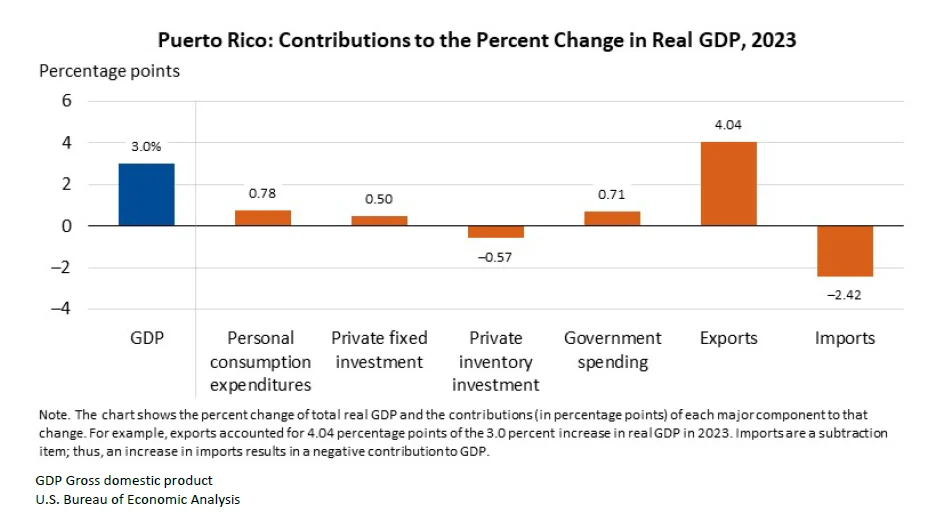
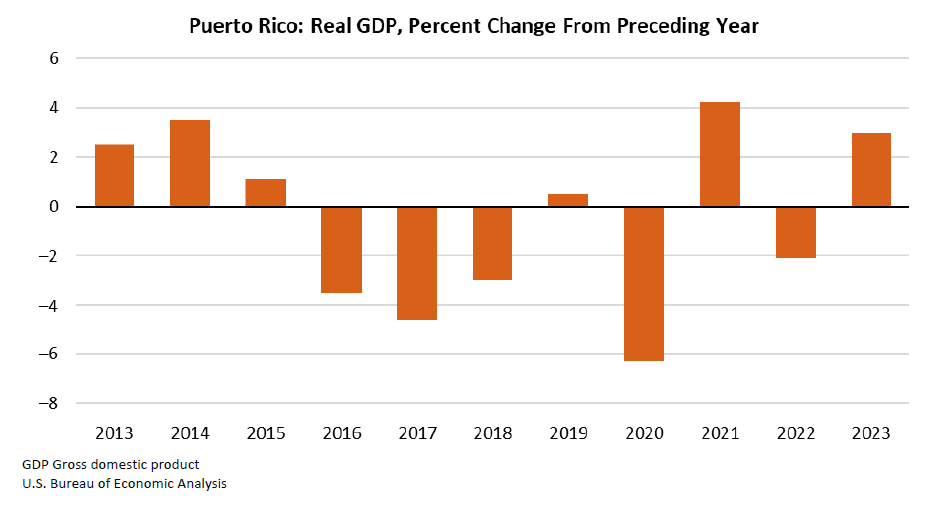
Puerto Rico’s economy demonstrated a significant recovery in 2023, with real gross domestic product (GDP) increasing by 3.0 percent. This marks a substantial turnaround from the 2.1 percent decrease observed in 2022, according to recent statistics released by the U.S. Bureau of Economic Analysis (BEA). The rebound in economic activity was primarily fueled by a robust surge in exports, alongside increases in personal consumption expenditures, government spending, and private fixed investment. While these positive drivers were partially offset by a decline in private inventory investment and an increase in imports, the overall economic picture for Puerto Rico in 2023 points towards a period of renewed growth and development.
A Year of Economic Resurgence: Key Drivers of GDP Growth
The 3.0 percent expansion in Puerto Rico’s real GDP in 2023 is a welcome development following a challenging year in 2022. The primary engine behind this growth was a notable increase in exports, which rose by 6.4 percent. This expansion encompassed both goods and services, with exports of goods seeing a 6.6 percent rise and exports of services growing by 5.6 percent. This indicates a strengthening of Puerto Rico’s position in international trade, suggesting increased demand for its products and services abroad.
Beyond exports, several other key components of GDP also contributed positively to the island’s economic performance. Personal consumption expenditures (PCE) saw a 1.2 percent increase. While spending on goods within PCE saw a slight decrease of 0.8 percent, this was more than compensated by a significant 4.0 percent rise in spending on PCE services. This suggests a shift in consumer behavior, with a greater allocation of resources towards services, a trend observed in many developed economies.
Government spending also played a crucial role in the economic uplift, registering a substantial increase of 4.8 percent. This growth was observed across all levels of government—federal, central, and municipal. A significant driver within government spending was investment, particularly in areas related to disaster recovery and infrastructure improvement. This investment is directly linked to ongoing efforts to rebuild and enhance critical infrastructure following a series of natural disasters that have impacted the island in recent years.
Private fixed investment also contributed to the positive economic momentum, growing by 3.8 percent. This growth was primarily driven by increased investment in equipment, with industrial equipment, including purchases of engines, turbines, and electrical equipment by businesses, leading the way. This suggests a renewed confidence in the business environment and a commitment to expanding operational capabilities.
However, the overall GDP growth was tempered by certain factors. Real private inventory investment experienced a decrease, with the manufacturing sector being the largest contributor to this decline. Additionally, real imports increased by 4.4 percent, primarily due to higher imports of goods, specifically pharmaceuticals and organic chemicals, which saw a 6.0 percent rise. While imports are a subtraction in the GDP calculation, their increase can also signal robust domestic demand and economic activity.
Background and Context: Navigating Economic Challenges
Puerto Rico’s economic landscape has been shaped by a complex interplay of factors, including its political status, natural disasters, and fiscal challenges. For years, the island has grappled with a prolonged economic recession, significant debt burdens, and the ongoing process of post-disaster recovery. The hurricanes of Irma and Maria in 2017, followed by earthquakes in 2019 and 2020, and Hurricane Fiona in 2022, have each left a profound impact on the island’s infrastructure and economy, necessitating substantial rebuilding efforts.
The BEA’s GDP statistics for Puerto Rico provide a crucial barometer of the island’s economic health. Unlike the mainland United States, which is covered by extensive surveys, Puerto Rico’s unique economic and political status requires specific methodologies for data collection and analysis. The BEA has consistently acknowledged the critical support provided by the government of Puerto Rico and various organizations on the island in producing these vital economic indicators.
The revision of GDP data for the years 2018-2022, incorporated into the latest release, highlights the dynamic nature of economic measurement. The largest revision to real GDP growth in any single year during this period was 0.4 percentage points in 2022. These revisions are a standard part of the statistical process, reflecting the incorporation of updated source data and methodological refinements.
A Timeline of Economic Recovery and Investment
The recent surge in government investment spending is directly tied to the ongoing recovery efforts from past natural disasters. The disbursement of federal funds for disaster recovery has been a critical lifeline for Puerto Rico. This funding has been allocated towards rebuilding and improving key infrastructure, including:
- The Power Grid: Significant investments have been made to modernize and strengthen Puerto Rico’s electrical infrastructure, aiming to enhance reliability and resilience against future storms. This includes projects to upgrade transmission and distribution lines, substations, and generation facilities.
- The Aqueduct System: Efforts are underway to repair and improve the island’s water and sewer systems, ensuring consistent access to clean water and effective wastewater management.
- Roads and Bridges: Extensive work is being undertaken to repair and rebuild damaged roads and bridges, facilitating transportation and commerce across the island.
- Camp Santiago: The National Guard’s Camp Santiago has also seen substantial investment for reconstruction and enhancement, supporting its operational capabilities.
These rebuilding efforts, spurred by federal aid, not only address immediate needs but also lay the groundwork for long-term economic stability and growth. The continued influx of federal funds for disaster recovery, coupled with strategic investments in infrastructure, has provided a significant impetus to economic activity.
Deeper Dive into Economic Components
Exports: A Global Reach
The impressive 6.4 percent increase in real exports in 2023 underscores Puerto Rico’s growing integration into the global marketplace. The strong performance in both goods and services exports suggests a diversified export base. The specific rise in exports of goods by 6.6 percent and services by 5.6 percent indicates that various sectors are contributing to this outward-looking economic growth. This can be attributed to factors such as competitive pricing, specialized production capabilities, and potentially increased demand from key trading partners.
Personal Consumption Expenditures (PCE): Shifting Spending Habits
The 1.2 percent rise in real PCE reflects an increase in consumer spending. The notable divergence between goods and services spending—a decrease in goods by 0.8 percent and an increase in services by 4.0 percent—points to evolving consumer preferences. This trend, where consumers allocate more of their budget to services like healthcare, entertainment, professional services, and personal care, is a significant indicator of economic maturation. The increase in PCE services suggests a growing disposable income and a willingness to spend on experiences and non-tangible goods.
Government Spending: Rebuilding and Investing for the Future
The substantial 4.8 percent increase in real government spending highlights the critical role of public sector investment in Puerto Rico’s economic recovery. The widespread nature of this increase across federal, central, and municipal levels signifies a coordinated effort to address the island’s needs. As detailed earlier, the disbursement of federal funds for disaster recovery has been a primary driver, targeting essential infrastructure projects. This sustained investment not only stimulates immediate economic activity through job creation and procurement but also enhances the island’s long-term resilience and attractiveness for further investment.
Private Fixed Investment: Building Business Capacity
The 3.8 percent growth in real private fixed investment signals a positive outlook among businesses. The focus on equipment, particularly industrial equipment, suggests that companies are investing in their productive capacity, aiming to improve efficiency, expand output, and potentially adopt new technologies. This type of investment is crucial for long-term economic competitiveness and job creation. The increase in industrial equipment purchases, including engines, turbines, and electrical equipment, points towards growth in sectors such as manufacturing and energy.
Inventory Investment and Imports: Balancing the Economic Equation
The decrease in real private inventory investment, particularly within the manufacturing sector, could indicate a strategy of more efficient inventory management, responding to immediate demand rather than building up large stockpiles. Alternatively, it might reflect challenges in production or supply chain disruptions affecting inventory levels.
The 4.4 percent increase in real imports, driven by pharmaceuticals and organic chemicals, suggests a reliance on external sources for key goods. While an increase in imports reduces the direct contribution to GDP, it also reflects the needs of a growing economy and its industries. The specific growth in pharmaceutical and chemical imports could indicate expansion in the island’s life sciences sector or increased consumer demand for these products.
Acknowledgments and Data Accessibility
The U.S. Bureau of Economic Analysis explicitly acknowledges the indispensable role of the government of Puerto Rico and numerous organizations and individuals on the island in the production of these economic statistics. This collaboration is essential given that Puerto Rico is not typically included in the standard surveys used for estimating U.S. GDP.
For those seeking more detailed information, the BEA provides access to a wealth of data through its Interactive Data Application. This includes comprehensive tables on GDP, Personal Consumption Expenditures (PCE), Exports and Imports of Goods and Services, Gross Domestic Investment, and Private Fixed Investment. These interactive tools allow users to explore historical data, analyze trends, and understand the specific components driving economic activity on the island.
A Note on Future Data Availability
It is important to note that with the release of the 2023 estimates, the BEA will no longer produce further Puerto Rico GDP statistics. Previously published data will remain accessible through the BEA’s Data Archive. This marks the end of an era for BEA’s detailed economic reporting on Puerto Rico, emphasizing the importance of utilizing the existing data to understand past economic performance and future trends.
Conclusion: A Path Towards Sustainable Growth
Puerto Rico’s 3.0 percent GDP growth in 2023 represents a significant step forward in its economic recovery. The diverse drivers of this growth—strong exports, resilient consumer spending, robust government investment in infrastructure, and increased business investment—paint a picture of an economy actively rebuilding and adapting. While challenges remain, particularly in managing imports and inventory levels, the overall trend indicates a positive trajectory. The continued focus on infrastructure development, fueled by disaster recovery funds, is likely to remain a cornerstone of economic activity in the coming years, laying a more stable foundation for Puerto Rico’s future. The insights gained from these final BEA reports will be invaluable for policymakers, businesses, and researchers as they navigate the island’s ongoing economic journey.