Lana Rhoades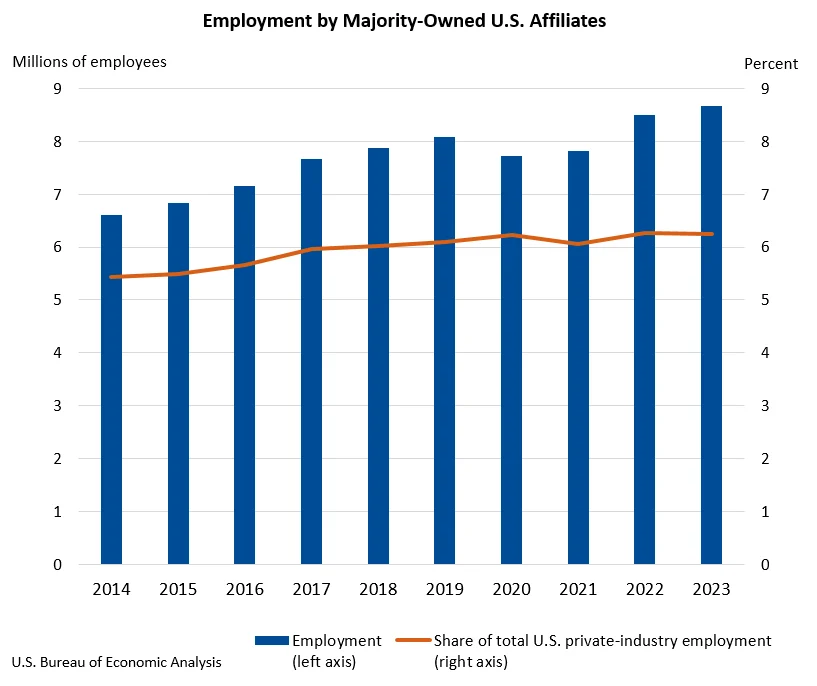
The U.S. operations of majority-owned affiliates of foreign multinational enterprises (MNEs) significantly contributed to the American economy in 2023, with employment figures showing a steady increase and key economic indicators demonstrating robust growth. According to the latest statistics released by the U.S. Bureau of Economic Analysis (BEA), these foreign-invested companies provided jobs for 8.66 million workers across the United States, marking a 1.9 percent rise from the 8.5 million employees recorded in 2022. This growth underscores the sustained importance of foreign direct investment (FDI) in bolstering the U.S. labor market and driving economic activity.
While the absolute number of jobs created by these affiliates expanded, their share of total private-industry employment in the United States saw a slight dip, moving from 6.3 percent in 2022 to 6.2 percent in 2023. This marginal decrease reflects the overall growth within the broader U.S. private sector, which also experienced employment gains during the same period. Nevertheless, the substantial workforce employed by foreign-owned entities highlights their integral role in the national economic landscape, contributing to diverse industries and communities.
The economic impact of these majority-owned U.S. affiliates extends far beyond direct employment. In 2023, their current-dollar value added, a key measure of their direct contribution to the nation’s Gross Domestic Product (GDP), surged by 6.3 percent, reaching an impressive $1.47 trillion. This substantial increase signifies a growing operational scale and enhanced productivity among these foreign-invested businesses. This metric is crucial for understanding the real economic output generated by these entities, independent of inflation.
Investment in the nation’s productive capacity also saw a significant uptick. Expenditures for property, plant, and equipment by majority-owned U.S. affiliates rose by 6.3 percent, totaling $322.7 billion. This robust investment signals a strong commitment by foreign MNEs to expand their physical infrastructure and operational capabilities within the United States, potentially leading to further job creation and technological advancements. Such capital expenditures are vital for long-term economic growth, fostering innovation and enhancing competitiveness.
Furthermore, the commitment to innovation and research within the U.S. is evident through the increased spending by these affiliates. Research and development (R&D) performed by majority-owned U.S. affiliates saw a 1.1 percent increase, reaching $87.8 billion. While this growth rate is more modest compared to other indicators, it still represents a substantial investment in the future of American innovation, contributing to the development of new technologies, products, and services.
A Deeper Dive into the Data and Trends
The statistics released by the BEA provide a granular view of the multifaceted contributions of foreign-owned companies operating in the U.S. These entities, ranging from manufacturing giants to technology innovators and service providers, are not merely employers but also significant drivers of economic value. The data for 2023 builds upon a solid foundation established in previous years, with ongoing revisions to historical data offering a more accurate picture of economic trends.
Key Indicators at a Glance (2023):
- Employment: 8.66 million workers, a 1.9% increase from 2022.
- Share of Private-Industry Employment: 6.2% (down slightly from 6.3% in 2022).
- Value Added (Contribution to GDP): $1.47 trillion, a 6.3% increase.
- Capital Expenditures (Property, Plant, and Equipment): $322.7 billion, a 6.3% increase.
- Research and Development Expenditures: $87.8 billion, a 1.1% increase.
These figures are derived from comprehensive surveys conducted by the BEA, which meticulously track the financial and operational activities of U.S. affiliates of foreign MNEs. The data is critical for policymakers, economists, and business leaders seeking to understand the dynamics of international investment and its impact on the U.S. economy.
Revisiting 2022: A Foundation for Growth
The BEA also provided revised statistics for 2022, offering a clearer perspective on the preceding year’s performance. These revisions incorporate newly available and updated source data, ensuring greater accuracy in economic assessments. The preliminary estimates for 2022, initially released in November 2024, have been refined, providing a more robust understanding of the economic landscape.
Updates to 2022 Statistics (Billions of dollars, except as noted):
| Indicator | Preliminary Estimate | Revised Estimate |
|---|---|---|
| Number of Employees (thousands) | 8,351.0 | 8,503.1 |
| Value Added | 1,350.1 | 1,382.1 |
| Expenditures for Property, Plant, and Equipment | 299.1 | 303.5 |
| Research and Development Expenditures | 80.3 | 86.8 |
These revisions highlight a stronger performance in 2022 than initially reported, particularly in value added and R&D expenditures. The revised employment figure for 2022, 8.503 million, serves as the crucial baseline from which the 2023 growth of 1.9% is calculated. This iterative process of data collection and revision is fundamental to the integrity of economic reporting, ensuring that analyses are based on the most accurate information available.
Context and Historical Perspective
The presence of foreign-owned companies in the U.S. economy is not a recent phenomenon. For decades, foreign direct investment has played a vital role in capital formation, job creation, and technological diffusion. The BEA’s statistics on the activities of U.S. affiliates of foreign MNEs have been a cornerstone of this understanding, providing essential data for tracking the evolution of international business operations within the United States.
The trends observed in 2023—growing employment, increased value added, and significant capital and R&D investments—reflect a broader pattern of sustained engagement by foreign firms in the U.S. market. This engagement is often driven by a combination of factors, including access to a large consumer base, a skilled workforce, a stable legal and regulatory environment, and opportunities for innovation and market expansion.
The BEA’s methodology for collecting these statistics involves extensive data gathering from a wide array of sources, including surveys of U.S. businesses with foreign ownership and administrative data from various government agencies. This comprehensive approach ensures that the reported figures are as representative as possible of the activities of this vital segment of the U.S. economy.
Broader Economic Implications and Analysis
The sustained growth in employment and economic contribution from majority-owned U.S. affiliates of foreign MNEs has several important implications for the U.S. economy.
Job Creation and Stability: The addition of nearly 160,000 jobs in 2023 by these entities is a significant contribution to overall U.S. employment. These jobs often represent stable, well-paying positions across various skill levels, supporting families and local economies. The diverse industries in which these affiliates operate, from automotive manufacturing and pharmaceuticals to technology services and retail, mean that their impact is felt across the nation.
Economic Output and GDP: The substantial increase in value added directly translates into higher contributions to the U.S. GDP. This not only boosts the nation’s overall economic output but also contributes to tax revenues at federal, state, and local levels, supporting public services and infrastructure. The robust growth in value added suggests that these foreign-owned companies are becoming more productive and efficient within the U.S. economic framework.
Investment in the Future: The significant capital expenditures on property, plant, and equipment signal a long-term commitment by foreign investors to their U.S. operations. This investment is crucial for modernizing industries, enhancing productivity, and creating the capacity for future growth. It also demonstrates confidence in the U.S. economic outlook and its potential for expansion.
Innovation and Technological Advancement: While R&D spending growth was more modest, the substantial investment of nearly $88 billion in research and development is critical for maintaining the U.S.’s competitive edge. These investments fuel innovation, lead to the development of new technologies, and contribute to the nation’s knowledge economy. Foreign-owned firms are often at the forefront of technological adoption and development, bringing global expertise and R&D capabilities to the U.S.
Potential Concerns and Nuances:
While the overall picture is positive, the slight decrease in the share of total private-industry employment warrants attention. This could indicate that the private sector as a whole is growing at a faster pace, or it could signal a shifting composition of employment within the U.S. economy. Policymakers and economic analysts will likely continue to monitor this trend to understand its underlying drivers.
Furthermore, the BEA’s data primarily focuses on "majority-owned" affiliates. This means that companies where foreign entities hold a significant, but not controlling, stake might not be fully captured in these specific statistics. Understanding the full scope of foreign investment often requires considering a broader set of indicators.
Official Commentary and Outlook
While the BEA’s release is primarily data-driven, the implications of these statistics are often interpreted by government officials and economic bodies. The U.S. Department of Commerce, for instance, frequently highlights the role of FDI in job creation and economic growth. Statements from such agencies typically emphasize the benefits of foreign investment in terms of job creation, technological transfer, and increased competitiveness.
The BEA’s continued commitment to providing detailed and timely data on these activities is crucial for informing policy decisions. By understanding the scale and nature of foreign investment, policymakers can better craft strategies to attract and retain foreign capital, foster innovation, and ensure that the benefits of FDI are broadly shared across the U.S. economy.
Future Releases and Data Availability
The BEA has indicated that future releases will continue to provide detailed statistics on the activities of U.S. affiliates of foreign MNEs. These releases will include data on sales, balance sheet and income statement items, compensation of employees, and trade, offering an even more comprehensive view of these companies’ economic footprint.
It is important to note that the BEA is also streamlining its data presentation. Starting with this release, tables are no longer included in the body of the news release but are available through BEA’s Interactive Data Application and comprehensive data tables. Additionally, some historical data tables have been discontinued or archived, a process that began in December 2025, impacting statistics related to U.S. affiliates with 50 percent or less foreign ownership and supplemental industry statistics.
The next release, scheduled for July 10, 2026, will cover the 2024 activities of U.S. affiliates of foreign multinational enterprises, promising further insights into this dynamic sector of the American economy. These ongoing statistical updates are essential for tracking economic trends and understanding the evolving landscape of international business in the United States.