Lana Rhoades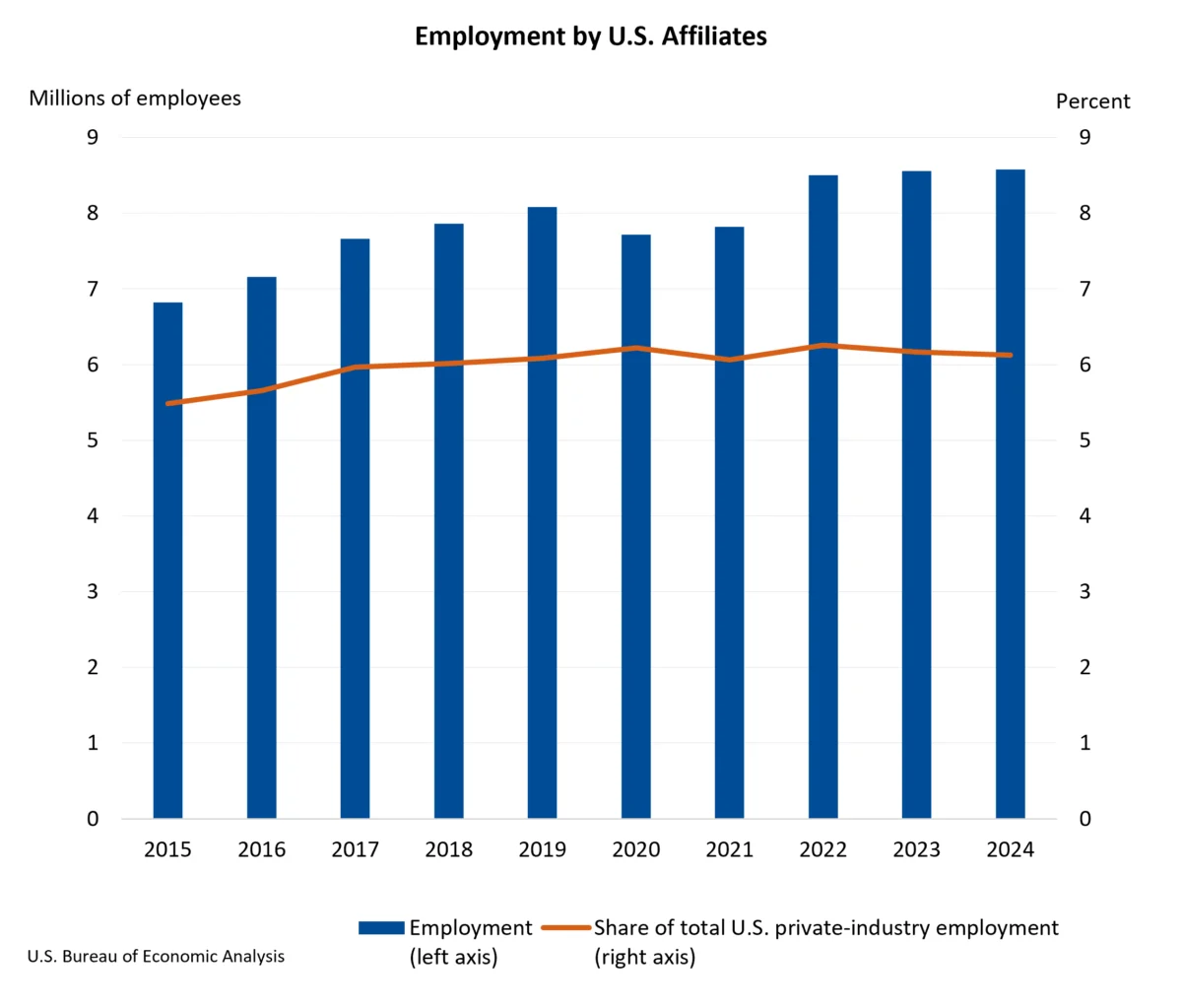
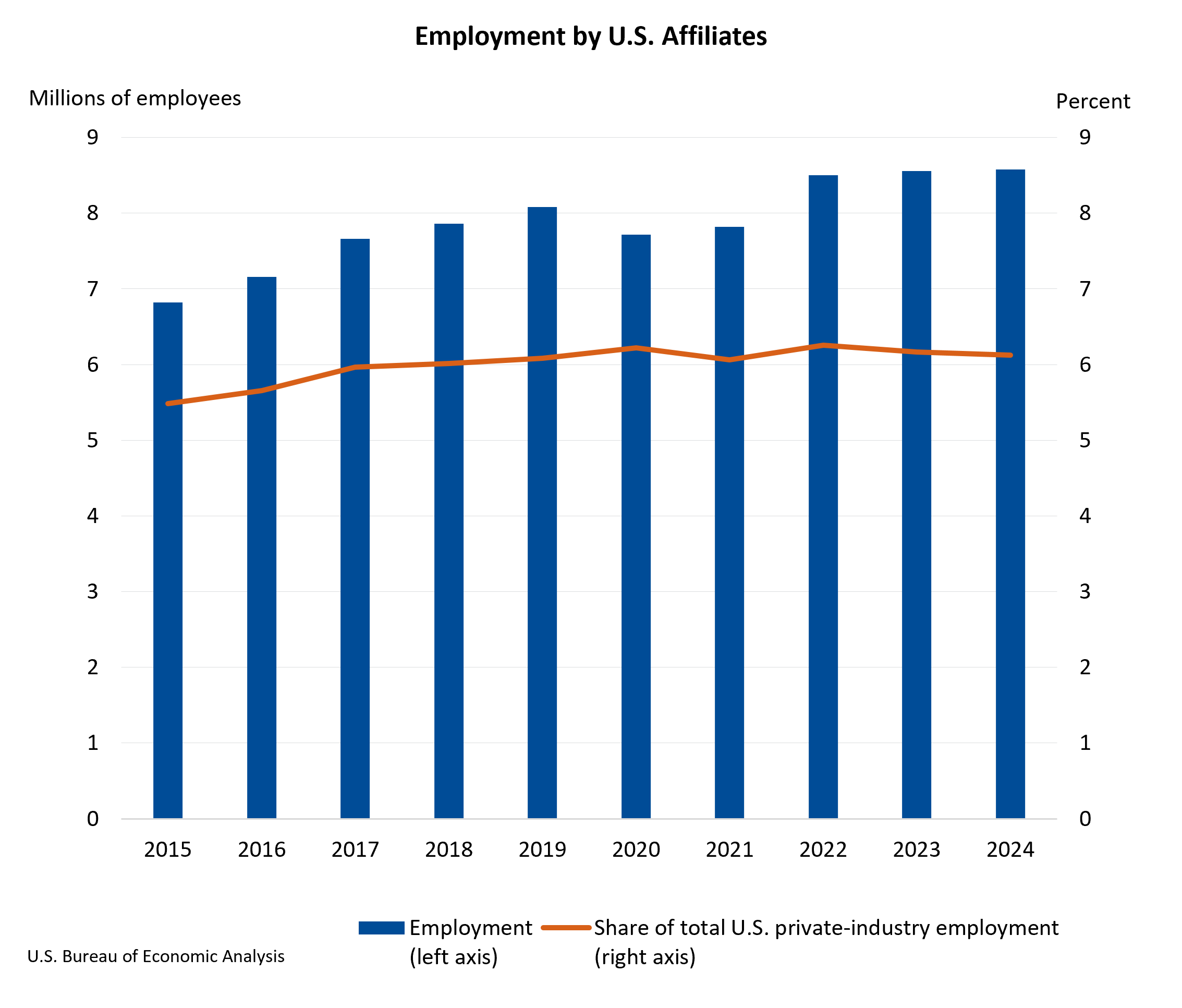
Majority-owned U.S. affiliates of foreign multinational enterprises (MNEs) provided employment for 8.57 million individuals across the United States in 2024, marking a marginal increase of 0.2 percent from the 8.56 million workers recorded in the preceding year. This data, released today by the U.S. Bureau of Economic Analysis (BEA), underscores the sustained and significant role of foreign direct investment (FDI) in the American labor market. While the growth rate is modest, it reflects a resilient employment base sustained by international companies operating within the U.S. economy.
These U.S. affiliates collectively represented 6.1 percent of total private-industry employment in the nation in 2024. This figure, though slightly down from 6.2 percent in 2023, still signifies a substantial contribution to the overall workforce. The sectors that benefited most from this employment were manufacturing and retail trade, two cornerstone industries of the U.S. economy. The United Kingdom, Japan, and Germany emerged as the leading countries of ultimate beneficial ownership for these affiliates, contributing the largest shares to the employment figures. This concentration highlights the long-standing economic ties and investment flows from these key global partners into the United States.
The economic footprint of these foreign-owned entities extends beyond employment. Their direct contribution to the U.S. gross domestic product (GDP), measured as current-dollar value added, saw a robust increase of 4.3 percent, reaching a total of $1.52 trillion in 2024. This value added accounted for 6.7 percent of the total U.S. business-sector value added, a slight decrease from 6.8 percent in 2023, but indicative of significant economic output.
Further demonstrating their commitment to long-term growth and operational capacity within the U.S., these affiliates significantly increased their capital expenditures. Expenditures for property, plant, and equipment surged by 3.3 percent, amounting to $328.0 billion. This investment signals confidence in the U.S. market and a strategic expansion of their physical and operational infrastructure.
Innovation and technological advancement are also key areas where U.S. affiliates of foreign MNEs are making substantial contributions. Research and development (R&D) performed by these entities experienced a notable increase of 5.3 percent, reaching $95.5 billion in 2024. Their R&D activities accounted for a significant 12.4 percent of total U.S. business R&D, highlighting their crucial role in driving innovation and maintaining the United States’ competitive edge in various technological fields.
Geographically, employment by these majority-owned U.S. affiliates is concentrated in key economic hubs. California led the nation with 885,200 jobs provided by these entities, followed by Texas with 717,400 jobs, and New York with 556,700 jobs. In each of these leading states, the manufacturing sector was the largest employer among U.S. affiliates. This geographical distribution reflects the presence of major industrial centers and access to skilled labor pools within these states, attracting substantial foreign investment.
A Deeper Dive into BEA Statistics and Revisions
The comprehensive data released by the BEA provides a granular view of the operations and finances of these U.S. affiliates. Statistics on sales, balance sheets, income statements, compensation of employees, and trade activities offer a multifaceted understanding of their economic impact. The BEA’s commitment to providing detailed, country- and state-level insights allows policymakers, researchers, and businesses to analyze trends and understand the nuances of FDI’s contribution to the U.S. economy.
A crucial aspect of the BEA’s reporting is the regular revision of historical data to incorporate newly available and updated source information. The statistics for 2023 have undergone such revisions, reflecting the dynamic nature of economic data collection and analysis. Preliminary estimates for 2023, released in December of the previous year, have been refined. For instance, the number of employees in 2023 was initially estimated at 8,661.8 thousand, but the revised figure stands at 8,556.9 thousand. Similarly, value added for 2023 was revised from a preliminary $1,469.1 billion to $1,456.3 billion. Expenditures for property, plant, and equipment were revised from $322.7 billion to $317.6 billion, while R&D expenditures saw an upward revision from $87.8 billion to $90.6 billion. These revisions are standard practice and ensure that the published data remains as accurate and representative as possible.
Historical Context and Trends in Foreign Direct Investment
The presence of foreign-owned enterprises in the U.S. economy is not a new phenomenon but rather a long-standing characteristic of globalized trade and investment. For decades, foreign direct investment has played a vital role in job creation, capital formation, and technological diffusion within the United States. The BEA’s data series on the activities of U.S. affiliates of foreign MNEs traces this evolution, providing a historical perspective on the scale and impact of FDI.
The trend observed in 2024, with a slight increase in employment and significant growth in value added and R&D expenditures, suggests a continued commitment from foreign investors to maintain and expand their U.S. operations. This resilience is particularly noteworthy in the context of evolving global economic landscapes, geopolitical shifts, and domestic policy considerations. The steady flow of investment indicates that the U.S. market continues to be perceived as an attractive destination for international capital, offering a stable regulatory environment, a large consumer base, and access to skilled labor and advanced technology.
Top Contributing Nations: A Look at Global Investment Patterns
The dominance of the United Kingdom, Japan, and Germany as leading sources of employment through their U.S. affiliates reflects historical patterns of foreign direct investment. These nations have consistently been major investors in the U.S. economy, establishing substantial operations across various sectors.
- United Kingdom: Historically, the UK has been a significant source of FDI into the United States, with substantial investments in financial services, manufacturing, and wholesale trade. British companies often leverage the U.S. as a gateway to the North American market.
- Japan: Japanese investment in the U.S. is particularly prominent in the automotive sector, electronics, and machinery manufacturing. Japanese firms have built extensive production facilities and supply chains, creating a large number of jobs.
- Germany: German companies, especially in the automotive, chemical, and pharmaceutical industries, have a strong presence in the U.S. Their investments often focus on advanced manufacturing and R&D, contributing significantly to high-value jobs and innovation.
The continued strength of these three nations as major employment providers highlights the enduring nature of transatlantic and transpacific economic partnerships. Their sustained investment underscores the strategic importance of the U.S. market for their global business strategies.
Sectoral Impact: Manufacturing and Retail Trade Lead the Way
The concentration of employment within the manufacturing and retail trade sectors is a key takeaway from the BEA report.
- Manufacturing: This sector has historically been a significant recipient of FDI, with foreign companies establishing production facilities that create jobs for American workers. These operations often involve complex supply chains, advanced technology, and a substantial workforce. The continued strength of manufacturing employment by foreign affiliates suggests that the U.S. remains competitive in certain manufacturing niches, potentially due to skilled labor, infrastructure, and market access.
- Retail Trade: The retail sector, driven by consumer demand, also benefits significantly from foreign investment. Many international retail brands operate through their U.S. affiliates, employing a large number of individuals in sales, logistics, and management roles. This sector’s reliance on consumer spending makes it sensitive to economic conditions but also a consistent source of employment.
The BEA report also indicates that in key states like California, Texas, and New York, manufacturing was the primary driver of employment by U.S. affiliates. This reinforces the importance of these sectors in attracting and sustaining foreign investment and creating substantial employment opportunities.
Implications for the U.S. Economy and Policymakers
The data released by the BEA carries significant implications for economic policy and analysis. The consistent employment figures, coupled with increases in value added and R&D investment, point to the tangible benefits of foreign direct investment for the U.S. economy. These benefits include:
- Job Creation: As highlighted, millions of Americans owe their employment to foreign-owned companies operating in the U.S.
- Economic Growth: The substantial value added contributes directly to the nation’s GDP, fueling economic activity.
- Innovation and Technology Transfer: Significant R&D spending by foreign affiliates can lead to the development of new technologies, processes, and products, benefiting the broader U.S. innovation ecosystem.
- Capital Investment: Expenditures on property, plant, and equipment represent tangible investments that can enhance productivity and infrastructure.
For policymakers, this data serves as a crucial indicator of the health and attractiveness of the U.S. as an investment destination. Understanding which countries and sectors are driving FDI and employment can inform strategies aimed at attracting further investment, fostering innovation, and ensuring that the benefits of FDI are broadly distributed across the nation.
The slight dip in the percentage of total private-industry employment, while notable, does not negate the overall positive contribution. It may reflect the growth of other sectors or shifts in the overall labor market composition. Continued monitoring of these trends will be essential for a comprehensive understanding of FDI’s evolving role.
Future Outlook and Data Availability
The BEA’s commitment to transparency and detailed data provision ensures that stakeholders can continuously assess the impact of foreign multinational enterprises on the U.S. economy. The availability of statistics on sales, compensation, trade, and more on the BEA website allows for in-depth analysis.
The next release, anticipated in Spring 2027, will provide data for the 2025 activities of U.S. affiliates of foreign multinational enterprises. This forward-looking information will offer further insights into emerging trends and the continued evolution of global investment patterns within the United States.
Furthermore, the BEA’s ongoing efforts to update its disclosure avoidance methods, including rounding and aggregation, aim to enhance data usability while maintaining respondent confidentiality. This commitment to methodological improvement ensures the reliability and integrity of the published statistics, providing a solid foundation for economic analysis and decision-making. The comprehensive set of statistics available on the BEA website, including modifications to certain tables concerning affiliate counts, underscores the agency’s dedication to providing the most accurate and accessible data possible.