Lana Rhoades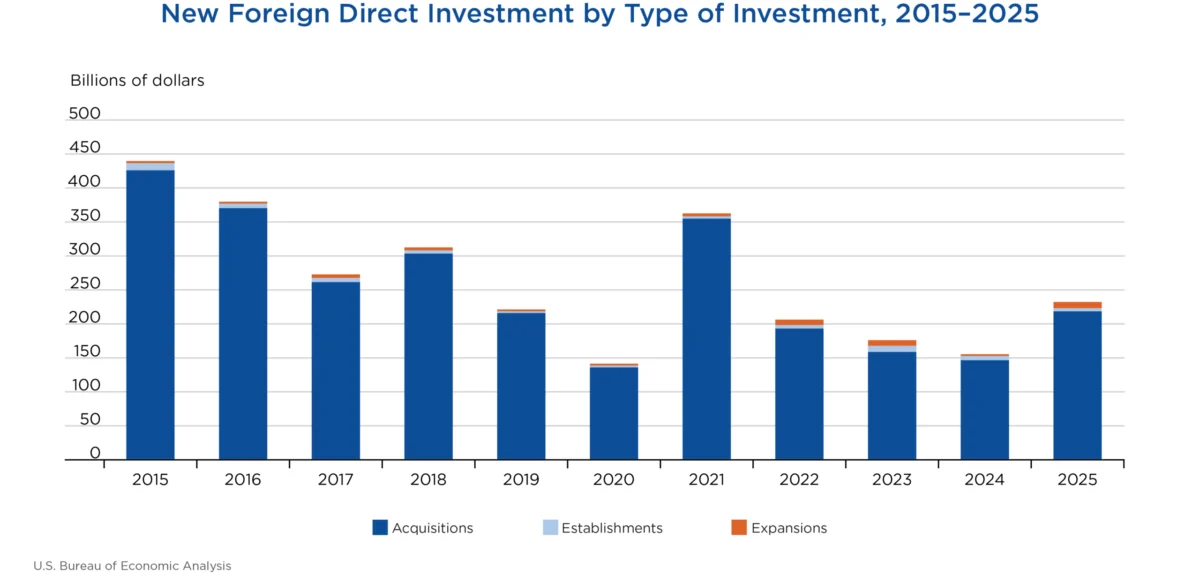
Expenditures by foreign direct investors to acquire, establish, or expand U.S. businesses reached a robust $232.2 billion in 2025, according to preliminary statistics released by the U.S. Bureau of Economic Analysis (BEA). This represents a significant increase of $76.8 billion, or 49.5 percent, from the $155.3 billion recorded in 2024, highlighting a substantial surge in international capital flow into the American economy. The lion’s share of these investments, mirroring trends from previous years, was directed towards the acquisition of existing U.S. businesses, underscoring the attractiveness of established American enterprises to overseas entities.
The BEA’s detailed report reveals that acquisition expenditures alone accounted for $218.4 billion of the total in 2025. Investment in establishing new U.S. businesses, often referred to as greenfield investments, totaled $4.6 billion, while expenditures aimed at expanding existing foreign-owned businesses within the United States amounted to $9.2 billion. When considering planned future expenditures in addition to initial first-year outlays, the total projected investment climbs to $284.5 billion, indicating a strong pipeline of future capital commitment. These investments in 2025 supported the creation or retention of 213,100 jobs in newly acquired, established, or expanded foreign-owned businesses across the nation.
Manufacturing Sector Dominates Investment Landscape
The manufacturing sector emerged as a primary beneficiary of this foreign investment influx, accounting for a commanding $121.8 billion, or 52.5 percent, of all new direct investment expenditures in 2025. Within manufacturing, specific sub-sectors showed particularly strong activity. Chemicals manufacturing attracted $45.4 billion, followed by plastics and rubber products manufacturing with $19.0 billion. Beyond manufacturing, publishing industries also saw significant investment, totaling $50.7 billion.
This surge in manufacturing investment signals renewed confidence in the U.S. industrial base and its capacity to absorb and leverage foreign capital for growth and innovation. The BEA’s data suggests a strategic interest from international players in bolstering their U.S. production capabilities, potentially driven by factors such as market access, skilled labor availability, and supportive economic policies.
Key Investor Nations and Regional Contributions
Japan led the pack among investing countries, contributing a substantial $50.5 billion in 2025. Germany followed with $26.7 billion, and Canada with $23.5 billion. These figures reflect long-standing economic ties and strategic interests of these nations in the U.S. market. On a regional basis, Europe was the largest contributor of new investment, injecting $116.6 billion, representing 50.2 percent of all new foreign direct investment. The Asia and Pacific region was the second-largest investing bloc, with expenditures totaling $71.9 billion.
The strong performance from European and Asian investors underscores the global appeal of the U.S. economy as a destination for capital. This broad-based international interest is crucial for fostering competition, driving technological advancement, and creating employment opportunities across various sectors.
State-Level Investment Patterns
California once again proved to be a magnet for foreign direct investment, attracting the largest share of first-year expenditures at $59.7 billion. Texas followed with $21.5 billion, and Pennsylvania secured the third position with $20.9 billion. These leading states typically offer robust economies, diverse industrial bases, and significant market access, making them prime targets for international investors.
Greenfield Investment: A Focus on New Operations and Expansions
While acquisitions dominated overall investment, greenfield investments—those focused on establishing new U.S. businesses or expanding existing foreign-owned ones—represented a notable $13.8 billion in 2025. This segment of FDI is particularly vital for job creation and the introduction of new operational capacity.
By industry, greenfield expenditures were most pronounced in transportation and warehousing, which received $3.6 billion, followed by computers and electronics products manufacturing ($2.0 billion) and chemicals manufacturing ($1.8 billion).
Investors from the Asia and Pacific region were the leading contributors to greenfield investments, with a total of $8.3 billion. Australia led this regional group with $3.0 billion, followed by South Korea ($2.2 billion) and Japan ($1.7 billion). On a state level, Louisiana attracted the highest greenfield investment at $3.0 billion, with Arizona ($2.7 billion) and Texas ($1.9 billion) also receiving significant inflows. The planned total expenditures for greenfield investments initiated in 2025, encompassing both initial and future outlays, were projected at $66.1 billion, indicating substantial long-term commitments to building and expanding operations from the ground up.
Employment Impact and Projections
The direct investment activities in 2025 had a considerable impact on employment. Current employment within newly acquired enterprises stood at 211,700 individuals. When factoring in planned employment for newly established businesses once fully operational and anticipated expansions, the total projected employment associated with these investments reached 232,400.
By industry, plastics and rubber parts manufacturing accounted for the largest number of current employees at 21,800, followed by transportation equipment manufacturing (17,300) and primary and fabricated metals manufacturing (16,400). Examining employment by country of origin, Mexico was associated with the largest number of current employees (54,600), followed by Canada (29,500) and the United Kingdom (26,800). California led the states in terms of current employment resulting from new foreign direct investment, with 37,200 jobs, followed by Illinois (17,600) and Texas (16,500).
Revisions to 2024 Data Indicate Upward Trend
The BEA also provided revised figures for 2024, which indicated a stronger performance than initially reported. First-year expenditures for new foreign direct investment in 2024 were revised upward to $155.3 billion, from a previous estimate of $151.0 billion. This upward revision was driven by increases in acquisitions ($146.4 billion from $143.0 billion), new establishments ($6.4 billion from $6.3 billion), and expansions ($2.5 billion from $1.8 billion). Similarly, planned total expenditures for 2024 were revised to $164.0 billion from $157.0 billion, reflecting adjustments in planned expansions and new establishments. These revisions suggest a consistent upward trajectory in foreign direct investment leading into 2025.
Analysis and Implications
The substantial increase in foreign direct investment in 2025, particularly its concentration in manufacturing and acquisitions, carries significant implications for the U.S. economy. The surge in acquisitions can be viewed as both a validation of the existing strength and potential of American businesses and a mechanism for foreign entities to gain immediate market access and operational capacity. The robust growth in manufacturing investment suggests a potential reshoring or near-shoring trend, where foreign companies are choosing to bolster their production bases within the United States to serve North American markets, potentially mitigating supply chain risks and benefiting from proximity to consumers.
The significant greenfield investment, though smaller in absolute terms than acquisitions, is crucial for long-term economic growth. It signifies the creation of new operational hubs, the introduction of new technologies, and the generation of novel employment opportunities, contributing to a more dynamic and diversified economic landscape. The leading roles of Japan, Germany, and European and Asian regions as investors highlight the interconnectedness of the global economy and the continued reliance of international businesses on the stability and opportunities presented by the U.S. market.
The concentration of investment in states like California, Texas, and Pennsylvania underscores their importance as economic powerhouses and preferred destinations for foreign capital. However, the distribution of greenfield investments across states like Louisiana and Arizona suggests that opportunities for growth and development are being recognized in a wider array of regions, potentially fostering economic diversification beyond traditional hubs.
The BEA’s commitment to enhancing data publication through methods like coarsening, which involves rounding and aggregation while maintaining confidentiality, allows for a more comprehensive understanding of FDI trends. This approach ensures that valuable economic data can be shared with the public and policymakers, facilitating informed decision-making.
Future Outlook
The preliminary data for 2025 paints a picture of a vibrant and attractive U.S. market for foreign investors. The strong growth observed in 2025, coupled with the upward revisions for 2024 and substantial planned future expenditures, suggests that this positive trend is likely to continue. The next release of data, scheduled for June 2027, will provide insights into new foreign direct investment in the United States for 2026, offering further clarity on the evolving landscape of international capital flows into the American economy. The ongoing commitment from foreign direct investors is a critical component of U.S. economic vitality, driving innovation, job creation, and global competitiveness.