Lana Rhoades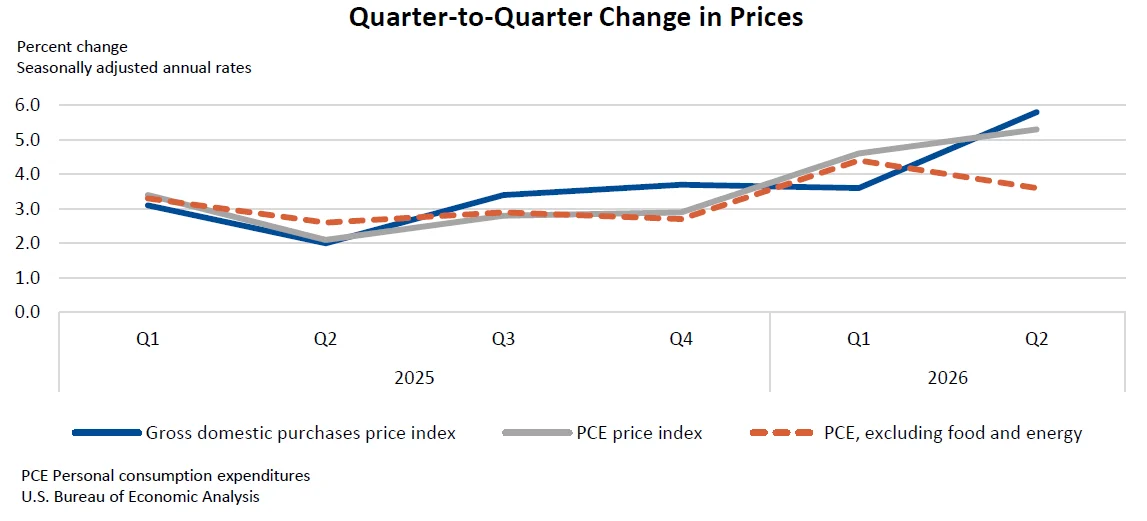
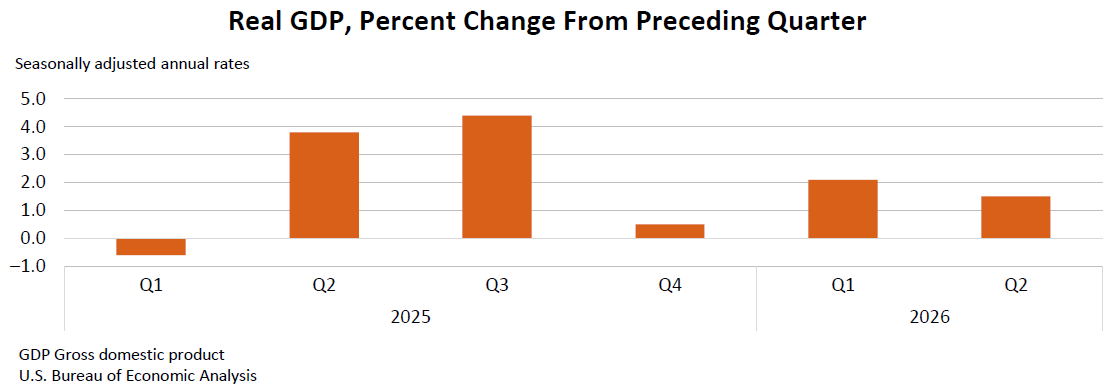
The U.S. economy demonstrated a more measured pace of expansion in the second quarter of 2026, with real gross domestic product (GDP) increasing at an annualized rate of 1.5 percent. This marks a deceleration from the 2.1 percent growth recorded in the first quarter, according to the second estimate released by the U.S. Bureau of Economic Analysis (BEA). While the overall growth rate remained consistent with the advance estimate, a closer examination of the components reveals shifts in the underlying economic drivers.
Key Drivers of Second-Quarter GDP
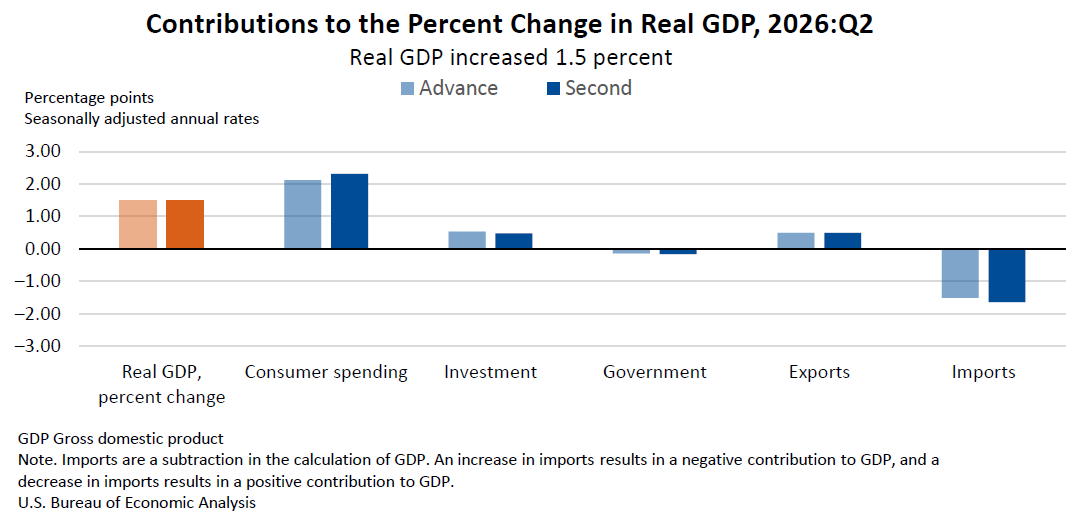
The modest increase in real GDP was primarily propelled by robust consumer spending, a surge in exports, and continued investment activity. These positive contributions, however, were partially counterbalanced by a contraction in government spending. Furthermore, imports, which are subtracted in the calculation of GDP, experienced an uptick, further moderating the headline growth figure.
The BEA’s revised data indicated that an upward adjustment in consumer spending provided a crucial boost to the economy. This was, in part, offset by an upward revision to the growth of imports. The BEA’s technical notes highlight that the second estimate of real GDP at 1.5 percent represents a downward revision of less than 0.1 percentage point from the advance estimate, with the upward revision to consumer spending being the key factor in maintaining the original projection, despite the import revision.
Shifting Economic Dynamics: A Quarter-over-Quarter Comparison
When compared to the first quarter, the slowdown in real GDP growth during the second quarter was largely attributable to a noticeable downturn in government spending. This was accompanied by decelerating trends in both investment and export growth. Conversely, consumer spending exhibited an acceleration, offering a degree of support to the overall economic expansion. The growth in imports also outpaced that of the first quarter, acting as a drag on GDP.
Private Domestic Demand Remains Strong
Despite the overall moderation in GDP growth, real final sales to private domestic purchasers – a key indicator of underlying domestic demand that includes consumer spending and gross private fixed investment – demonstrated significant strength. This measure increased by 4.2 percent in the second quarter, representing an upward revision of 0.3 percentage point from the previous estimate. This sustained robust private demand suggests underlying resilience in the domestic economy, independent of government activity or international trade flows.
Inflationary Pressures Moderate Slightly
On the inflation front, the price index for gross domestic purchases, a broad measure of inflation across goods and services purchased by consumers, businesses, and governments, rose by 5.8 percent in the second quarter. This was a slight upward revision of 0.1 percentage point from the advance estimate.
The personal consumption expenditures (PCE) price index, a key inflation gauge closely watched by the Federal Reserve, increased by 5.3 percent. This also saw an upward revision of 0.2 percentage point. The core PCE price index, which excludes volatile food and energy prices, increased by 3.6 percent, also revised upward by 0.2 percentage point. While still elevated, the continued moderation in core inflation suggests that underlying price pressures may be gradually easing, though remaining a point of focus for policymakers.
Gross Domestic Income and Average Measures Show Mixed Signals
In a parallel measure of economic activity, real gross domestic income (GDI) – which measures the income side of the economy – showed a more robust increase of 2.2 percent in the second quarter, a significant uptick from the 1.2 percent growth in the first quarter. The BEA calculates the average of real GDP and real GDI as a potentially more reliable indicator of economic trends, as it smooths out the divergences that can arise between the expenditure and income approaches. In the second quarter, this average increased by 1.8 percent, compared to 1.7 percent in the first quarter, indicating a somewhat more positive underlying economic performance than the headline GDP figure might suggest.
Corporate Profits Show Strong Rebound
Corporate profits from current production, a measure of the profitability of U.S. corporations, experienced a substantial increase in the second quarter. Profits rose by $400.9 billion, a significant jump from the $74.4 billion increase observed in the first quarter. This strong rebound in corporate profitability could signal a healthier business environment and potentially greater capacity for investment and hiring in the coming periods.
Context and Background: The Post-Pandemic Economic Landscape
The current economic trajectory unfolds against a backdrop of evolving global and domestic economic conditions. Following the significant disruptions and stimulus measures of the COVID-19 pandemic, economies worldwide have been navigating a complex recovery phase characterized by fluctuating inflation rates, supply chain adjustments, and shifting consumer behaviors. The U.S. economy, in particular, has seen periods of robust growth interspersed with concerns about inflation and the potential for economic slowdown.
The BEA’s release of GDP data is a crucial component of economic reporting, providing policymakers, businesses, and the public with essential insights into the nation’s economic health. The second estimate, released approximately one month after the advance estimate, incorporates more comprehensive data, allowing for a more refined assessment of economic performance.
Timeline of Economic Releases and Updates
The BEA’s release schedule for GDP data follows a structured pattern. The advance estimate for a given quarter is typically released about a month after the quarter ends, followed by a second estimate about a month later, and a third (and final) estimate about a month after that. These subsequent estimates incorporate additional data as it becomes available, leading to refinements in the reported figures.
The upcoming release on September 30, 2026, will be particularly significant as it marks the annual update of the National and Regional Economic Accounts. This comprehensive update will include GDP, gross domestic income, GDP by industry, monthly personal income and outlays, and related statistics. For the first time, the annual updates for national, industry, and regional data will be released simultaneously on this date, reflecting improvements in BEA’s concurrent production of statistics.
Broader Implications and Analysis
The moderating GDP growth in the second quarter of 2026 suggests a potential cooling of the economy after a period of more rapid expansion. While consumer spending remains a key engine of growth, the slowdown in government spending and decelerating investment and export growth warrant close monitoring.
The resilience of private domestic demand, as indicated by the strong growth in real final sales to private domestic purchasers, provides a positive counterpoint. This suggests that the underlying domestic economy is still expanding at a healthy clip, driven by consumer activity.
The inflationary picture, while showing some signs of easing in core measures, remains elevated. Policymakers at the Federal Reserve will be carefully observing these trends as they formulate monetary policy. The continued upward revisions to price indices, even if slight, indicate that bringing inflation back to the Fed’s target may still be a gradual process.
The robust increase in corporate profits is an encouraging sign for businesses and could translate into increased investment and job creation. However, the impact of moderating GDP growth on future profit margins will be a key factor to watch.
Official Commentary and Market Reactions
While the BEA release itself is a factual report, economists and market analysts typically offer their interpretations of the data. A deceleration in GDP growth often prompts discussions about the sustainability of economic expansion and potential shifts in monetary policy. Analysts may also focus on the composition of growth, looking for signs of potential vulnerabilities or strengths in specific sectors.
In response to such data, financial markets may react with adjustments in stock prices, bond yields, and currency valuations. A slower growth rate could lead to expectations of a less aggressive stance from the Federal Reserve regarding interest rate hikes, potentially impacting bond markets. Conversely, strong private demand and corporate profits might temper concerns about a significant economic downturn.
Future Outlook and Next Steps
The BEA will release its third estimate for second-quarter 2026 GDP, along with updated data on industries, corporate profits, state GDP, and state personal income, on September 30, 2026. This release will also include state Personal Consumption Expenditures (PCE) for 2025.
Looking ahead, the economic outlook will depend on a multitude of factors, including the trajectory of inflation, the effectiveness of monetary policy in managing price stability without stifling growth, geopolitical developments, and the continued strength of consumer and business confidence. The BEA’s ongoing releases of economic data will be critical in providing the necessary information for informed analysis and decision-making throughout the remainder of 2026 and beyond.
The BEA’s commitment to providing timely and accurate economic data underscores its vital role in supporting a well-informed public discourse on the nation’s economic well-being. The detailed breakdowns within the GDP report offer a nuanced understanding of the forces shaping the U.S. economy, enabling a more comprehensive grasp of its current state and future prospects.