Lana Rhoades
Majority-owned U.S. affiliates of foreign multinational enterprises (MNEs) provided employment for 8.57 million individuals across the United States in 2024, marking a slight increase of 0.2 percent from the 8.56 million workers recorded in 2023. This data, released by the U.S. Bureau of Economic Analysis (BEA), offers a comprehensive look at the significant role foreign investment plays in the American labor market and economy. While the employment figures show modest growth, the share of total private-industry employment attributed to these affiliates dipped marginally from 6.2 percent in 2023 to 6.1 percent in 2024. This subtle shift underscores the dynamic nature of the U.S. employment landscape, where foreign-owned entities continue to be a substantial, albeit slightly less dominant, component.
The sectors that most heavily rely on employment from U.S. affiliates of foreign MNEs remain consistent, with manufacturing and retail trade leading the pack. These sectors, vital to the U.S. economy, benefit from the capital, technology, and market access that foreign companies bring. Employment within these sub-sectors is crucial for job creation and economic stability, particularly in regions with a strong manufacturing base or significant retail activity. Furthermore, the data highlights the principal origins of this foreign investment and employment. The United Kingdom, Japan, and Germany stand out as the largest contributors to employment through their U.S. affiliate operations. These nations have historically maintained robust economic ties with the United States, and their continued investment reflects a long-standing confidence in the U.S. market and its potential for growth.
The economic contribution of these foreign-owned entities extends beyond direct employment. The current-dollar value added by U.S. affiliates, a key indicator of their direct impact on the nation’s Gross Domestic Product (GDP), experienced a notable increase of 4.3 percent, reaching $1.52 trillion in 2024. This surge in value added signifies enhanced productivity, increased output, and greater economic activity generated by these companies. Despite this growth in absolute terms, their share of total U.S. business-sector value added saw a slight decrease from 6.8 percent in 2023 to 6.7 percent in 2024. This marginal decline, similar to the employment share, suggests that the broader U.S. business sector also experienced growth, maintaining or slightly increasing its overall economic output relative to foreign-affiliated operations.
Investment in the future productivity of the U.S. economy is also evident in the capital expenditures made by these affiliates. Expenditures for property, plant, and equipment by U.S. affiliates saw a healthy increase of 3.3 percent, totaling $328.0 billion. This investment signals a commitment to expanding operational capacity, upgrading infrastructure, and enhancing the long-term productive potential of their U.S. operations. Such capital injections are vital for economic development, creating jobs in construction and manufacturing of capital goods, and ultimately boosting the nation’s overall economic capacity.
Innovation remains a cornerstone of economic progress, and U.S. affiliates of foreign MNEs are significant contributors to this domain. Research and development (R&D) performed by these entities increased by a robust 5.3 percent, reaching $95.5 billion in 2024. This substantial investment underscores the role of foreign companies in driving technological advancement and innovation within the United States. These affiliates accounted for an impressive 12.4 percent of total U.S. business R&D in 2024, demonstrating their critical role in pushing the boundaries of scientific and technological discovery. This contribution is particularly important in high-tech sectors, where R&D is essential for competitiveness and future economic growth.
Geographically, the impact of these foreign-owned enterprises is concentrated in key economic hubs. California continues to lead in terms of U.S. affiliate employment, with 885,200 workers. Texas follows closely with 717,400 employees, and New York ranks third with 556,700 workers. In all three of these major economic powerhouses, the manufacturing sector accounted for the largest share of employment generated by U.S. affiliates. This concentration highlights the strategic importance of these states for foreign direct investment and the continued strength of their manufacturing industries, often supported by the global supply chains and technological expertise brought by foreign MNEs.
The BEA’s comprehensive data release provides a detailed look into various facets of U.S. affiliate operations. Beyond employment and value added, statistics on sales, balance sheet and income statement items, compensation of employees, and trade are also available. This granular data allows for a deeper understanding of the financial health, operational scale, and international trade activities of these entities. The availability of industry-, country-, and state-level details further enhances the utility of this information for policymakers, researchers, and businesses seeking to understand the intricate landscape of foreign investment in the U.S. economy.
Revisions and Updates to 2023 Statistics
A significant aspect of the BEA’s release includes the revision of 2023 statistics, incorporating newly available and revised source data. Preliminary estimates for 2023, initially released in December 2025, have been refined to provide a more accurate picture of that year’s economic performance. These revisions are a standard part of the statistical process, aimed at ensuring the highest level of accuracy and reliability in economic reporting.
For instance, the number of employees in U.S. affiliates for 2023 has been revised from a preliminary estimate of 8,661.8 thousand to a revised figure of 8,556.9 thousand. Similarly, value added for 2023 was revised from $1,469.1 billion to $1,456.3 billion. Expenditures for property, plant, and equipment saw a revision from $322.7 billion to $317.6 billion. In the realm of innovation, R&D expenditures were revised upwards from a preliminary $87.8 billion to $90.6 billion. These adjustments, while seemingly minor in percentage terms, are crucial for precise economic analysis and forecasting.
Historical Context and Broader Implications
The presence of foreign multinational enterprises in the U.S. economy is not a new phenomenon. For decades, foreign direct investment (FDI) has been a vital engine of economic growth, job creation, and technological advancement in the United States. Historical data from the BEA consistently shows a significant and growing footprint of foreign-owned companies across various sectors. This trend reflects the attractiveness of the U.S. market, its large consumer base, skilled workforce, and stable regulatory environment.
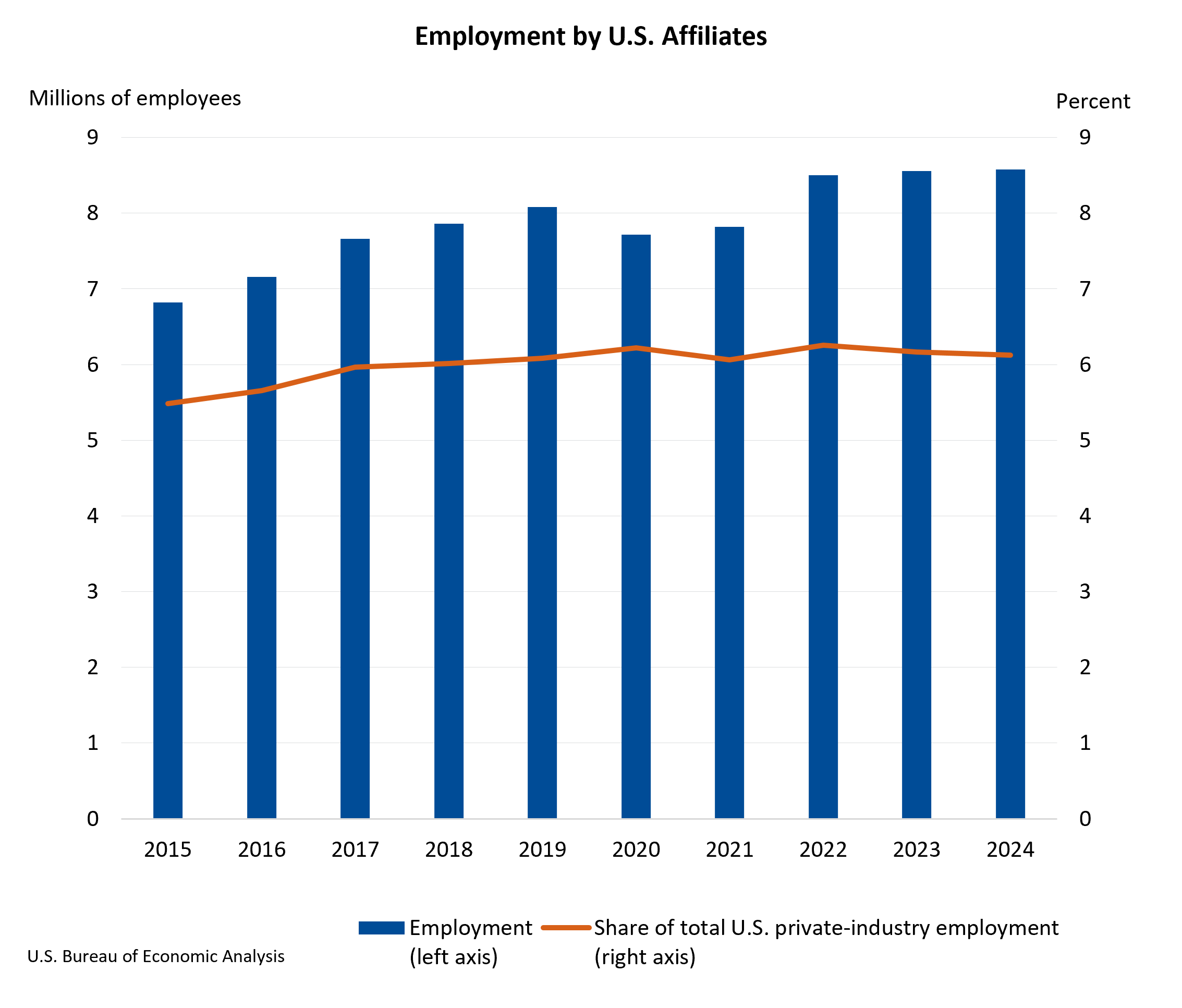
The current data reflects a continuation of this trend, albeit with nuanced shifts. The slight increase in employment, while positive, also indicates the ongoing competition for labor and the evolving nature of industries. The sustained high levels of investment in property, plant, and equipment, alongside robust R&D spending, suggest that foreign investors view the U.S. as a long-term strategic location for their operations and innovation efforts. This confidence is a positive signal for the U.S. economy, indicating continued inflows of capital and expertise.
However, the marginal decrease in the share of both employment and value added warrants attention. It suggests that the domestic U.S. business sector is also growing robustly, and in some areas, may be expanding at a pace that slightly outstrips the growth of foreign-affiliated operations. This could be attributed to various factors, including domestic policy initiatives supporting U.S. businesses, shifts in global investment patterns, or evolving competitive dynamics within specific industries.
Analysis of Sectoral Contributions
The dominance of manufacturing and retail trade in employment figures from U.S. affiliates is a consistent theme. Manufacturing, a sector that has undergone significant transformation in recent decades, continues to be a major employer, benefiting from foreign investment in advanced manufacturing techniques, automation, and globalized supply chains. Foreign ownership in this sector often brings specialized knowledge, access to international markets, and capital for modernization, which can help U.S. manufacturing facilities remain competitive on a global scale.
The retail trade sector’s reliance on foreign investment highlights the global nature of consumer markets. Foreign retailers often bring diverse product offerings, innovative retail formats, and sophisticated supply chain management, contributing to consumer choice and competitive pricing. The employment generated in this sector is crucial for local economies, supporting a wide range of jobs from store associates to logistics and management roles.
The leading roles of the United Kingdom, Japan, and Germany as sources of employment are deeply rooted in historical trade and investment relationships. These countries have long been key economic partners of the United States, with significant cross-border investment flows. Their continued presence and investment underscore the enduring strength of these bilateral economic ties and the strategic importance of the U.S. market for their global business strategies.
State-Level Economic Impact
The concentration of U.S. affiliate employment in states like California, Texas, and New York reflects their status as major economic engines of the United States. These states often possess large markets, robust infrastructure, skilled workforces, and favorable business environments that attract foreign direct investment. The fact that manufacturing is the largest employer in these states, even as they are known for their strength in technology and services, indicates the diverse economic base that foreign investment helps to support.
California’s strong showing, with nearly 900,000 employees, is a testament to its dynamic economy, encompassing both advanced manufacturing and a vast consumer market. Texas, with its significant energy sector and growing manufacturing base, also represents a critical hub for foreign investment. New York, a global financial and commercial center, also hosts a substantial number of employees through its foreign-affiliated companies, particularly in sectors aligned with its economic strengths.
Future Outlook and Data Availability
The BEA’s commitment to releasing timely and comprehensive data on U.S. affiliate operations is crucial for informed economic policy and business strategy. The upcoming release for 2025, scheduled for Spring 2027, will provide further insights into the evolving landscape of foreign investment in the U.S. economy. The continuous updates and revisions to historical data, as seen with the 2023 figures, ensure that economic analysis is based on the most accurate and up-to-date information available.
The BEA’s ongoing efforts to enhance data publication through methods like coarsening, which includes rounding and aggregation, aim to balance the need for detailed statistical information with the imperative of protecting the confidentiality of survey respondents. This approach allows for the release of more data points, thereby enriching the public’s understanding of complex economic phenomena.
In conclusion, the 2024 statistics on U.S. affiliates of foreign multinational enterprises paint a picture of sustained, albeit moderately growing, contribution to the U.S. economy. While employment figures saw a slight uptick, and value added experienced more significant growth, the overall share of these affiliates within the broader U.S. economic landscape remained largely consistent. The continued investment in capital and R&D, coupled with their substantial presence in key sectors and states, solidifies their role as integral players in the American economic narrative, driving job creation, innovation, and overall economic prosperity.