Lana Rhoades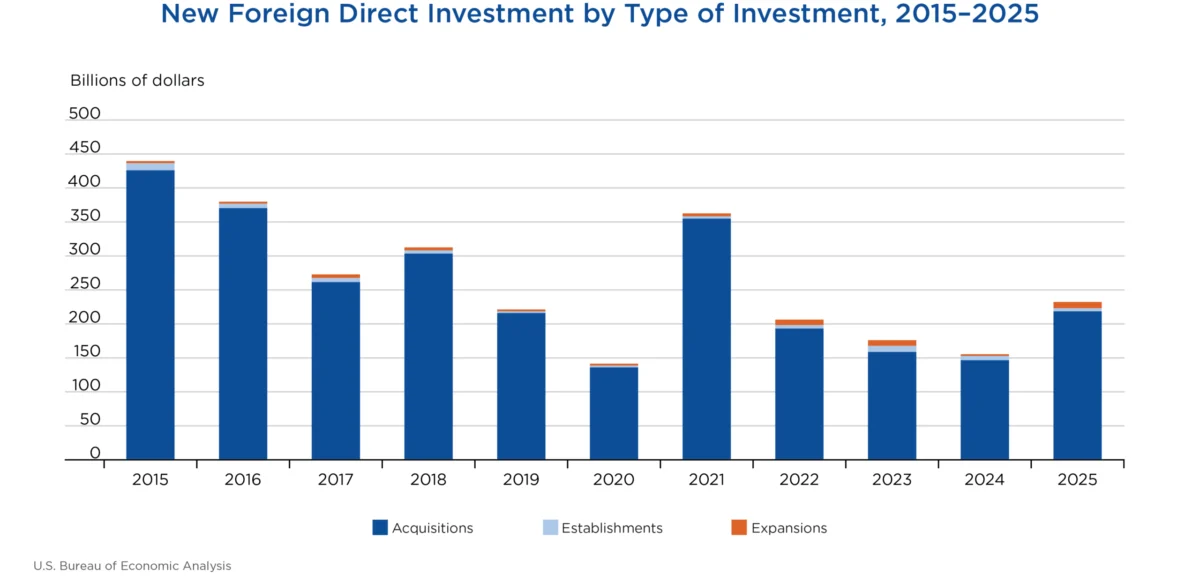
Expenditures by foreign direct investors to acquire, establish, or expand U.S. businesses surged to $232.2 billion in 2025, marking a significant 49.5 percent increase from the previous year, according to preliminary statistics released by the U.S. Bureau of Economic Analysis (BEA). This robust growth underscores the continued attractiveness of the American market for international capital, with acquisitions of existing U.S. businesses remaining the dominant form of investment.
The substantial uptick in foreign direct investment (FDI) in 2025, an increase of $76.8 billion from 2024 levels, signals a robust economic environment and a strong appetite among global firms to engage with U.S. industries. This surge occurred against a backdrop of evolving global economic conditions, including fluctuating interest rates, geopolitical developments, and shifting supply chain dynamics, highlighting the resilience and strategic importance of the United States as an investment destination.
A Deeper Dive into Investment Patterns
Breaking down the $232.2 billion in expenditures, acquisitions of established U.S. businesses accounted for the lion’s share, totaling $218.4 billion. This indicates a strong preference among foreign investors for leveraging existing market presence, established customer bases, and operational infrastructure. Expenditures to establish new U.S. businesses, often referred to as greenfield investments, reached $4.6 billion, while investments aimed at expanding existing foreign-owned businesses amounted to $9.2 billion.
Looking beyond the initial year, planned total expenditures, which encompass both first-year commitments and anticipated future investments, were projected at $284.5 billion. This forward-looking figure suggests a sustained commitment from foreign investors and an expectation of continued growth and development within their U.S. operations.
The impact of this FDI on the U.S. labor market was also considerable. In 2025, newly acquired, established, or expanded foreign-owned businesses provided employment for 213,100 individuals. This figure represents a direct contribution to job creation and economic vitality across various sectors and regions of the United States.
Industry and Geographic Distribution of Investment
The BEA data reveals significant concentration of investment across specific industries. Publishing industries attracted the largest share of new direct investment, with expenditures reaching $50.7 billion. This was closely followed by chemicals manufacturing at $45.4 billion, and plastics and rubber products manufacturing at $19.0 billion. Collectively, the manufacturing sector commanded a substantial 52.5 percent of total expenditures, amounting to $121.8 billion, underscoring its enduring importance to the U.S. economy and its appeal to foreign manufacturers seeking access to U.S. markets and technological expertise.
On a country-by-country basis, Japan emerged as the leading investor in 2025, contributing $50.5 billion. Germany followed with $26.7 billion in investments, and Canada with $23.5 billion. Regionally, Europe was the largest source of new investment, accounting for $116.6 billion, or 50.2 percent of all new FDI. The Asia and Pacific region was the second-largest contributor, with $71.9 billion in expenditures, demonstrating a broad geographical base for inbound investment.
California continued its long-standing position as a prime destination for foreign capital, receiving the highest amount of first-year investment expenditures at $59.7 billion. Texas followed with $21.5 billion, and Pennsylvania with $20.9 billion, indicating the continued economic dynamism and attractive business environments offered by these key states.
Focus on Greenfield Investments: Building the Future
Greenfield investments, which involve the establishment of new businesses or the expansion of existing ones, offer a distinct perspective on foreign investor confidence and long-term growth strategies. In 2025, greenfield expenditures totaled $13.8 billion. Within this category, transportation and warehousing emerged as the leading sector, attracting $3.6 billion in greenfield investment. This was followed by computers and electronics products manufacturing ($2.0 billion) and chemicals manufacturing ($1.8 billion).
Investors from the Asia and Pacific region were particularly active in greenfield investments, contributing the highest dollar value at $8.3 billion. Australia led this regional surge with $3.0 billion, followed by South Korea ($2.2 billion) and Japan ($1.7 billion). At the state level, Louisiana attracted the most significant greenfield investment, with $3.0 billion, signaling a strategic focus on developing new operational bases in the state. Arizona ($2.7 billion) and Texas ($1.9 billion) also saw substantial greenfield capital inflows.
The planned total expenditures for greenfield investments initiated in 2025 were robust, reaching $66.1 billion. This figure, which includes both initial outlays and projected future spending, suggests a strong commitment to building and expanding operations from the ground up, indicating confidence in the long-term growth prospects of these new or expanded ventures.
Employment Implications: A Growing Workforce
The influx of foreign direct investment in 2025 had a tangible impact on employment figures. Current employment at acquired enterprises stood at 211,700. When factoring in the planned employment for newly established businesses and expansions, the total projected employment associated with these new FDI initiatives reached 232,400.
Analyzing employment by industry reveals that plastics and rubber parts manufacturing accounted for the largest number of current employees at 21,800. Transportation equipment manufacturing followed with 17,300 employees, and primary and fabricated metals manufacturing with 16,400.
By country of origin, Mexico was the largest contributor to current employment, with 54,600 employees. Canada followed with 29,500 employees, and the United Kingdom with 26,800. California led all states in current employment resulting from new FDI, with 37,200 jobs, followed by Illinois with 17,600 and Texas with 16,500.
Revisions to 2024 Data Signal Continued Momentum
The BEA also released updated figures for 2024, indicating a revision to previously published statistics for new foreign direct investment in the United States. These revisions underscore the dynamic nature of FDI data and provide a more accurate picture of investment trends. First-year expenditures for 2024 were revised upward to $155.3 billion from a previously reported $151.0 billion. This revision was driven by upward adjustments in acquisitions of U.S. businesses ($146.4 billion revised from $143.0 billion) and expansions of U.S. businesses ($2.5 billion revised from $1.8 billion).
Planned total expenditures for 2024 were also revised to $164.0 billion from $157.0 billion. These adjustments suggest that the initial estimates may have understated the full scope of foreign investment activity in the preceding year, further emphasizing the strong and sustained interest in the U.S. market.
Analysis and Implications
The substantial increase in FDI in 2025 can be attributed to a confluence of factors. The U.S. economy, despite facing global headwinds, has demonstrated resilience, offering a relatively stable and predictable investment environment. Furthermore, strategic sectors such as manufacturing and technology continue to attract significant foreign capital, driven by innovation, market access, and skilled labor availability. The emphasis on acquisitions suggests that foreign investors are looking for established platforms to gain immediate market share and operational efficiencies.
The robust growth in greenfield investments, particularly in sectors like transportation and warehousing, indicates a long-term strategic outlook by foreign companies. These investments are crucial for expanding infrastructure, creating new jobs, and fostering technological advancements within the U.S. economy. The geographic distribution of investment highlights the continued importance of established economic hubs like California and Texas, while also pointing to emerging opportunities in states like Louisiana and Arizona, suggesting a broadening appeal of U.S. states for FDI.
The employment figures provide a clear indication of the direct economic benefits of FDI. The creation of over 200,000 jobs in acquired, established, or expanded foreign-owned businesses is a significant contribution to the U.S. labor market, impacting livelihoods and contributing to regional economic development.
Looking Ahead
The BEA’s release of these preliminary statistics provides valuable insights into the current landscape of foreign direct investment in the United States. As these figures are refined and more detailed data becomes available, a clearer picture of the long-term implications for U.S. economic growth, innovation, and employment will emerge. The sustained high levels of FDI suggest a positive outlook for the U.S. economy and its continued role as a global hub for international investment. The next release, scheduled for June 2027, will offer data for the 2026 fiscal year, providing further insight into these evolving trends. The BEA’s commitment to enhancing data disclosure through methods like coarsening, which includes rounding and aggregation, aims to balance the need for robust data publication with the imperative of protecting respondent confidentiality.