Julia Chirkova
U.S. business leaders, particularly those holding Certified Public Accountant (CPA) and Chartered Global Management Accountant (CGMA) designations, have reported a significant upswing in optimism regarding the nation’s economic trajectory and the internal prospects of their own companies during the first quarter of 2026. This positive sentiment is a key finding of the latest AICPA and CIMA Economic Outlook Survey, released on Thursday, which gauges the economic pulse of senior financial executives across American businesses. The survey reveals a notable rebound in confidence from the previous quarter, signaling a potentially more robust outlook for the coming year, although persistent concerns about operational costs and external economic conditions continue to shape strategic considerations.
Resurgence in Economic Confidence
The Q1 2026 survey indicates a substantial increase in optimism concerning the U.S. economy’s outlook over the next 12 months. Thirty-nine percent of business executives surveyed expressed a positive view, a marked improvement from the 28% who held similar sentiments in the fourth quarter of 2025. This nearly 11-percentage-point jump suggests a growing belief among financial leaders that the broader economic landscape is stabilizing or improving, potentially driven by a combination of moderating inflation, resilient consumer spending, and targeted policy initiatives that may have begun to yield positive results by early 2026.
This renewed optimism extends directly to the perceived health and future performance of their own organizations. The survey found that 47% of executives were confident in their companies’ prospects, a six-percentage-point increase from 41% in the preceding quarter. This dual improvement in both macro and microeconomic sentiment is a strong indicator of a more favorable business environment, where companies feel better positioned to navigate challenges and capitalize on opportunities.
Growth Aspirations on the Rise
Beyond confidence levels, the survey also highlights a tangible increase in plans for business expansion. A majority of executives, 55%, anticipate growth within their companies in the first quarter of 2026, up from 48% in the last quarter of 2025. This upward trend in expansion plans suggests that improved confidence is translating into proactive strategies for scaling operations, increasing market share, and potentially investing in new ventures or product lines. Such forward-looking investment is often a precursor to broader economic activity and job creation.

Persistent Concerns Amidst Easing Inflation
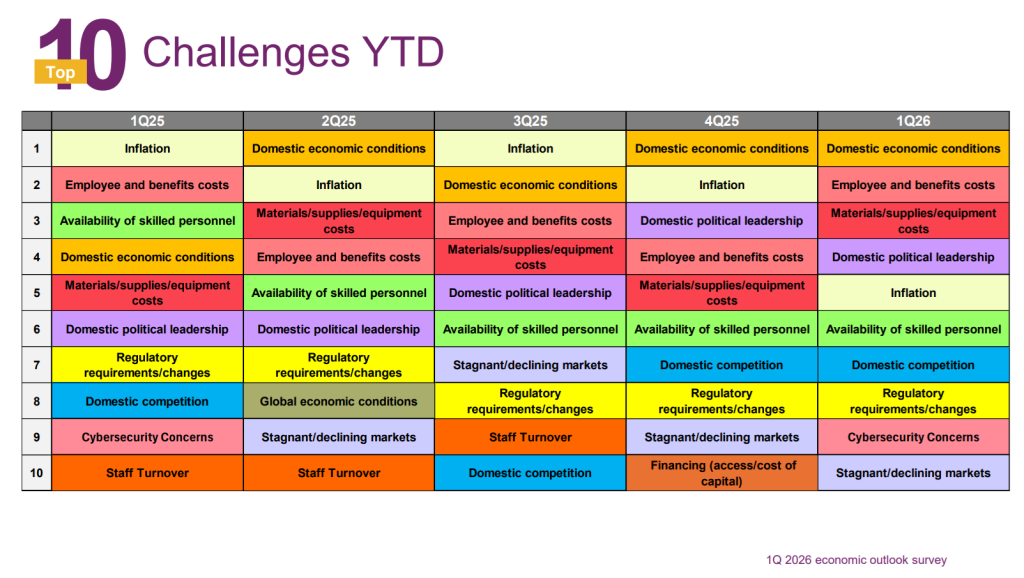
Despite the prevailing optimism, CPA business leaders continue to prioritize several key operational and economic concerns. Domestic economic conditions remain the paramount worry for executives, underscoring the sensitivity of business planning to the broader financial environment. This concern is closely followed by employee and benefits costs, which have climbed to the second position, and the escalating costs of materials, supplies, and equipment, now ranked third. These rising operational expenses present ongoing challenges for businesses seeking to maintain profitability and competitive pricing.
Interestingly, concerns surrounding inflation, which had been a dominant worry in previous quarters (ranking second in Q4 2025), have seen a notable retraction, sliding to the fifth position. This suggests that while inflation remains a factor, its immediate pressure may have lessened for many businesses by the start of 2026. However, it is crucial to note that the survey’s data collection period concluded before recent military activity in the Middle East. This geopolitical development could potentially reintroduce inflationary pressures, particularly concerning energy and supply chain disruptions, a dynamic that executives and analysts will be closely monitoring.
Survey Methodology and Context
The AICPA and CIMA Economic Outlook Survey is a quarterly report that polls a representative sample of U.S. business executives, including CEOs, CFOs, controllers, and other CPAs and CGMA designation holders in senior management accounting roles. The Q1 2026 survey incorporated 236 qualified responses, collected between February 3rd and February 24th, 2026. This survey serves as a valuable forward-looking indicator, offering insights into the expectations and strategies of financial leaders for the subsequent 12 months. Its findings are often contrasted with retrospective data, such as the U.S. Department of Labor’s monthly employment reports, to provide a comprehensive view of economic trends.
The AICPA and CIMA, formed by the alliance of the American Institute of CPAs and The Chartered Institute of Management Accountants, represent a global body of finance professionals. Their surveys are designed to provide real-time intelligence on the business environment, helping to inform strategic decision-making for companies and policymakers alike.
Expert Analysis and Outlook
Tom Hood, executive vice president of business engagement and growth at the Association of International Certified Professional Accountants, provided commentary on the survey’s findings. "Business leaders are feeling a renewed sense of optimism this quarter, both about the U.S. economy and the near-term prospects for their own organizations," Hood stated. He elaborated, "While economic conditions, workforce costs, and input prices remain key areas of focus, we’re encouraged to see inflation pressures easing earlier in the quarter."

Hood also acknowledged the evolving geopolitical landscape. "That said, we’re mindful that recent geopolitical developments could affect inflation trends, and we’re watching those dynamics closely," he cautioned. "Even with this uncertainty, the steady rise in company outlooks and expansion plans shows that executives are positioning their businesses for growth. With disciplined planning and continued investment in talent and innovation, we believe there is real opportunity ahead to build resilience and outperform in the coming year." His remarks highlight a balanced perspective, recognizing both the positive momentum and the potential headwinds that businesses may face.
Broader Economic Implications and Historical Context
The shift in sentiment observed in the Q1 2026 survey can be viewed against the backdrop of economic conditions experienced in the preceding years. Following periods of significant inflation, supply chain disruptions, and a fluctuating labor market, the current data suggests a potential stabilization or even a nascent recovery phase for the U.S. economy. The improved outlook for corporate expansion, in particular, could signal a return to more aggressive investment strategies, which are crucial for long-term economic growth and job creation.
Historically, surveys of this nature have served as leading indicators for key economic metrics. An increase in business confidence and expansion plans often precedes a rise in capital expenditures, hiring, and overall Gross Domestic Product (GDP) growth. However, the caveat regarding geopolitical events remains significant. The interconnectedness of the global economy means that unforeseen international conflicts or shifts in global trade can rapidly alter domestic economic conditions. Businesses that have learned to build resilience, as suggested by Hood, will be better equipped to adapt to such changes.
Key Concerns: A Deeper Dive
While inflation has receded as a top concern, the persistent worries about domestic economic conditions, employee and benefits costs, and the cost of materials, supplies, and equipment warrant further consideration.
- Domestic Economic Conditions: This broad concern likely encompasses a range of factors, including anticipated changes in consumer demand, regulatory environments, interest rate policies, and the overall stability of financial markets. Executives are keenly aware that their company’s performance is intrinsically linked to the health of the national economy.
- Employee and Benefits Costs: The rising cost of labor and benefits remains a significant challenge for businesses. This could be attributed to ongoing labor shortages in certain sectors, increased demand for skilled workers, and the rising cost of healthcare and other employee benefits. Companies may be exploring strategies such as automation, enhanced training programs, and competitive compensation packages to manage these costs.
- Costs of Materials, Supplies, and Equipment: Persistent supply chain vulnerabilities and global demand for commodities can keep input costs elevated. Businesses are likely adapting by diversifying their supply chains, negotiating longer-term contracts, or seeking more cost-effective alternative materials.
The slight shift in the ranking of these concerns, with employee costs and material costs moving up, suggests that while inflation may be less of an immediate shock, the underlying pressures on business operations are still substantial.
Future Outlook and Strategic Positioning
The AICPA and CIMA survey provides a snapshot of business sentiment at a specific point in time. The resilience demonstrated by CPA business leaders, characterized by their improved outlook and expansion plans, suggests a proactive approach to navigating the economic landscape. The emphasis on disciplined planning, talent investment, and innovation, as highlighted by Tom Hood, are critical components for businesses aiming to not only survive but thrive in an increasingly complex global economy.
As the year 2026 progresses, ongoing monitoring of inflation trends, geopolitical developments, and the effectiveness of economic policies will be crucial. The positive sentiment reported in this first-quarter survey offers a hopeful outlook, but businesses must remain agile and prepared to adapt to a dynamic economic environment. The insights gleaned from this survey will undoubtedly inform strategic decisions across various sectors, potentially shaping investment patterns and employment trends throughout the year. The ability of businesses to manage rising operational costs while capitalizing on renewed optimism will be a key determinant of their success in the coming quarters.