Lana Rhoades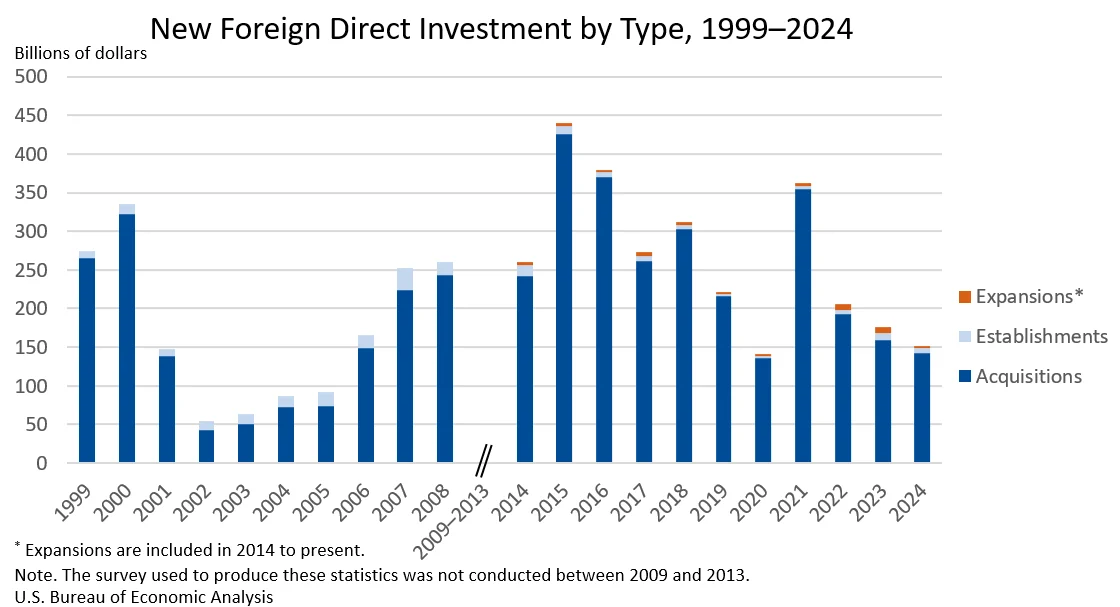
Expenditures by foreign direct investors to acquire, establish, or expand U.S. businesses totaled $151.0 billion in 2024, a notable decrease from the previous year, according to preliminary statistics released by the U.S. Bureau of Economic Analysis (BEA). This figure represents a $24.9 billion, or 14.2 percent, drop from the revised $176.0 billion recorded in 2023. The 2024 total also falls significantly below the annual average of $277.2 billion observed between 2014 and 2023, indicating a cooling trend in foreign investment activity within the United States.
The primary driver of this decline was a reduction in the acquisition of existing U.S. businesses, which historically constitutes the largest portion of foreign direct investment (FDI). In 2024, expenditures for acquisitions amounted to $143.0 billion, while investments to establish new U.S. businesses totaled $6.3 billion, and expansions of existing foreign-owned businesses accounted for $1.8 billion. Planned total expenditures, encompassing both initial outlays and projected future spending, were estimated at $157.0 billion for the year.
This dip in FDI signals a potentially shifting landscape for capital investment in the American economy. While the United States remains a highly attractive destination for global capital, the decrease suggests a combination of factors, potentially including global economic uncertainties, evolving geopolitical dynamics, and increased competition for investment capital from other regions. The BEA’s data provides a critical snapshot of the health and direction of international economic engagement with the U.S.
Key Sectors and Origins of Investment
Despite the overall decline, certain sectors and countries continued to be significant sources and recipients of foreign investment. The manufacturing sector attracted the largest share of new direct investment in 2024, with expenditures reaching $67.7 billion, representing 44.9 percent of the total. Within manufacturing, the chemical industry emerged as a particular focal point, drawing $23.7 billion in investment. Other sectors that saw substantial foreign investment include finance and insurance ($23.2 billion) and utilities ($16.0 billion).
Geographically, Europe was the leading source of new investment, contributing $96.7 billion, which constituted 64.0 percent of all new FDI. Asia and the Pacific region followed as the second-largest investing bloc, with expenditures totaling $23.2 billion. On a country-specific level, Ireland emerged as the largest investor, injecting $30.1 billion into the U.S. economy, followed by Canada with $23.9 billion.
Within the United States, Texas was the top destination for foreign investment in 2024, attracting $22.8 billion in expenditures. Georgia and California also saw significant inflows, with $16.3 billion and $12.9 billion respectively. These figures underscore the persistent appeal of diverse economic hubs across the nation for international businesses seeking to expand their operations or establish a presence.
Greenfield Investments: A Measure of New Growth
Greenfield investments, which involve establishing new businesses or expanding existing foreign-owned enterprises, totaled $8.1 billion in 2024. This category is often viewed as a strong indicator of new job creation and long-term economic development. The professional, scientific, and technical services sector led greenfield expenditures, accounting for $2.8 billion, with management, scientific, and technical consulting services being a key driver within this area ($1.6 billion).
Europe was also the largest contributor to greenfield investments, with $3.8 billion, followed by Latin America and the Other Western Hemisphere ($1.4 billion), and Asia and the Pacific ($1.2 billion). At the state level, Wyoming ($2.0 billion) and New Mexico ($1.4 billion) recorded the highest levels of greenfield investment. Planned total expenditures for greenfield investment initiated in 2024, including future outlays, were projected to reach $14.1 billion.
Employment Impact of Foreign Direct Investment
The influx of foreign direct investment has a tangible impact on the U.S. labor market. In 2024, newly acquired, established, or expanded foreign-owned businesses in the United States provided employment for 204,200 individuals. The manufacturing sector, which also led in investment expenditures, accounted for the largest number of current employees within foreign-owned enterprises, with 73,600 workers.
By country of origin, Ireland and Canada were the top employers, with 43,100 and 37,500 employees, respectively. On a state level, Florida recorded the highest number of current employees resulting from new FDI, with 32,700, followed by Texas (18,200) and New York (14,200). These figures highlight the critical role foreign investment plays in supporting and expanding the U.S. workforce across various industries and regions. Total planned employment, encompassing current and future anticipated roles, was estimated at 213,200.
Revisions to 2023 Data Highlight Volatility
The BEA’s release also included significant revisions to the 2023 foreign direct investment figures. Previously published first-year expenditures for 2023 stood at $148.8 billion, but the revised figure now stands at $176.0 billion. This substantial upward revision, particularly in the acquisition of U.S. businesses (from $136.5 billion to $158.7 billion), underscores the dynamic and sometimes unpredictable nature of FDI flows. Planned total expenditures for 2023 were also revised upward from $175.9 billion to $218.8 billion. These revisions suggest that initial estimates can be subject to considerable adjustments as more comprehensive data becomes available, emphasizing the importance of preliminary statistics while acknowledging their evolving nature.
Background and Context of Foreign Direct Investment
Foreign direct investment is a cornerstone of global economic integration, representing a long-term investment by an entity in one country into a business enterprise located in another country. It typically involves the acquisition of a substantial ownership stake, granting the investor significant influence over the management of the foreign enterprise. FDI can take various forms, including establishing new operations (greenfield investment), acquiring existing companies, or expanding current facilities.
The flow of FDI into the United States has historically been robust, driven by the size and dynamism of the U.S. market, its skilled workforce, technological innovation, and a stable regulatory environment. Global economic conditions, trade policies, and investor confidence all play a crucial role in shaping these investment patterns. The recent decline in 2024 could be attributed to a confluence of factors, including rising interest rates globally, geopolitical tensions, and ongoing supply chain adjustments.
Broader Implications and Future Outlook
The decrease in foreign direct investment in 2024, particularly in acquisitions, may have several implications for the U.S. economy. A slowdown in FDI could potentially lead to reduced capital infusion for businesses, slower job growth in sectors heavily reliant on foreign investment, and a potential impact on innovation and technology transfer. However, the continued strength in manufacturing and specific service sectors suggests that investment is becoming more targeted.
The BEA’s detailed breakdown by industry, country, and state offers valuable insights for policymakers and businesses. Understanding which sectors and regions are most attractive to foreign investors can inform economic development strategies and trade policies. The emphasis on greenfield investments also highlights the potential for future growth and job creation, even amidst a broader slowdown in acquisition-driven FDI.
Looking ahead, the trajectory of foreign direct investment in the U.S. will likely be influenced by the evolving global economic landscape, the effectiveness of U.S. economic policies in fostering a favorable investment climate, and the competitive landscape for international capital. The BEA’s commitment to providing detailed and timely data will be essential for monitoring these trends and understanding their impact on the American economy. The next release of data for new foreign direct investment in the United States, covering 2025, is anticipated in June 2026, offering further insights into the continuing evolution of global investment flows into the U.S. economy.
The BEA’s comprehensive data tables, available through its Interactive Data Application and Supplemental Data Tables, provide a granular view of these investment trends, allowing for deeper analysis of specific industries, countries, and states. These resources are crucial for researchers, policymakers, and business leaders seeking to understand the intricate dynamics of foreign direct investment in the United States.