Layla Zulfa
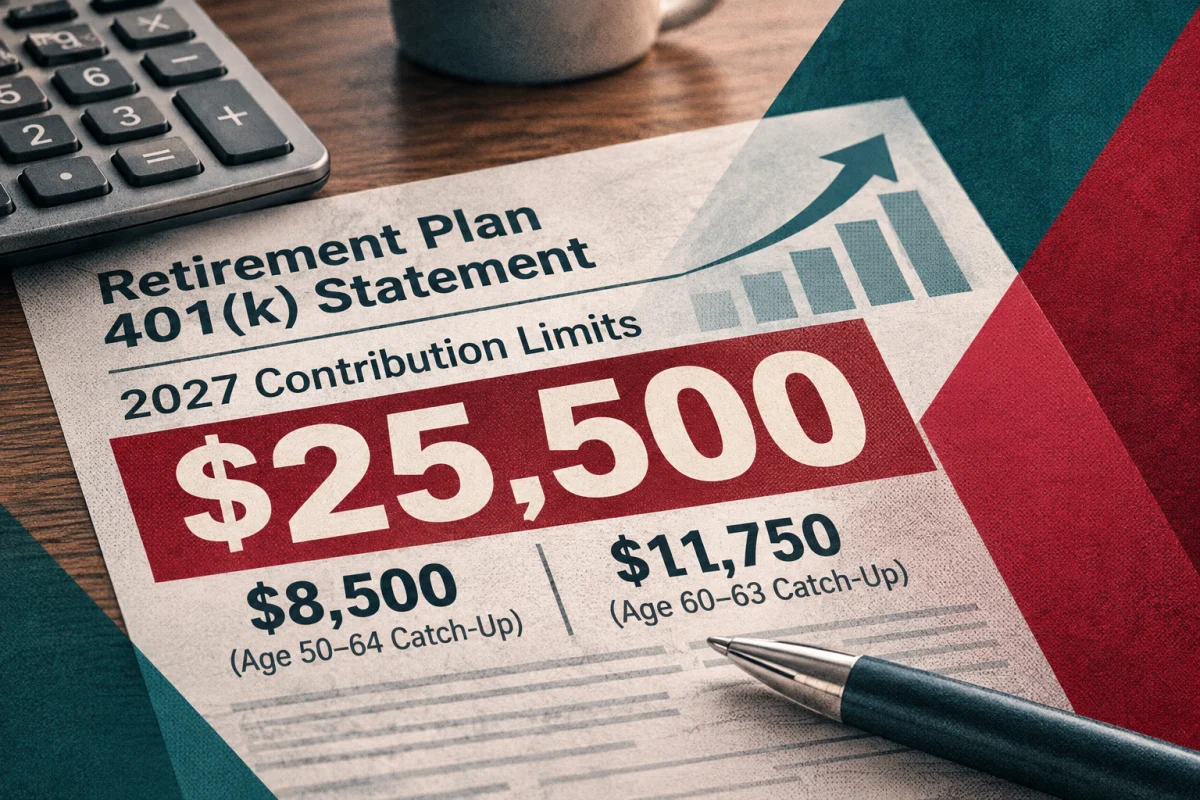
The Internal Revenue Service (IRS) has announced significant increases to the annual contribution limits for several key retirement savings plans, including 401(k)s, 403(b)s, governmental 457 plans, and the Thrift Savings Plan, for the 2027 tax year. These adjustments, detailed in IRS Notice 2026-66, reflect the agency’s commitment to helping American workers bolster their retirement nest eggs amidst evolving economic conditions. The 401(k) contribution limit will rise to $25,500, an increase of $1,000 from the $24,500 limit set for 2026. This marks a consistent upward trend in retirement contribution ceilings, a policy direction reinforced by recent legislative efforts aimed at enhancing retirement security.
Key Increases in Retirement Contribution Limits for 2027
The upward adjustment in the base contribution limit is accompanied by a notable increase in catch-up contributions, a crucial component for individuals nearing retirement age. For employees aged 50 and older, the catch-up contribution limit has been raised to $8,500, a $500 increment from the $8,000 limit in 2026. This brings the total potential annual contribution for this demographic to $34,000, a figure that underscores the importance of these plans for those seeking to maximize their retirement savings in their later working years.
Further enhancing retirement savings options, the SECURE 2.0 Act of 2022 has introduced more favorable catch-up contribution provisions for specific age groups. For 2027, employees between the ages of 60 and 63 will benefit from an elevated catch-up contribution limit of $11,750. This provision allows eligible participants in this age bracket to contribute a remarkable total of $37,250 annually, providing a significant boost for those who may have faced financial setbacks or delayed their retirement savings journey. The rationale behind these tiered catch-up contributions is to offer targeted support to individuals who may need additional time and opportunity to achieve their retirement financial goals.
Stable Limits for Individual Retirement Accounts (IRAs)
In contrast to the increases seen in employer-sponsored plans, the annual contribution limit for Individual Retirement Arrangements (IRAs) will remain unchanged at $7,500 for 2027. Similarly, the catch-up contribution limit for IRA participants aged 50 and older will also stay at $1,100. While these limits have not seen an increase, they remain substantial avenues for individuals to save for retirement, particularly for those who are self-employed or whose employers do not offer retirement plans. The consistent limits suggest a strategic focus on employer-sponsored plans for the most significant adjustments, potentially reflecting a broader policy objective to encourage workplace retirement participation.
Expanding Tax Deductions and Contribution Eligibility
Beyond direct contribution limits, the IRS has also adjusted several income thresholds that impact the deductibility of contributions and eligibility for various retirement savings vehicles. These adjustments are designed to ensure that a wider range of taxpayers can benefit from retirement savings incentives as incomes rise.
For traditional IRAs, the income phase-out range for single taxpayers who are covered by a workplace retirement plan has been widened. The range now extends from $83,000 to $93,000, an increase from $81,000 to $91,000 in 2026. This means that more single individuals with moderate incomes can continue to deduct their IRA contributions.
Married couples filing jointly will also experience an expanded phase-out range for traditional IRA contributions when the contributing spouse is covered by a workplace retirement plan. This range has increased to $133,000 to $153,000, up from $129,000 to $149,000 in 2026. This adjustment aims to support dual-income households in their retirement planning efforts.
For married individuals whose spouses are covered by a workplace retirement plan, but who themselves are not covered, the phase-out range for IRA contributions has also seen an upward adjustment. This range now falls between $250,000 and $260,000, an increase from the previous $242,000 to $252,000. This broader range acknowledges the financial realities of couples where one partner has access to employer-sponsored retirement benefits.
Roth IRA Income Thresholds Also Adjusted
The income thresholds for Roth IRA contributions have also been revised, offering greater access to this tax-advantaged savings vehicle for more individuals. For single taxpayers and heads of household, the income phase-out range for Roth IRA contributions has been expanded to $158,000 to $173,000, an increase from $153,000 to $168,000 in 2026. This adjustment is particularly significant for those who prefer the tax-free growth and withdrawal benefits of Roth IRAs.
Married couples filing jointly will see their Roth IRA income phase-out range increase to $250,000 to $260,000, up from $242,000 to $252,000. This aligns with the adjustments made for traditional IRAs and reflects an effort to maintain parity in retirement savings incentives across different filing statuses and account types.
SIMPLE IRA Contributions See Modest Increases
Savings Incentive Match Plan for Employees (SIMPLE) IRAs, designed for small businesses, also benefit from increased contribution limits. The annual contribution limit for SIMPLE IRAs has been raised to $17,500, a $500 increase from the 2026 limit of $17,000. Furthermore, certain eligible SIMPLE plans will see a higher limit of $19,100, an increase from $18,100 in 2026. These adjustments are crucial for small business owners and their employees, offering a more robust retirement savings option.
Catch-up contribution limits for most SIMPLE plans remain steady at $4,000 for employees aged 50 and older. However, specific provisions within SIMPLE plans do offer higher catch-up limits: $3,850 for certain applicable SIMPLE plans and $5,250 for employees aged 60 through 63, reflecting the tiered approach to catch-up contributions introduced by the SECURE 2.0 Act.
Saver’s Credit Income Limits Also Raised
The Saver’s Credit, a valuable tax incentive for low- and moderate-income workers who contribute to retirement accounts, also sees an increase in its income eligibility limits for 2027. This credit can significantly reduce a taxpayer’s liability, making retirement saving more accessible. For married couples filing jointly, the income limit is now $83,000. Heads of household can benefit up to an income of $62,250, and single taxpayers and married individuals filing separately can qualify with incomes up to $41,500. These adjustments aim to ensure that more individuals in these income brackets can take advantage of this important incentive.
Background and Context of Retirement Plan Adjustments
The annual adjustments to retirement plan contribution limits are mandated by the Internal Revenue Code and are tied to inflation. The IRS utilizes a cost-of-living adjustment (COLA) to ensure that the purchasing power of these savings limits is maintained over time. This process is crucial for preserving the real value of retirement savings and encouraging consistent contributions.
The 2027 adjustments are particularly noteworthy in the context of recent legislative efforts to bolster retirement security. The SECURE Act of 2019 and its successor, the SECURE 2.0 Act of 2022, have introduced a series of reforms designed to expand access to retirement savings plans, encourage greater participation, and enhance the generosity of retirement savings incentives. These acts have been instrumental in shaping the current landscape of retirement planning in the United States, with the IRS’s annual adjustments serving as a key mechanism for implementing these policy changes.
The increases announced for 2027 are a direct consequence of these ongoing efforts to modernize and strengthen retirement savings. By raising contribution limits and expanding eligibility thresholds, the IRS and Congress aim to empower more Americans to achieve financial security in their retirement years. This proactive approach acknowledges the increasing life expectancies and the growing need for robust retirement planning to support a longer post-working life.
Official Statements and Analysis
IRS CEO Frank J. Bisignano, in a statement accompanying the announcement, highlighted the positive impact of these adjustments. "Along with the Working Families Tax Cuts, this increase in the pension limitations will help American families keep more of their hard-earned income," Bisignano stated. This sentiment underscores the dual objective of retirement policy: encouraging savings while simultaneously easing the financial burden on working families. The inclusion of the "Working Families Tax Cuts" in his statement suggests a broader policy framework where retirement savings incentives are integrated with other tax relief measures.
The implications of these increases are multifaceted. For employees, it means an opportunity to save more money on a tax-advantaged basis, potentially accelerating their journey toward retirement readiness. For employers, particularly small businesses, the adjustments to SIMPLE IRA limits offer an enhanced ability to attract and retain talent by providing more competitive retirement benefits.
From an economic perspective, increased retirement savings can have a positive impact on aggregate savings rates and long-term economic stability. As individuals accumulate larger retirement funds, they are better positioned to maintain their standard of living in retirement, reducing reliance on public assistance programs. Furthermore, the investment of these savings into financial markets can fuel economic growth and capital formation.
The adjustments to income thresholds for IRA deductions and Roth IRA contributions are also significant. They demonstrate an effort to ensure that retirement savings incentives remain accessible to a broad spectrum of the population, not just high-income earners. By expanding these phase-out ranges, the IRS is signaling its commitment to inclusivity in retirement planning.
The differing catch-up contribution limits, particularly those introduced by the SECURE 2.0 Act for individuals aged 60-63, highlight a targeted strategy to address specific demographic needs. This approach recognizes that individuals’ retirement savings journeys are not uniform and that tailored support can be more effective in helping them achieve their goals.
Planning for the Future
The IRS’s announcement serves as a critical reminder for individuals and employers to review their retirement savings strategies. With higher contribution limits and adjusted income thresholds, it is an opportune time to reassess personal savings goals and explore the full potential of available retirement plans. Financial advisors often recommend maximizing contributions to these plans, especially as individuals approach their peak earning years, to take full advantage of tax benefits and compounding growth.
The consistency in IRA contribution limits, while perhaps surprising to some, emphasizes the ongoing importance of these individual accounts as a complementary savings vehicle. For those who are self-directed or who have more flexibility in their investment choices, IRAs continue to offer a powerful means of building long-term wealth.
The IRS’s stated intent – to account for cost-of-living changes and help taxpayers and employers plan for the coming year – underscores the proactive and forward-looking nature of these annual adjustments. By providing advance notice of these changes, the agency empowers stakeholders to make informed financial decisions and to adapt their retirement strategies accordingly. This transparency and predictability are vital for effective long-term financial planning in an ever-changing economic landscape.
Ultimately, the increased contribution limits for 2027 represent a positive development for retirement savers across the United States. They reflect a sustained commitment to fostering financial security in retirement and a recognition of the evolving needs of the American workforce. As individuals and businesses navigate the complexities of financial planning, these adjustments provide valuable tools and incentives to build a more secure future.