Lana Rhoades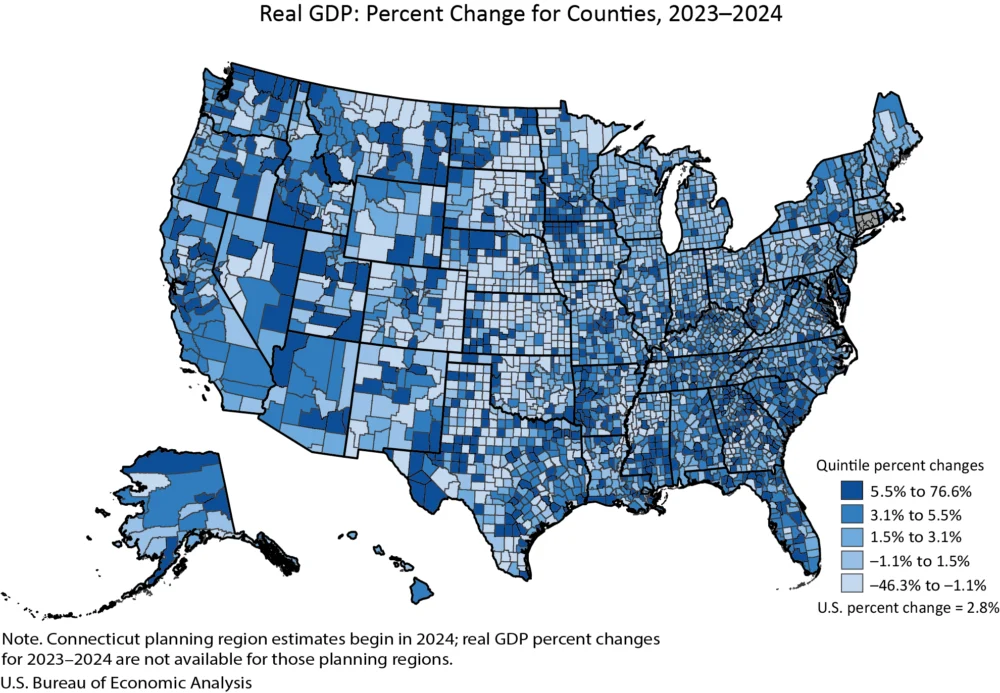
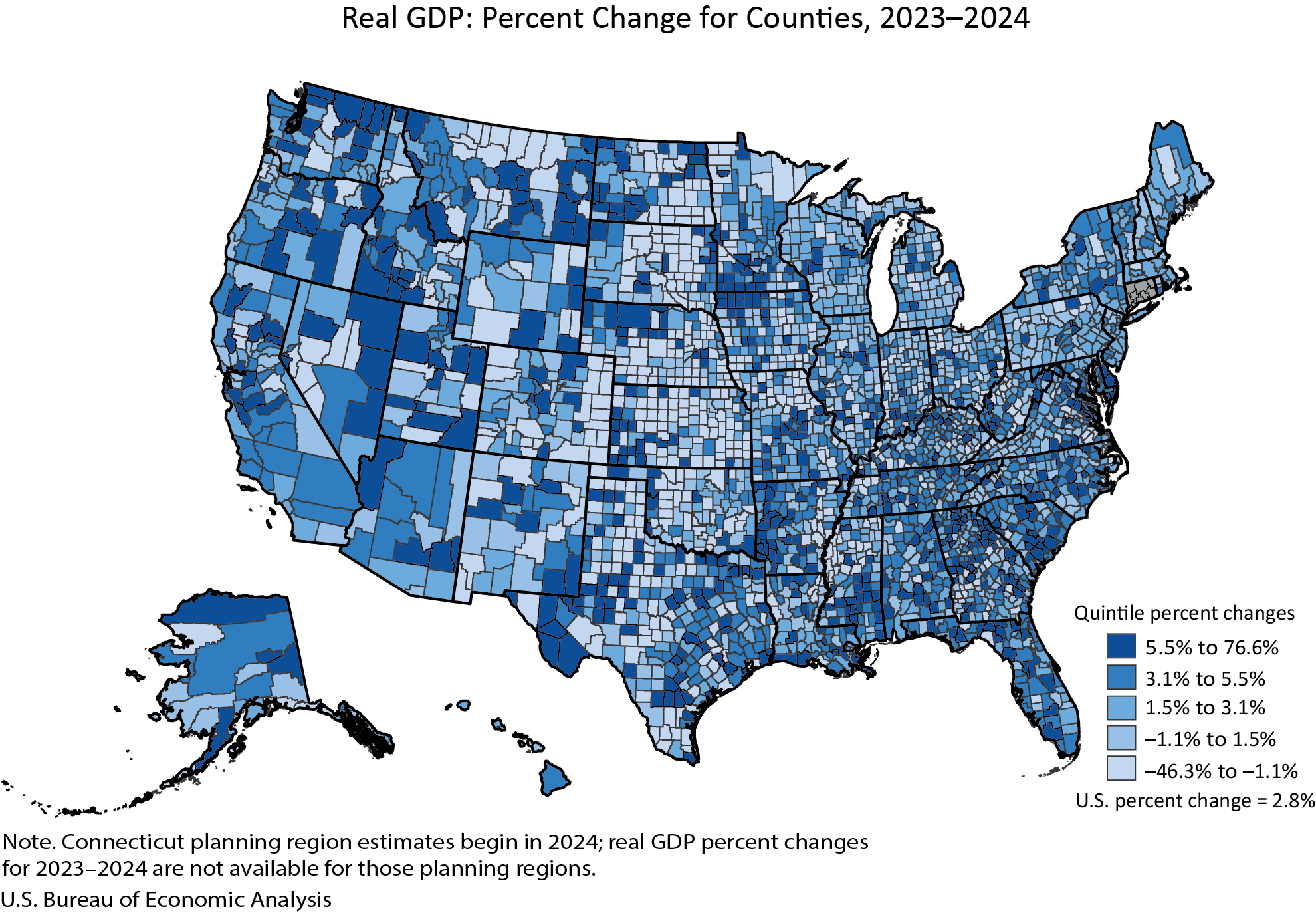
The economic landscape of the United States in 2024 presented a complex tapestry of growth and contraction across its counties, as detailed in the latest estimates released by the U.S. Bureau of Economic Analysis (BEA). Real gross domestic product (GDP) experienced an increase in a substantial 2,273 counties, signifying a broad-based expansion. However, this positive trend was counterbalanced by a decline in 809 counties, highlighting localized economic challenges, while 24 counties remained largely unchanged. These figures underscore the intricate and often uneven nature of economic development at the sub-national level.
The range of economic performance at the county level was dramatic. Carter County, Montana, emerged as a standout performer, registering an impressive 76.6 percent increase in its real GDP. This remarkable surge points to significant economic activity or a substantial shift in the county’s economic base. Conversely, Baca County, Colorado, faced considerable economic headwinds, experiencing a 46.3 percent decline in its real GDP. Such a sharp contraction suggests significant industry downturns, population outflows, or other severe economic disruptions. The disparity between these two counties encapsulates the vast economic variability present within the nation.
Understanding County-Level Economic Indicators
The BEA’s release provides crucial insights into the economic health of American communities, focusing on two key metrics: real Gross Domestic Product (GDP) and personal income. Real GDP measures the total value of goods and services produced within a county, adjusted for inflation, offering a comprehensive view of its economic output. Personal income, on the other hand, encompasses all income received by individuals residing in a county from all sources, including wages, salaries, proprietors’ income, and transfer payments. Together, these indicators paint a detailed picture of both production and individual financial well-being at the granular, county level.
The scale of economic activity also varies immensely. In 2024, New York County, New York (Manhattan), stood as the nation’s economic powerhouse, boasting a staggering real GDP of $813.7 billion. This figure reflects its status as a global financial hub and a center for commerce and innovation. In stark contrast, Issaquena County, Mississippi, reported a real GDP of just $15.7 million, illustrating the vast economic disparities that exist across the United States. These figures are not merely statistics; they represent the vastly different economic opportunities, infrastructure, and resource bases available to residents of different counties.
Divergent Trends in Real GDP Across County Sizes
The BEA’s analysis further breaks down economic performance by county size, categorized by population. This stratification reveals distinct patterns and trends:
-
Large Counties (Population > 500,000): These economic hubs saw 145 counties experience real GDP growth, while none recorded a decline, and one remained unchanged. The trend range for these counties was from a robust 10.7 percent increase in Pinal County, Arizona, to a stable 0.0 percent change in Johnson County, Kansas. This suggests that larger, more diversified economies are generally more resilient to economic shocks and capable of sustained growth. Pinal County’s significant growth may be attributed to its proximity to metropolitan areas, population influx, and burgeoning industries.
-
Medium Counties (Population 100,000 to 500,000): This group displayed a healthy economic expansion, with 451 counties reporting an increase in real GDP. A modest 20 counties saw declines, and 3 remained static. The growth in this segment ranged from a notable 12.4 percent in Jefferson County, Texas, to a slight decline of 2.6 percent in Black Hawk County, Iowa. This category often represents a balance between established economic bases and areas experiencing significant development, making them sensitive to both national economic trends and local growth drivers.
-
Small Counties (Population < 100,000): While the majority of counties fall into this category, their economic performance was the most varied. A total of 1,677 small counties experienced real GDP growth. However, this segment also accounted for the vast majority of counties with declining GDP, with 789 reporting a decrease. This volatility is often characteristic of smaller economies that may be heavily reliant on a few key industries or natural resources, making them more susceptible to market fluctuations. The extreme ends of the performance spectrum, including the aforementioned Carter County, MT, and Baca County, CO, were found within this category, highlighting the significant potential for both dramatic gains and steep losses in these less populated areas.
Personal Income Trends Reflect Economic Realities
Beyond the aggregate measure of GDP, personal income offers a crucial lens into the financial well-being of residents. In 2024, personal income demonstrated a more widespread pattern of growth compared to GDP. A substantial 2,768 counties saw an increase in personal income, while only 331 experienced a decrease, and a mere 7 remained unchanged. This suggests that even in counties where overall economic output may have stagnated or declined, many individuals may still have seen their incomes rise, potentially due to factors such as increased wages in specific sectors, government transfer payments, or shifts in employment composition.
The range of personal income change was also significant. Harding County, South Dakota, reported a remarkable 22.6 percent increase in personal income, indicating a period of significant economic uplift for its residents. Conversely, Issaquena County, Mississippi, a county that also saw a substantial decline in GDP, experienced a 23.3 percent decrease in personal income, underscoring the direct correlation between overall economic health and individual financial standing in some regions.
Similar to GDP, personal income levels show a vast disparity across the nation. Los Angeles County, California, reported the highest total personal income at $818.5 billion, reflecting its immense population and diverse, robust economy. At the other end of the spectrum, Loving County, Texas, recorded a personal income of $10.6 million, highlighting the challenges faced by very small, often resource-dependent communities.
Personal Income Performance by County Size
The analysis of personal income by county population size reveals:
-
Large Counties: These counties saw a strong showing, with 146 experiencing income growth. The reported trend range for these counties was from a high of 9.7 percent in San Joaquin County, California, to a still positive 2.7 percent in Philadelphia County, Pennsylvania. This suggests that large urban centers generally offer stable and growing income opportunities for their residents.
-
Medium Counties: This segment also exhibited robust income growth, with 474 counties showing increases. The trend range here was from 10.9 percent in Merced County, California, to 1.6 percent in Genesee County, Michigan. These counties often benefit from spillover effects from larger metropolitan areas or possess their own significant economic drivers.
-
Small Counties: While the majority of counties are small, their personal income trends were more varied, with 2,148 counties experiencing growth. However, this category also accounted for the 331 counties that saw personal income decline and the 7 with no appreciable change. The extreme ranges for personal income were also found here, with Harding County, South Dakota, at the top end of growth and Issaquena County, Mississippi, at the low end of decline. This reinforces the notion that smaller economies can be highly sensitive to local economic conditions.
Methodological Updates and Data Revisions
The BEA’s release of the 2024 county statistics is particularly significant due to the incorporation of extensive data revisions. The estimates for GDP and personal income from 2020 to 2023 have been revised to reflect more complete and accurate source data. This process aligns the county-level figures with the annual updates to the National Income and Product Accounts (NIPA) and state-level statistics, ensuring greater consistency and reliability across BEA’s economic datasets. These revisions are crucial for understanding long-term economic trends and for making informed policy decisions.
A notable methodological change involves Connecticut, which will now utilize its planning region geographic definitions instead of county boundaries for its GDP and personal income estimates, beginning with the 2024 data. While these planning region estimates are available for 2024, they were not included in the percent change ranges for counties in this release due to the lack of historical comparative data for these new regions. This shift highlights the evolving nature of statistical measurement and the BEA’s commitment to refining its reporting methods.
Furthermore, the BEA has introduced new estimates for per capita personal income for 2024, calculated using U.S. Census Bureau population figures for the period 2020 through 2024. Per capita personal income provides a vital measure of the average income per person, offering another dimension to understanding economic well-being and living standards within a county.
New Combined News Release Format
A significant change in the presentation of this data is the introduction of a single, combined news release for annual GDP and personal income by county. Previously, these statistics were published in two separate releases on different dates. This consolidation aims to provide a more holistic and comprehensive view of county economies, enhancing efficiency and offering users a more integrated understanding of economic activity at the local level.
Discontinuation of Metropolitan Area Statistics
In conjunction with the enhanced focus on county-level data, the BEA has discontinued the publication of statistics for various metropolitan and micropolitan statistical areas, as well as metropolitan divisions, combined statistical areas, and metropolitan and nonmetropolitan portions. The BEA will continue to provide GDP and personal income estimates exclusively by county. This strategic shift underscores the BEA’s commitment to granular data analysis and may be influenced by the increasing availability and utility of county-level data for economic research and policy formulation. A dedicated FAQ section on the BEA website offers further details regarding this discontinuation.
Enhanced Data Accessibility Through Interactive Tools
Reflecting a broader trend in data dissemination, tables previously embedded directly within news releases are now exclusively available through BEA’s online Interactive Data Application. This move streamlines the dissemination process, reduces redundancy, and directs users to a more dynamic and flexible platform. The Interactive Data Application allows for customization of data tables, access to full time series, and download options in various formats, including PDF, Excel, and CSV. This approach ensures that users have access to the most up-to-date and comprehensive data sets available.
Implications for Economic Development and Policy
The detailed county-level data released by the BEA has profound implications for economic development strategies and policy decisions at federal, state, and local levels. Understanding where economic growth is occurring, and where it is lagging, allows policymakers to target investments and interventions more effectively. For example, counties experiencing significant GDP declines might require focused support for diversification, workforce retraining, or infrastructure improvements. Conversely, rapidly growing counties could benefit from strategic planning to manage expansion and ensure sustainable development.
The divergence in personal income growth also presents critical insights. While overall GDP might be growing, if personal incomes are not keeping pace, it can indicate issues with wage stagnation, income inequality, or the composition of employment. Policymakers must consider these nuances when designing programs aimed at improving economic well-being for all residents.
The BEA’s commitment to revising historical data and introducing new analytical tools, such as per capita personal income, further empowers researchers and stakeholders with the information needed to navigate the complex economic terrain of the United States. The move towards a single, comprehensive county-level release, coupled with enhanced online data accessibility, marks a significant step forward in making critical economic data more usable and impactful.
Looking Ahead
The BEA’s release schedule indicates that the 2024 county-level data will be superseded by the 2025 estimates on December 2, 2026. This regular update cycle ensures that economic analysis remains current and relevant. For those seeking historical context or detailed breakdowns, the BEA’s Data Archive remains a valuable resource for accessing past data releases. The ongoing evolution of data presentation and methodology by the BEA underscores its critical role in providing the foundational economic intelligence necessary for understanding and shaping the American economy. The insights derived from this latest release will undoubtedly inform economic discourse and decision-making for the foreseeable future, shaping the trajectory of communities across the nation.