Lana Rhoades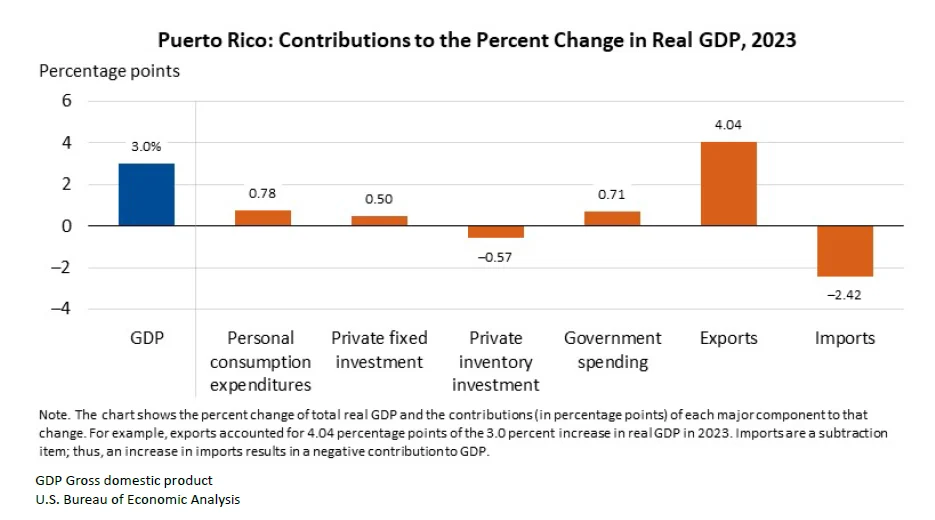
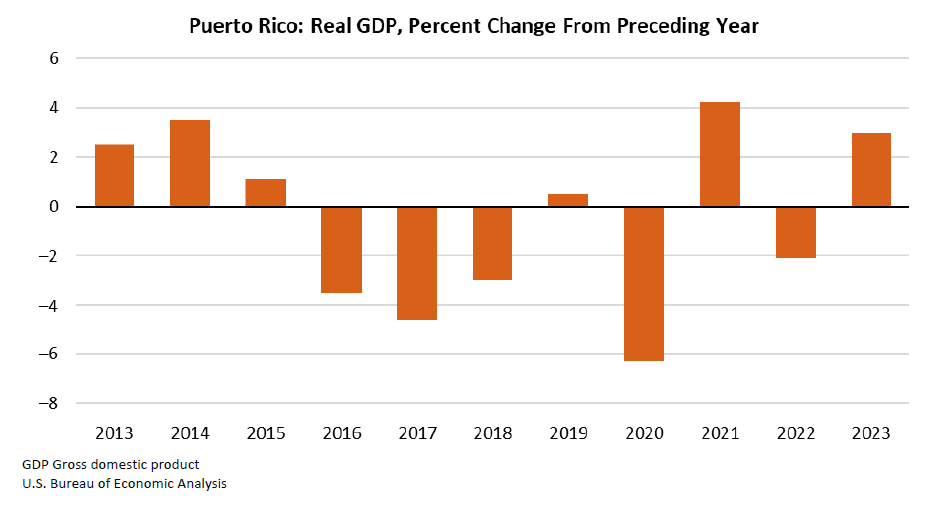
Puerto Rico’s economy experienced a significant rebound in 2023, with its real gross domestic product (GDP) growing by 3.0 percent. This marks a substantial improvement from the 2.1 percent contraction recorded in 2022, according to the latest statistics released by the U.S. Bureau of Economic Analysis (BEA). The positive economic momentum in 2023 was primarily propelled by a robust increase in exports, alongside growth in personal consumption expenditures, government spending, and private fixed investment.
Economic Recovery Driven by Export Growth and Investment
The resurgence in Puerto Rico’s GDP is largely attributable to a notable upswing in its export sector. Real exports climbed by 6.4 percent in 2023, encompassing both goods and services. Exports of goods saw an increase of 6.6 percent, while exports of services grew by 5.6 percent. This expansion in international trade signals a strengthening demand for Puerto Rican products and services in global markets.
Beyond exports, domestic economic activity also contributed positively. Personal consumption expenditures (PCE), a key indicator of consumer spending, rose by 1.2 percent. While spending on durable and non-durable goods within PCE saw a slight decrease of 0.8 percent, this was more than offset by a substantial 4.0 percent increase in spending on services. This suggests a shift in consumer patterns, with a greater allocation of resources towards services.
Government spending also played a crucial role in bolstering the economy, with real government spending increasing by 4.8 percent. This growth was observed across all levels of government—federal, central, and municipal. A significant driver of this increase was government investment spending, which saw widespread gains. These investments are largely fueled by disbursements of federal funds allocated for disaster recovery efforts. The ongoing reconstruction and improvement projects, stemming from the impacts of Hurricanes Irma and Maria in 2017, earthquakes in 2019 and 2020, and Hurricane Fiona in 2022, continue to stimulate economic activity. Notable projects include substantial investments in modernizing the island’s power grid, upgrading the aqueduct system, repairing and improving roads and bridges, and enhancing infrastructure at Camp Santiago, the National Guard’s training facility.
Private fixed investment also demonstrated healthy growth, with a 3.8 percent increase in real terms. This rise was predominantly driven by increased investment in equipment, particularly within the industrial sector, which includes business purchases of engines, turbines, and electrical equipment. This uptick in private investment suggests growing confidence among businesses in the island’s economic prospects and a commitment to expanding productive capacity.
Counterbalancing Factors and Trade Dynamics
While the overall economic picture is positive, certain components had a moderating effect on GDP growth. Real private inventory investment experienced a decrease, with the manufacturing sector being the largest contributor to this decline. This could indicate a strategic effort by manufacturers to optimize inventory levels or a response to changing market demands.
On the trade front, real imports also saw an increase of 4.4 percent, primarily driven by a rise in imports of goods. Specifically, the pharmaceutical and organic chemical sectors led this increase, with imports in these categories growing by 6.0 percent. While increased imports can be a sign of robust domestic demand and economic activity, they are subtracted in the calculation of GDP, thus acting as a counterweight to export growth.
Contextualizing Puerto Rico’s Economic Performance
The 2023 GDP figures represent a welcome turnaround for Puerto Rico, which has faced numerous economic challenges in recent years. The island has been grappling with a prolonged debt crisis, population out-migration, and the devastating impacts of natural disasters. The economic contraction in 2022, following a period of growth in the years prior, highlighted the vulnerability of the island’s economy to external shocks and structural issues.
The BEA’s data on Puerto Rico’s GDP is produced with significant support and assistance from the government of Puerto Rico, acknowledging that the island is not typically included in the major surveys used for U.S. GDP estimation. This collaborative effort underscores the unique nature of Puerto Rico’s economic landscape and the importance of tailored statistical methodologies.
Revisions and Data Integrity
The BEA also announced revisions to real GDP estimates for Puerto Rico covering the period 2018-2022. These revisions were incorporated to reflect updated source data. The largest revision in any single year was a modest 0.4 percentage point in 2022, indicating a generally consistent trend in the economic data. The revised estimates for 2018-2022 continue to show a pattern of inflation-adjusted GDP growth that aligns with the previously published figures, reinforcing the reliability of the historical economic trends.
The BEA has provided a detailed breakdown of these revisions, including a table that illustrates the changes in real GDP in millions of chained (2012) dollars and the percentage change from the preceding period. For instance, the percentage change in real GDP for 2022 was revised from -2.1 percent to reflect a slightly larger decrease, but the overall narrative of a downturn in that year remains consistent. This meticulous approach to data revision ensures the highest level of accuracy in economic reporting.
A Look at Specific Economic Sectors
Exports: The strong performance in exports is a significant positive indicator. The increase in both goods and services exports suggests diversification and growing competitiveness in international markets. This sector’s growth is vital for generating foreign exchange and supporting job creation within Puerto Rico.
Personal Consumption Expenditures (PCE): The 1.2 percent rise in PCE indicates that households are increasing their spending, a fundamental driver of economic activity. The shift towards services spending, with a 4.0 percent increase, may reflect a post-pandemic normalization of consumer behavior, with greater demand for leisure, entertainment, and personal care services. The slight dip in goods consumption could be attributed to a variety of factors, including rising inflation on certain goods or a prioritization of services.
Government Spending: The robust 4.8 percent increase in government spending, particularly in investment, highlights the critical role of federal aid in driving economic activity and reconstruction. The ongoing federal support for disaster recovery is not only rebuilding essential infrastructure but also creating employment opportunities and stimulating local businesses. The mention of specific projects like the power grid and aqueduct system underscores the long-term investment in the island’s foundational infrastructure, which is crucial for sustained economic growth and resilience.
Private Fixed Investment: The 3.8 percent growth in private fixed investment, especially in industrial equipment, signals a positive outlook from the business community. Increased investment in machinery and equipment often precedes an expansion of production capacity and an increase in employment. This suggests that businesses are anticipating future demand and are willing to commit capital to enhance their operations.
Inventory Investment: The decrease in private inventory investment, particularly in manufacturing, warrants attention. While a reduction in inventories can sometimes indicate a slowdown in anticipated sales, it can also reflect improved inventory management strategies and a move towards just-in-time production models, reducing carrying costs. However, if sustained, a significant decline could signal concerns about future demand within the manufacturing sector.
Imports: The 4.4 percent increase in imports, especially in pharmaceuticals and organic chemicals, points to strong demand for these specific goods within Puerto Rico. This could be driven by the needs of the healthcare sector or by manufacturing processes that rely on these imported inputs. While necessary for certain economic activities, a consistently high import bill can place pressure on the trade balance.
Broader Implications and Future Outlook
The positive GDP growth in 2023 offers a much-needed boost to Puerto Rico’s economic narrative. It suggests that the island is moving in the right direction, leveraging its strengths in exports and benefiting from strategic investments in infrastructure and recovery efforts. The continued inflow of federal funds for disaster resilience and reconstruction will likely remain a significant economic stimulus in the coming years.
However, the long-term economic health of Puerto Rico will depend on its ability to foster sustainable growth beyond reliance on external aid and to address persistent structural challenges, such as improving the business climate, retaining skilled labor, and diversifying its economic base. The reported data provides a snapshot of economic activity, and continued monitoring of key indicators will be essential to gauge the trajectory of the island’s recovery and development.
The BEA’s commitment to producing these estimates, despite the unique challenges, is invaluable for policymakers, businesses, and researchers seeking to understand and shape Puerto Rico’s economic future. The detailed data tables provided by the BEA offer a granular view of the economic components, enabling in-depth analysis of trends and contributing to informed decision-making.
A Note on Data Availability
It is important to note that, as per the release, the BEA will no longer produce Puerto Rico GDP statistics after the 2023 estimates. This marks the end of an era for this specific economic reporting. However, previously published data will remain accessible in the BEA’s Data Archive, ensuring that historical economic trends can still be studied. This discontinuation underscores the evolving landscape of economic data collection and reporting by federal agencies.
The technical notes accompanying the release emphasize the collaborative nature of these statistics, with significant contributions from various organizations and individuals in Puerto Rico. This highlights the importance of partnerships in generating accurate and relevant economic data, particularly for regions with unique statistical needs.
In conclusion, Puerto Rico’s economic performance in 2023, characterized by a robust 3.0 percent GDP growth, signals a period of recovery and resilience. Driven by a strong export sector and significant government and private investment, the island is demonstrating its capacity to overcome past adversities and forge a path toward sustained economic development. The detailed insights provided by the BEA are crucial for understanding these dynamics and charting a course for future prosperity.