Lana Rhoades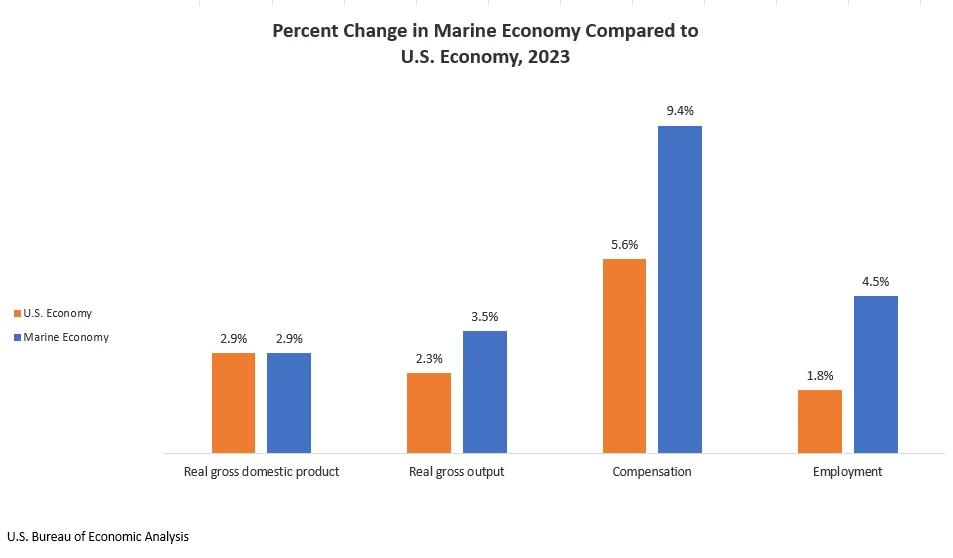
The United States marine economy demonstrated significant economic vitality in 2023, contributing an impressive $511.0 billion, or 1.8 percent, to the nation’s current-dollar Gross Domestic Product (GDP). This marks a notable increase from the $482.4 billion generated in 2022, according to the latest statistics released by the U.S. Bureau of Economic Analysis (BEA). The marine sector’s economic footprint extended further, accounting for $826.6 billion, or 1.7 percent, of the nation’s total current-dollar gross output.
This robust performance underscores the growing importance of the marine economy, a complex and multifaceted sector encompassing a wide array of industries and activities directly or indirectly reliant on the nation’s vast ocean, coastal, and Great Lakes resources. The BEA’s Marine Economy Satellite Account (MESA) provides a critical framework for understanding this economic engine, offering detailed insights into its value added, gross output, employment, and compensation.
Key Growth Metrics Signal a Thriving Sector
Beyond the headline GDP figures, the real (inflation-adjusted) GDP for the marine economy saw a substantial increase of 2.9 percent from 2022 to 2023. This growth rate mirrored that of the overall U.S. economy, indicating that the marine sector is not only expanding but also keeping pace with national economic trends. This parallel growth is a positive indicator for the sector’s sustained health and its capacity to contribute to broader economic prosperity.
Perhaps even more compelling are the figures related to employment and compensation. Marine economy compensation experienced a significant surge of 9.4 percent, translating to an additional $19.1 billion in earnings for workers within the sector. This substantial rise in compensation suggests improved wages and potentially higher-skilled job creation. Concurrently, employment within the marine economy grew by a robust 4.5 percent, adding 111,000 full- and part-time jobs. This dual growth in compensation and employment highlights the sector’s capacity to generate well-paying jobs and absorb a growing workforce.
Updated Data Reflects Comprehensive Economic Analysis
The current release also incorporates updated statistics for the period spanning 2014 to 2022. These revisions are the result of the BEA’s comprehensive 2023 update and the 2024 annual update of the National Economic Accounts, which includes the Industry Economic Accounts. These updates are crucial as they integrate newly available and revised source data, ensuring the highest level of accuracy and detail in economic reporting. Such meticulous data refinement allows for more precise analysis of economic trends and the identification of emerging opportunities and challenges within sectors like the marine economy.
Understanding the Marine Economy: A Multifaceted Approach
The BEA’s MESA employs a dual perspective to analyze the marine economy: by activity and by industry. This innovative approach allows for a more nuanced understanding of how different economic functions and specific industry sectors contribute to the overall marine economy.
- Marine Economy by Activity: This framework reorganizes industry value added and gross output statistics to reflect marine-related activities. The BEA categorizes these activities into ten general areas, providing a comprehensive overview of where economic value is generated within the marine realm. This granular approach is essential for identifying specific drivers of growth and potential areas for targeted investment or policy support.
- Marine Economy by Industry: This perspective focuses on the contributions of specific industries to the marine economy. It examines their impact on value added (GDP by industry), gross output, employment, and compensation. By dissecting the marine economy into its constituent industries, policymakers and business leaders can gain a clearer picture of the sector’s composition and the relative importance of different industrial players.
Real Gross Output Sees Strong Gains
In 2023, real gross output for the marine economy, a measure of inflation-adjusted sales or receipts, increased by 3.5 percent, or $22.7 billion. This metric is vital as it encompasses both sales to final users (GDP) and sales to other industries (intermediate inputs), providing a holistic view of the sector’s production and market reach. The strong growth in gross output further reinforces the narrative of a dynamic and expanding marine economy.
A Deeper Dive into Marine Economy Activities and Industries
While the initial release highlights overall growth, the BEA’s detailed reports, often accompanied by charts and tables, offer granular insights into specific segments of the marine economy. For instance, the BEA’s MESA framework allows for the analysis of activities such as:
- Marine Transportation: Including shipping, port operations, and related services.
- Commercial Fishing and Seafood: Encompassing harvesting, processing, and distribution.
- Recreation and Tourism: Such as boating, fishing charters, and coastal tourism.
- Marine Biotechnology and Pharmaceuticals: Harnessing marine resources for scientific and medical advancements.
- Offshore Energy Production: Including oil, gas, and increasingly, renewable energy sources like offshore wind.
- Ship and Boat Building and Repair: A critical manufacturing component of the marine sector.
- Marine Research and Development: Scientific exploration and innovation related to marine environments.
- Aquaculture: The farming of aquatic organisms.
- Coastal Management and Conservation: Efforts to protect and restore marine ecosystems, which also generate economic activity.
- Defense and Security: Naval operations and related industries.
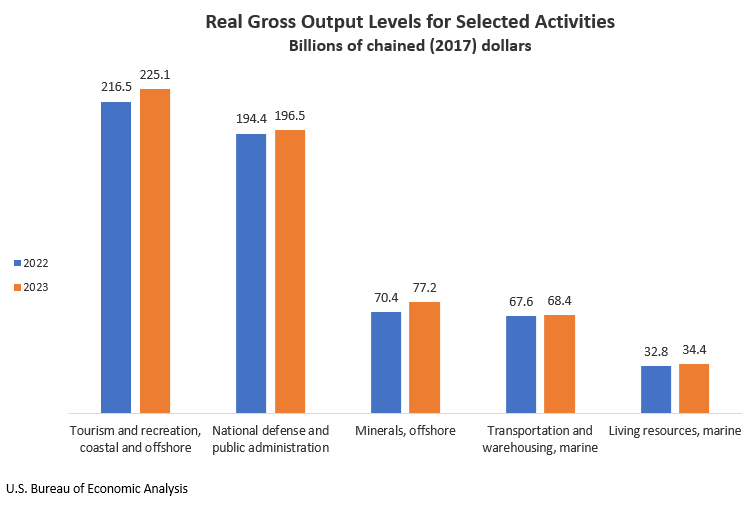
The specific contributions and growth rates within these categories, as detailed in the BEA’s supplementary materials, would reveal which segments are driving the overall expansion. For example, a surge in offshore wind development could significantly boost the "Offshore Energy Production" and "Ship and Boat Building" categories, while increased tourism could amplify "Recreation and Tourism."
Similarly, the industry breakdown provides insights into which sectors are most intertwined with marine activities. Key industries likely to feature prominently include:
- Transportation and Warehousing: Especially water transportation.
- Manufacturing: Including shipbuilding, seafood processing, and equipment production.
- Accommodation and Food Services: Driven by coastal tourism.
- Professional, Scientific, and Technical Services: For research, consulting, and engineering.
- Arts, Entertainment, and Recreation: Fueled by marine tourism.
- Agriculture, Forestry, Fishing, and Hunting: Specifically the commercial fishing and aquaculture sub-sectors.
Methodology and Scope: Ensuring Accuracy and Breadth
The Marine Economy Satellite Account is a sophisticated model built upon the BEA’s comprehensive supply and use framework. This framework meticulously details the relationships among industries and their contributions to GDP. The MESA essentially reconfigures these established tables, employing specialized estimation methods to isolate and quantify marine-related economic activity.
A critical aspect of the MESA’s methodology is its reliance on a diverse array of private and public data sources. This allows for the accurate identification of marine-related spending and production, forming the bedrock of the MESA estimates. The inclusion of both gross output and value added by marine economic activity, alongside the standard industry-based presentation, is a significant advantage. This dual presentation is particularly valuable for analyzing economic activity that spans multiple industries, offering a more holistic view of the marine economy’s reach and impact.
The geographic scope of the MESA is also expansive, encompassing the Atlantic, Pacific, and Arctic Oceans within the U.S. Exclusive Economic Zone (approximately 200 nautical miles offshore). It also includes marginal seas such as the Chesapeake Bay, Puget Sound, Long Island Sound, and San Francisco Bay, as well as the U.S. shoreline directly adjacent to these waters. Furthermore, the Great Lakes, up to the international boundary with Canada, are integrated into the account. This broad geographic coverage ensures that the MESA captures the full spectrum of U.S. marine economic activity.
Partnership and Future Outlook
The development of the Marine Economy Satellite Account is a testament to interagency collaboration, undertaken in partnership with the National Oceanic and Atmospheric Administration (NOAA). This collaboration leverages the expertise of both agencies to provide a comprehensive and authoritative measure of the U.S. marine economy.
The BEA also makes detailed annual statistics for the marine economy available on its website, covering the period from 2014 to 2023. These statistics include data on gross output and value added by both industry and activity, as well as employment and compensation by industry. This accessibility is crucial for researchers, policymakers, and industry stakeholders who rely on this data for informed decision-making.
The BEA has announced that the next release of the Marine Economy Satellite Account, covering data for 2024, is scheduled for Spring 2026. This regular cadence of updates ensures that the economic picture of this vital sector remains current and relevant.
Broader Implications and Future Trends
The consistent growth and significant contribution of the marine economy have far-reaching implications. As a sector that leverages natural resources, its expansion is intrinsically linked to sustainable practices and effective resource management. The BEA’s data provides a vital baseline for assessing the economic impact of environmental policies and for understanding the economic opportunities associated with a healthy marine ecosystem.
Furthermore, the increasing emphasis on renewable energy, particularly offshore wind, suggests that the marine economy is poised for continued transformation and growth. Investments in this area are likely to spur innovation, create new jobs, and attract further economic activity along coastal regions. The BEA’s detailed breakdowns by activity and industry will be instrumental in tracking these evolving trends and their economic consequences.
The marine economy is not merely a collection of disparate industries; it is an interconnected ecosystem of economic activity that plays a crucial role in national prosperity, security, and environmental stewardship. The BEA’s meticulous tracking through the Marine Economy Satellite Account provides the essential data to understand, nurture, and harness the full potential of this vital sector for years to come.