Lana Rhoades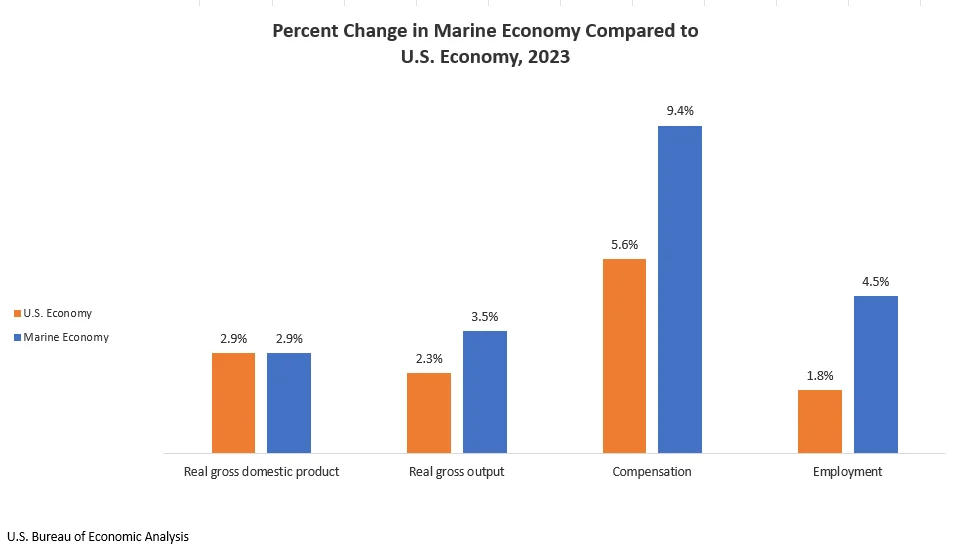
The U.S. marine economy demonstrated a strong performance in 2023, contributing significantly to the nation’s economic output and showing robust growth in employment and compensation. Statistics released by the U.S. Bureau of Economic Analysis (BEA) today reveal that the marine economy accounted for $511.0 billion, or 1.8 percent, of current-dollar U.S. gross domestic product (GDP) in 2023. This marks a notable increase from the $482.4 billion recorded in 2022, underscoring the sector’s expanding influence. Furthermore, the marine economy generated $826.6 billion, or 1.7 percent, of current-dollar gross output in 2023, indicating the broad scope of its economic activity.
Marine Economy Outpaces Overall U.S. Economy in Key Growth Metrics
The latest figures from the Marine Economy Satellite Account (MESA) paint a picture of a dynamic and growing sector. In real terms, adjusted for inflation, the gross domestic product (GDP) of the marine economy experienced a substantial increase of 2.9 percent from 2022 to 2023. This growth rate precisely matched that of the overall U.S. economy, signaling that the marine sector is not only expanding but doing so in step with national economic trends.
Beyond GDP, the MESA data highlights significant gains in employment and compensation within the marine economy. Compensation surged by an impressive 9.4 percent, adding $19.1 billion to the sector’s payrolls. This substantial increase suggests not only job creation but potentially higher wages or increased hours for existing workers. Employment within the marine economy also saw a healthy uptick, rising by 4.5 percent and creating 111,000 new full- and part-time positions. This expansion in the workforce is a critical indicator of the sector’s vitality and its capacity to absorb new talent.
Updated Data Reflects Comprehensive Economic Assessment
The release of the 2023 statistics is accompanied by updated figures for the years 2014 through 2022. These revisions are the result of the BEA’s comprehensive 2023 update and the 2024 annual update of the National Economic Accounts, which encompass the Industry Economic Accounts. Such updates are crucial for ensuring the accuracy and reliability of economic data, incorporating newly available and revised source information. This rigorous process of data refinement allows for a more precise understanding of economic trends and the underlying drivers of growth.
Understanding the Marine Economy: A Multifaceted Approach
The Marine Economy Satellite Account employs a unique framework to measure economic activity associated with the nation’s oceans, coasts, and Great Lakes. Unlike traditional economic accounts that focus solely on industries, the MESA categorizes economic contributions based on specific marine-related activities. This approach allows for a more granular analysis, identifying how various sectors contribute to the broader marine economy, even if their primary classification lies elsewhere.
The MESA defines the marine economy as encompassing activities within the U.S. Exclusive Economic Zone (approximately 200 nautical miles off the U.S. coast), marginal seas like the Chesapeake Bay and Puget Sound, the U.S. shoreline directly adjacent to these waters, and the Great Lakes up to the international boundary with Canada. This broad geographic scope ensures a comprehensive capture of economic activity linked to marine environments.
The account reorganizes industry value added (GDP) and gross output statistics to reflect these marine-related activities. These activities are grouped into 10 general categories, providing a clear structure for analysis. While the specific categories were not detailed in the provided text, this classification system is fundamental to isolating and quantifying the diverse economic contributions of the marine sector.
Gross Output: A Measure of Total Economic Activity
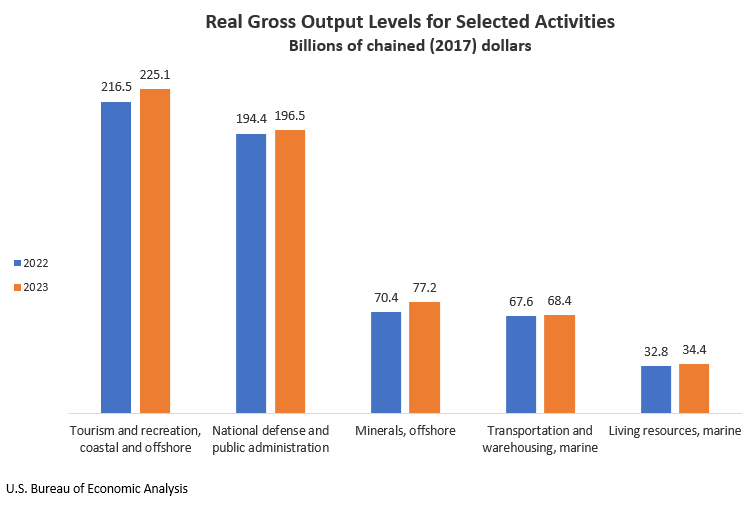
Marine economy real gross output, a measure of the sector’s inflation-adjusted sales or receipts, increased by 3.5 percent, or $22.7 billion, in 2023. Gross output encompasses both sales to final users (contributing to GDP) and sales to other industries as intermediate inputs. This growth in gross output signifies an expansion in the overall volume of goods and services produced within the marine economy.
Industry Contributions to the Marine Economy
Beyond activities, the MESA also analyzes the marine economy by industry. This perspective highlights the specific sectors that contribute to marine economic output, value added, employment, and compensation. By examining industry contributions, policymakers and businesses can identify key drivers of growth and areas that may require targeted support or investment. The provided charts, though not visible, would likely illustrate the dominant industries within the marine economy and their respective shares of value added.
Historical Context and Methodological Foundation
The development of the Marine Economy Satellite Account is rooted in a commitment to providing comprehensive and detailed economic data. The MESA was built upon the BEA’s established supply and use framework, which offers a detailed view of inter-industry relationships and GDP contributions. The MESA effectively rearranges these published tables, employing specialized estimation methods to isolate marine-specific spending and production. This rigorous methodology relies on a variety of public and private data sources to accurately identify and quantify marine-related economic activities.
A key innovation of the MESA is its dual presentation of data: by marine economic activity and by industry. This dual approach is particularly valuable for analyzing sectors where significant economic activity is dispersed across multiple industries, offering a more holistic understanding of the marine economy’s structure and impact.
Broader Economic Implications and Future Outlook
The robust growth observed in the marine economy in 2023 has several important implications. Firstly, it underscores the sector’s increasing importance as a contributor to national economic prosperity. The creation of over 100,000 jobs signifies opportunities for American workers and a potential boost to regional economies that rely heavily on marine-related industries. The substantial increase in compensation suggests a positive trend for wages and income within the sector.
Secondly, the synchronized growth rate of the marine economy’s real GDP with that of the overall U.S. economy indicates that the marine sector is not an isolated entity but an integral component of the broader economic landscape. Its performance is intertwined with national economic health, and conversely, its growth can contribute to national economic resilience.
The detailed statistics provided by the MESA, including data on gross output and value added by both industry and activity, as well as employment and compensation by industry, offer invaluable insights for a range of stakeholders. Businesses can leverage this data for strategic planning, investment decisions, and market analysis. Policymakers can utilize these insights to develop effective strategies for economic development, resource management, and environmental stewardship related to marine resources. Researchers can further explore the complex interdependencies within the marine economy and its impact on other sectors.
The partnership between the BEA and the National Oceanic and Atmospheric Administration (NOAA) in producing the MESA is a testament to the interdisciplinary nature of understanding and managing marine resources and economies. NOAA’s expertise in ocean science and management complements BEA’s economic data analysis, leading to a more informed and holistic approach.
Data Availability and Future Releases
The complete set of detailed annual statistics for the marine economy from 2014 to 2023 is accessible on the BEA’s website. This includes comprehensive data on gross output and value added, presented by both industry and activity, alongside employment and compensation figures broken down by industry. This accessibility is crucial for fostering transparency and enabling widespread use of the data.
Looking ahead, the BEA has indicated that the next release of Marine Economy Satellite Account data is anticipated in the Spring of 2026, which will include statistics for 2024. This regular release schedule ensures that stakeholders have access to timely and up-to-date information, allowing for continuous monitoring and adaptation to evolving economic conditions within the marine sector. The ongoing commitment to updating and refining these statistics demonstrates the BEA’s dedication to providing a clear and accurate picture of the U.S. marine economy’s vital role in national prosperity.