Nila Kartika Wati
The political landscape of the United States is currently witnessing a profound transformation in the engagement and alignment of Latine voters, a demographic that has historically served as a cornerstone of the Democratic coalition. As the nation moves toward the 2026 midterms and the 2028 presidential cycle, the traditional assumption that Latine communities are a monolith of liberal support is being rigorously challenged by shifting economic priorities, generational divides, and a growing frustration with federal immigration policies. Nonprofits led by Latine advocates are now navigating a complex environment where they must balance the mobilization of a disillusioned electorate against increasingly aggressive voter intimidation tactics and institutional barriers.
A Historical Overview of Latine Voting Patterns
The narrative of the "Hispanic vote" has been a central focus of American political strategy for decades. In 1985, the Federation for American Immigration Reform founded the Center for Immigration Studies (CIS), a conservative think tank that would later release a seminal 2001 report questioning the Republican Party’s ability to ever secure a significant portion of the Latine electorate. At that time, with the exception of the Cuban community in Florida, Latine voters were viewed as staunchly Democratic. Analysts at the time expressed skepticism regarding whether the GOP’s efforts to woo these voters were worth the substantial investment required to achieve meaningful gains.
However, the political climate shifted significantly during the presidency of Bill Clinton. Following a term marked by personal scandals, the implementation of the North American Free Trade Agreement (NAFTA), and support for neoliberal policies that destabilized various Latin American economies, the 2000 election saw George W. Bush capture 35 percent of the Hispanic vote. By 2004, that figure rose to 40 percent. Political scientists attribute this surge to a focus on national security in the wake of the September 11 attacks and a strategic emphasis on "moral values," which resonated with socially conservative Catholic and Evangelical Latine voters.
The Republican momentum proved short-lived. In 2008, Barack Obama secured an overwhelming 67 percent of the Hispanic vote. This shift was largely driven by a backlash against the anti-immigrant rhetoric that had begun to permeate Republican platforms, often characterized by racial overtones. Despite this support, the Obama administration’s legacy on immigration remains a point of deep contention. While Obama campaigned on the promise of the DREAM Act and a path to legalization, his administration also oversaw a massive expansion of the deportation machine.
The Legacy of Enforcement and the "Deporter-in-Chief"
The creation of U.S. Immigration and Customs Enforcement (ICE) under the Homeland Security Act of 2002 provided the federal government with unprecedented tools for domestic immigration enforcement. Under the Bush administration, deportations more than doubled. Paradoxically, the Obama administration exceeded these numbers by over one million people, eventually earning the president the moniker "deporter-in-chief" from advocacy groups.
In 2009, Department of Homeland Security (DHS) Secretary Janet Napolitano prioritized border security and the removal of undocumented immigrants. By 2011, many Latine advocates felt a sense of betrayal. In response, the United We Dream Network mobilized thousands of young "Dreamers" to demand executive action. This pressure led to the 2012 announcement of the Deferred Action for Childhood Arrivals (DACA) policy. While DACA helped Obama retain 71 percent of the Hispanic vote in his reelection, the broader deportation campaign continued. Statistics from the era indicate that approximately 69 percent of those deported under the Obama administration were non-criminals or low-level offenders, contradicting the administration’s claims of targeting only "the worst of the worst."
This era of aggressive enforcement laid the groundwork for the 2016 election. For the first time in its history, the ICE union endorsed a presidential candidate: Donald J. Trump. Simultaneously, Democratic support among Latine voters began a steady decline, falling to 67 percent for Hillary Clinton in 2016, 61 percent for Joe Biden in 2020, and 57 percent for Kamala Harris in 2024. Data suggests that many Latine voters in recent cycles were motivated more by a vote against the opposition than by a strong affinity for the Democratic platform.
Modern Challenges: Economic Strain and the Border Crisis
As the 2024 election cycle concluded, it became clear that the Latine vote was shifting toward a focus on economic stability and healthcare. While immigration remains a vital issue, it has frequently fallen to fourth or fifth on the list of primary concerns for Latine households. The Biden administration’s handling of the post-COVID-19 economic recovery and the subsequent surge in migration created a difficult political environment.
Despite creating some humanitarian pathways for naturalization, the Biden administration continued the use of Title 42 expulsions and expanded ICE detention capacity from 25,000 to 40,000 beds. According to the CATO Institute, deportation charter flights increased by 55 percent during this period. Organizations like the ACLU warned that by maintaining Trump-era enforcement infrastructures—such as partnerships with local law enforcement and private prison corporations—the administration effectively left a "deportation machine" ready for future use.
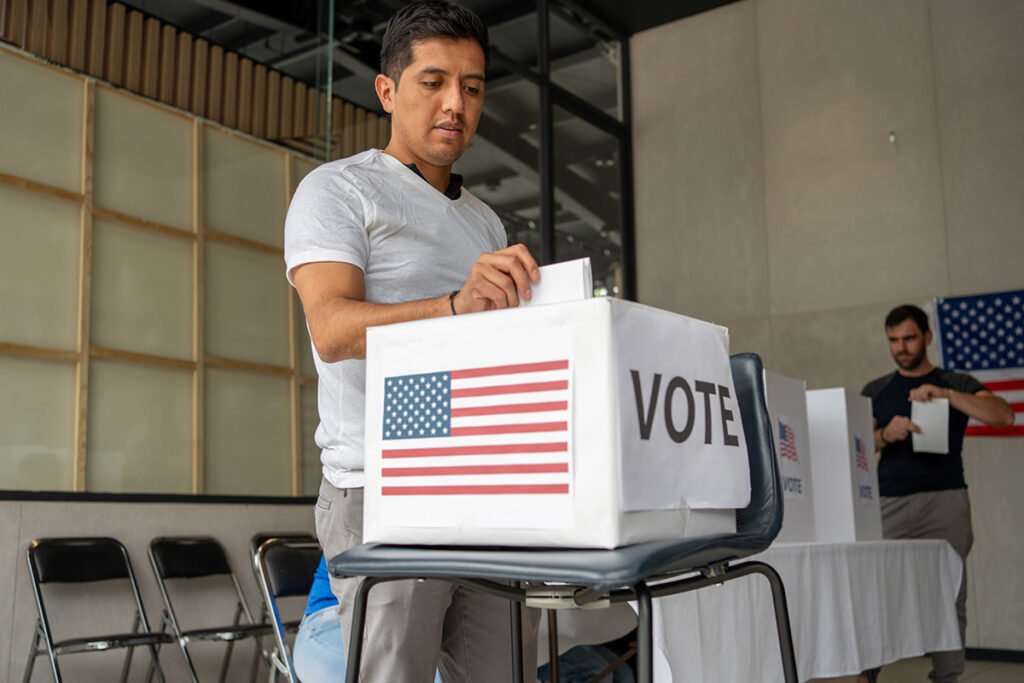
The 2024 election results further debunked the myth of the Latine vote as a monolith. While Trump made gains, analysts point out that the shift was not universal. Instead, the loss of support was more reflective of Democratic failure to address the specific economic anxieties of Latine men and young voters.
Confronting Voter Suppression and Intimidation
As the demographic weight of the Latine electorate grows—with 36 million eligible voters in 2026—conservative strategies have increasingly shifted toward demobilization. Advocacy groups have identified several key tactics used to discourage Latine participation:
- Gerrymandering: The strategic redrawing of district lines to dilute the voting power of concentrated Latine communities.
- Voter Intimidation: High-profile threats to deploy the National Guard or ICE agents to polling locations. Such actions, while often legally dubious, serve to frighten naturalized citizens and mixed-status families.
- The SAVE Database: The use of the Systematic Alien Verification for Entitlements (SAVE) database to verify voter eligibility has been criticized for its inaccuracy. The system frequently flags naturalized citizens whose records have not been updated, leading to illegal voter purges, such as those struck down by the courts in Florida in 2014.
- Field Investigations: Recent reports have surfaced regarding the "Unlawful Voter Initiative," involving DHS officers conducting in-person interviews at the homes of recently naturalized citizens to "verify" their eligibility.
The Nonprofit Response: Mobilizing for 2026 and 2028
In response to these challenges, a robust network of Latine-led nonprofits has launched a multi-front defense of voting rights. These organizations are betting that community empowerment will overcome fear-based tactics.
Legal Action and Advocacy:
On September 18, 2024, a coalition including LatinoJustice PRLDEF and the National Immigration Law Center (NILC) filed a federal lawsuit challenging the threatened use of armed federal agents at polling sites. A subsequent lawsuit filed on September 21 sought to stop the DHS from compiling voter lists for home interviews, targeting what they describe as blatant voter interference.
Grassroots Engagement:
The Voto Latino Foundation has mobilized a force of over 28,000 volunteers to facilitate voter registration and education. Their digital hub, "El Brief," specifically targets the one million young Latine voters who become eligible to vote each year, focusing on cultural relevance and modern communication.
Similarly, Mi Familia Vota has adopted a "365-day engagement" model. Operating in critical states like Arizona, Nevada, and North Carolina, the organization connects voting to a broad spectrum of issues, including reproductive rights, workers’ rights, and environmental justice. This year-round presence aims to move beyond the "seasonal" outreach that often leaves Latine voters feeling ignored by major political parties.
State-Level Organizing:
In Texas, La Unión del Pueblo Entero (LUPE) has been instrumental in organizing people’s assemblies in the Rio Grande Valley. Their "Valle Fuerte, Valle Libre" campaign serves as a blueprint for community-led registration drives that emphasize the intersection of immigration reform and economic survival.
Implications for the Future of American Democracy
The trajectory of the Latine vote will undoubtedly dictate the future of the American political map. A bipartisan poll conducted by UnidosUS of 3,000 Latine voters revealed that 76 percent planned to vote in the most recent cycle, yet 68 percent felt the country was heading in the wrong direction. This disconnect presents both a risk and an opportunity for political candidates.
The shift is even visible in traditional strongholds like Florida. While older generations of Cuban Americans remain influenced by anti-communist rhetoric, younger Cuban Americans are increasingly focused on domestic issues like college tuition and the job market. This generational "Americanization" suggests that the ideological labels of the past are losing their potency.
As the 2026 midterms approach, the effectiveness of Latine nonprofits in safeguarding the ballot box will be a litmus test for the resilience of the U.S. electoral system. If these organizations can successfully counter intimidation and link voting to tangible improvements in the economy and healthcare, the Latine electorate may not only "move the needle" but fundamentally redefine the American political center. Candidates who ignore this "surging sentiment" do so at their own peril, as the second-largest voting-age population in the country continues to assert its independence and its power.