Lana Rhoades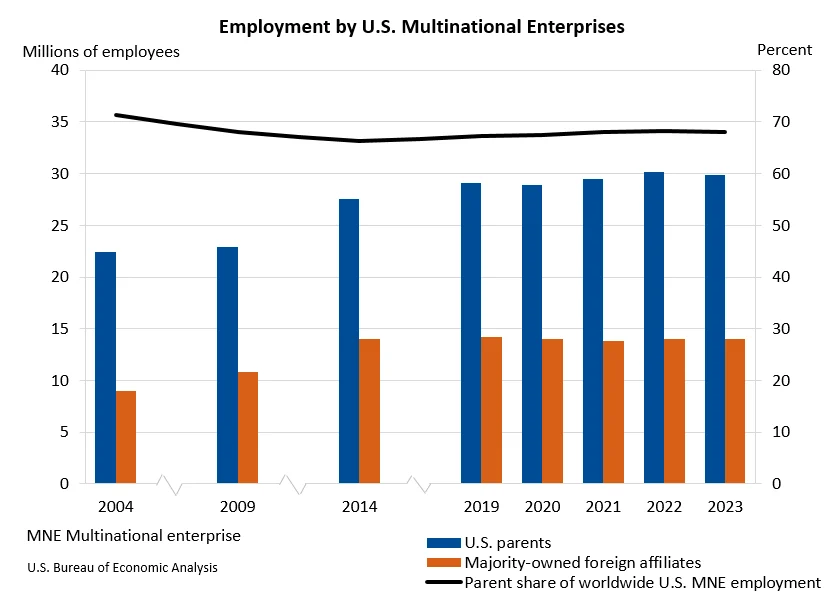
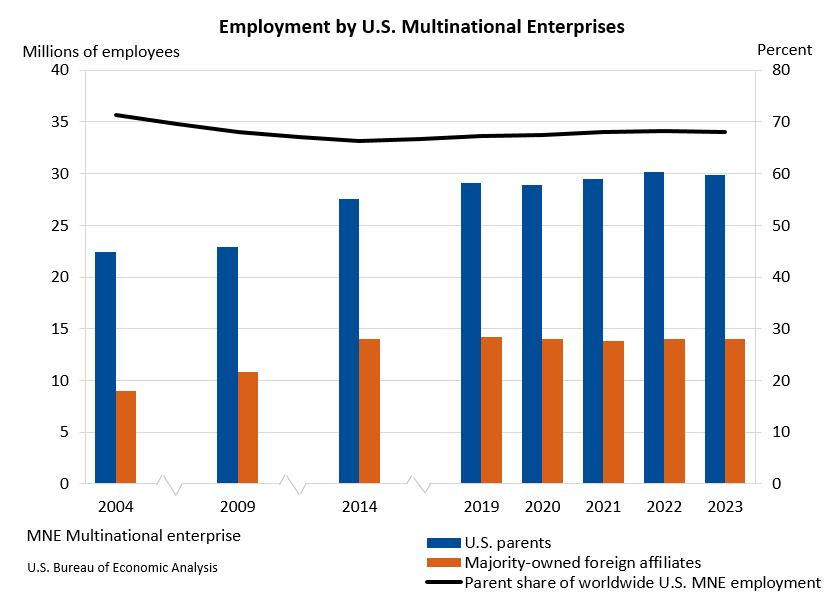
Washington D.C. – U.S. multinational enterprises (MNEs) experienced a slight contraction in their global workforce during 2023, with worldwide employment falling by 0.4 percent to 43.9 million workers, according to preliminary statistics released by the U.S. Bureau of Economic Analysis (BEA). This marks a decrease from the revised figure of 44.1 million workers in 2022. The data, which scrutinizes the operations and financial activities of U.S. parent companies and their foreign affiliates, offers a nuanced view of the global reach and employment dynamics of American businesses abroad.
The overall decline in global employment masks a divergence in trends between domestic and international operations. While the total workforce saw a marginal dip, employment within the United States by U.S. parent companies experienced a more significant decrease of 0.8 percent, bringing the total down to 29.9 million workers in 2023. Despite this decline, U.S. parents still represent a substantial portion of the MNE employment landscape, accounting for 68.1 percent of the worldwide workforce. This figure is a slight reduction from 68.3 percent in the preceding year, indicating a subtle but observable shift towards international employment growth relative to domestic.
In contrast, employment abroad by foreign affiliates of U.S. MNEs demonstrated resilience, increasing by 0.2 percent to reach 14.0 million workers. This growth abroad means that international employment now constitutes 31.9 percent of the total global employment generated by U.S. MNEs, a testament to the ongoing expansion and operational footprint of American companies in overseas markets.
Shifting Employment Landscape: Domestic vs. International
The BEA’s comprehensive data reveals that U.S. parent companies’ contribution to the total private industry employment within the United States also saw a fractional decrease, falling from 22.5 percent in 2022 to 21.9 percent in 2023. This indicates a broadening of the overall private employment base or a more concentrated impact of the decline within the MNE sector. The primary sectors within the U.S. for parent company employment remain consistent, with manufacturing leading the pack, followed by a broad category of "other industries" – notably including transportation and warehousing – and then retail trade.
Conversely, the international employment figures highlight key regions of growth. Majority-owned foreign affiliates of U.S. MNEs saw their largest employment concentrations in India, Mexico, and the United Kingdom. These countries have long been significant hubs for foreign direct investment and manufacturing, reflecting strategic global operational decisions by U.S. corporations. The slight increase in foreign affiliate employment suggests a sustained or growing demand for labor in these key international markets, potentially driven by consumer demand, production capacities, or strategic market access.
Economic Contribution: Value Added Trends
Beyond employment figures, the BEA’s report also sheds light on the economic value generated by U.S. MNEs. The worldwide current-dollar value added by these enterprises saw a decrease of 0.6 percent, settling at $6.9 trillion. Value added serves as a crucial measure of an entity’s direct contribution to gross domestic product (GDP).
Within this global figure, the value added by U.S. parents, which directly contributes to the U.S. GDP, declined by 1.0 percent to $5.3 trillion. This domestic contribution represented 21.4 percent of total U.S. private-industry value added in 2023, a notable decrease from 23.1 percent in 2022. This contraction in the domestic value-added share could be attributed to several factors, including shifts in investment, operational efficiencies, or the relative growth of foreign affiliate contributions.
The value added by majority-owned foreign affiliates, however, experienced a modest increase of 0.8 percent, reaching $1.6 trillion. This international economic contribution was most pronounced in the United Kingdom, Canada, and Ireland. The growth in foreign affiliate value added, even as domestic value added contracted, underscores the increasing economic significance of overseas operations for U.S. multinational corporations. This trend suggests a strategic reallocation of resources or a more dynamic economic environment in these key international locations.
Investment and Innovation: Capital Expenditures and R&D
Significant investments in property, plant, and equipment (capital expenditures) by U.S. MNEs demonstrate a commitment to expanding their global infrastructure and production capabilities. Worldwide expenditures for these assets surged by 7.5 percent to $1.1 trillion in 2023. Of this substantial sum, U.S. parents accounted for $886.1 billion, while majority-owned foreign affiliates contributed $216.2 billion. The robust increase in capital expenditures signals a forward-looking strategy, likely aimed at enhancing productivity, meeting growing global demand, or modernizing facilities.
Parallel to physical investments, research and development (R&D) expenditures, a key indicator of innovation and future competitiveness, also saw a significant rise. Worldwide R&D expenditures by U.S. MNEs climbed by 7.5 percent to $558.3 billion. U.S. parents were the primary drivers of this investment, accounting for $476.6 billion in R&D spending. Majority-owned foreign affiliates contributed $81.7 billion to global R&D efforts. This strong growth in R&D spending, particularly by U.S. parents, suggests a continued focus on technological advancement and the development of new products and services, which are crucial for maintaining a competitive edge in the global marketplace.
Historical Context and Revisions
The statistics released by the BEA are part of a regular reporting cycle that provides crucial insights into the global economic activities of U.S. multinational enterprises. The data for 2023 are preliminary and subject to revision as more comprehensive source data becomes available. Similarly, the revised figures for 2022, which were incorporated into this release, highlight the dynamic nature of economic data collection and analysis.

The BEA’s efforts to refine its statistical models and data collection methodologies are ongoing. For instance, preliminary statistics for 2022, initially released in August 2024, underwent revisions and were further detailed in the "Survey of Current Business" in September 2024. This iterative process ensures that the reported figures become increasingly accurate over time, providing a more reliable basis for economic understanding and policy-making. The table detailing updates to 2022 statistics illustrates the minor but important adjustments made to figures for employment, value added, and expenditures, reflecting the complexities of compiling such extensive global economic data.
Broader Implications and Future Outlook
The trends observed in the 2023 data carry significant implications for both the U.S. and global economies. The slight decrease in domestic employment by U.S. parents, coupled with a declining share of U.S. private-industry value added, might prompt discussions about domestic investment strategies and the impact of globalization on the U.S. labor market. Conversely, the growth in foreign affiliate employment and value added underscores the continued importance of international markets for U.S. corporate growth and profitability.
The robust increase in capital expenditures and R&D spending signals confidence in future economic activity and a commitment to innovation. This investment in future growth is critical for maintaining long-term competitiveness. The BEA’s comprehensive data tables, made available through its Interactive Data Application and other resources, provide a granular look at these trends across various industries and countries, enabling deeper analysis by policymakers, businesses, and researchers.
The BEA’s commitment to providing up-to-date and detailed statistics on the activities of U.S. multinational enterprises is invaluable. These reports offer a vital lens through which to understand the complex interconnectedness of the global economy and the multifaceted role U.S. corporations play within it. As the world continues to navigate evolving economic landscapes, these data will remain essential for informed decision-making and strategic planning. The next release, covering the 2024 activities of U.S. MNEs, is anticipated in November 2026, promising further insights into these critical economic dynamics.