Layla Zulfa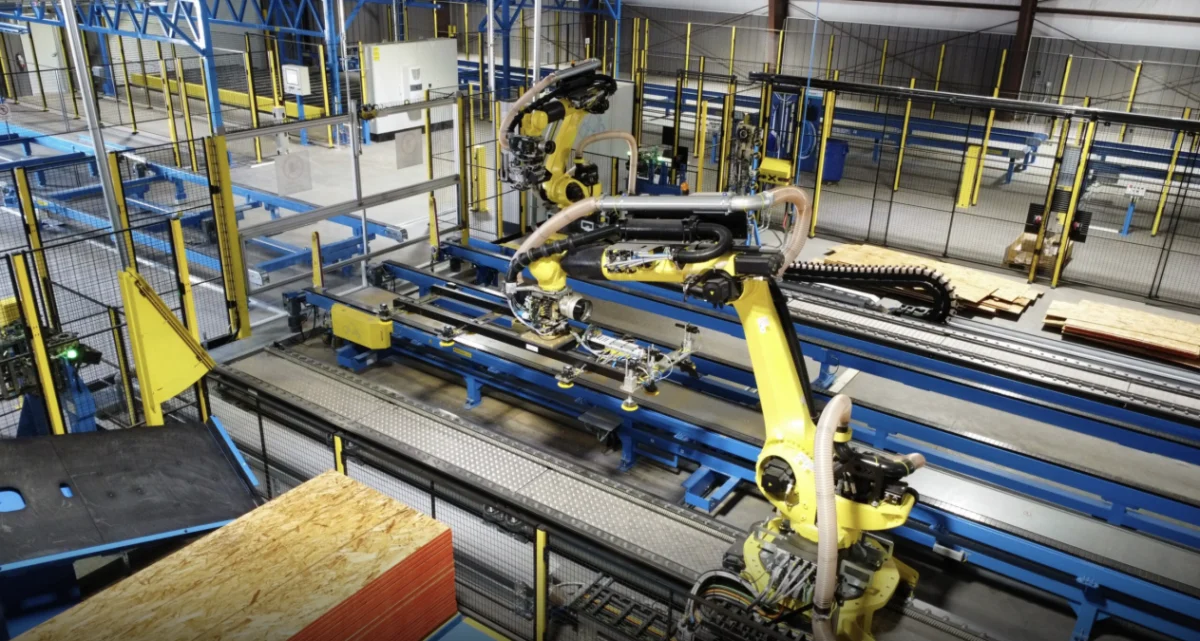
Dozens of innovative companies have sprung up over the past 15 years, each vowing to revolutionize home building. Many haven’t, don’t, and won’t make it through the "early-stage" gauntlet of A, B, and C series capital raises, where they can pay off their debt, cover their bills, and sustainably generate net earnings from their operations. A pedigreed strategic and operational brain trust at FrameTec believes the venture can do what others have struggled with – successfully scale operations while offering a sustainable alternative to builders that reduces cycle times and boosts worker efficiency. Founded in 2022 and launched online in mid-2025, FrameTec now produces pre-cut framing systems at its robotic factory in Arizona, with plans to expand into Texas and other new-home-construction hotbeds, pending new investment.
During a session last week at The SHIFT, an Orlando gathering of placemaking thought and practice leaders hosted by Tavistock Development Company, FrameTec COO Josh Lewis discussed how the company operates, what they believe they can contribute to homebuilders, and how they hope to address the skilled labor shortage in residential construction. The SHIFT, now in its third year, brings together a diverse group of stakeholders including developers, urban planners, architects, policymakers, and technology providers to explore the future of community development and the built environment. This year’s event focused on the intersection of technology, sustainability, and affordability in creating resilient and livable communities.
The FrameTec Process: Precision Manufacturing Meets On-Site Efficiency
FrameTec’s innovative approach begins with a meticulous review and refinement of a builder’s project plans. This initial phase is crucial for verifying that site conditions align precisely with the design specifications, mitigating potential issues before they arise. Once FrameTec’s system finalizes and confirms the data, the information is transmitted to its state-of-the-art, 120,000-square-foot automated plant in Camp Verde, Arizona. Here, advanced robotics utilize this precise data to cut and assemble comprehensive wall panels and framing components with unparalleled accuracy.
The factory’s sophisticated manufacturing capabilities extend to producing wall panels, roof trusses, and floor trusses. These components are delivered to construction sites with pre-marked studs, detailed nail patterns, and integrated layout information, significantly streamlining the on-site assembly process. This level of pre-fabrication eliminates the need for manual layout and measurement on the job, a common source of delays and errors in traditional construction.
The Camp Verde facility currently boasts a production capacity capable of supporting approximately 3,500 homes annually. Over the past year, it has contributed to the construction of an estimated 850,000 to one million square feet of housing within Arizona. FrameTec’s technological backbone at this facility includes a partnership with the Swedish manufacturer Randek, a recognized leader in developing and manufacturing systems and machinery for prefabricated housing. This collaboration ensures that FrameTec’s operations are at the forefront of industry innovation.
The automated plant employs advanced robotic systems for a multitude of tasks, including cutting, framing, sheathing, gluing, routing, insulating, and stacking structural components. This sophisticated automation requires a significantly reduced on-site human workforce compared to conventional framing methods. While robots handle the bulk of the intricate and repetitive tasks, a team of skilled workers supervises the robotic equipment and performs specific tasks that have not yet been fully automated. This hybrid approach ensures both efficiency and quality control.
Sustainability at the Core: Minimizing Waste Through Advanced Technology
A significant byproduct of FrameTec’s automated manufacturing process is its commitment to waste reduction. By automating the cutting process with high precision, the factory minimizes material offcuts. Furthermore, any reclaimed wood pieces are expertly processed through finger-jointed methods, allowing for their reintegration into new lumber. FrameTec claims that its factory-controlled, pre-cut framing systems can decrease wood waste to "near-zero."
This focus on waste minimization is particularly impactful when considering the environmental footprint of traditional home construction. According to the Environmental Protection Agency (EPA), the construction of a typical single-family home generates approximately 8,000 pounds of waste, with wood constituting roughly 20 to 30% of that total. FrameTec’s approach directly addresses this issue.
"Any defect we remove is cut out, and the remaining pieces go into the finger-joint process… so instead of throwing away material, we’re using those pieces to create continuous lumber," Josh Lewis explained during The SHIFT session. This circular approach to material utilization not only reduces landfill waste but also contributes to more sustainable building practices, a growing priority for both developers and consumers.
Addressing the Skilled Labor Crisis: Accelerating Timelines and Enhancing Productivity
For homebuilders grappling with an increasingly acute skilled labor shortage, FrameTec’s ability to dramatically improve construction cycle times presents a compelling solution. The company’s automated factory can typically deliver pre-cut frames to a construction site within an expedited timeframe of 10 to 14 business days. Once on-site, FrameTec asserts that it can accelerate key stages of the construction process by several days. This acceleration is directly attributable to the precision-engineered wall panels and framing components, which arrive pre-marked with studs, nail patterns, and layout details.
Lewis, whose extensive background includes nearly 17 years with building materials suppliers like Builders FirstSource and BMC, followed by approximately five years at Foxworth-Galbraith Lumber Company, highlighted the tangible impact of this efficiency. "We can stand walls, come in line and stack a roof in one day on a 3,500-square-foot house. For most guys, that’s a week. We’re doing it in a day," he stated, underscoring the dramatic reduction in on-site labor time.
The benefits extend to specialized trades as well. FrameTec has documented instances where a pair of electricians could complete the rough-in phase of a house – installing outlet boxes, junction boxes, and routing electrical wiring through wall studs and ceiling joists before drywall installation – in as little as two hours. This contrasts sharply with the typical ten hours it might take two electricians to perform the same task without FrameTec’s pre-fabricated components.
"Every stud that goes through our factory is pre-‘built.’ There is a mark at the switch height location and a mark location on every stud," Lewis elaborated. "That’s how those electricians get those five or six degrees of productivity… They don’t have to pull their tape, and they don’t have to pull the hole hawg out of the truck to drill a hole. It’s simple, but we’re moving instructions to the point of work." This meticulous pre-marking transforms repetitive tasks into highly efficient operations, enabling tradespeople to focus on execution rather than measurement and layout.
Lewis views the FrameTec model as a crucial component in addressing the persistent skilled labor shortage within the residential construction sector. According to the Fall 2025 Construction Labor Market report from The Home Builders Institute, the industry faces a critical need to hire approximately 723,000 construction workers annually to bridge the existing gap. FrameTec’s approach offers a dual benefit: it automates specific construction tasks, thereby reducing the overall demand for certain types of labor, and it streamlines on-site processes, allowing remaining workers to build faster with less extensive training.
Furthermore, Lewis believes that the integration of advanced technology into the construction process can serve as a powerful recruitment tool. "That’s the other thing that adding technology into the process helps. It makes young people excited about the trades. This is cool. It’s flashy," he remarked, suggesting that a modern, tech-driven approach can attract a new generation of workers to a historically labor-intensive industry.
Navigating Resistance and Charting a Course for Expansion
FrameTec is actively forging partnerships with homebuilders in Arizona, including notable projects with Mandalay Homes, encompassing everything from single-lot custom homes to large-scale residential subdivisions. Building on its early successes and demonstrating tangible results, FrameTec is investing in a significant expansion of its operational capacity. The company is currently constructing a second, larger factory in Casa Grande, Arizona. This new facility, spanning 254,000 square feet, will significantly increase FrameTec’s annual output capability to an estimated 10,000 housing units per year, more than doubling its current capacity.
Lewis cites this rapid growth and a successful first year of operations as indicators of strong market momentum. However, he acknowledges that convincing skeptical builders of the long-term sustainability and benefits of this prefabrication model still requires considerable effort. "I’m promising a lot, and they worry about disrupting their current supply chains because they’re so fragile," Lewis admitted. "So, if they were to get on board with FrameTech, they’re going to burn a bridge with their existing lumberyard and their existing framing contractor, because our process kind of requires a wholesale shift in those avenues."
The specter of past failures in the off-site construction industry also looms as a significant obstacle. The cautionary tale of Katerra, a company that raised over $2 billion, invested heavily in factories for modular components, and promised to reduce construction times, only to file for bankruptcy in 2021, remains a potent reminder of the challenges inherent in scaling innovative construction models. Such high-profile collapses can foster understandable caution among potential adopters.
Currently, FrameTec is focused on validating and solidifying its operational model within the competitive Southwest market. Looking ahead, the company’s strategic vision includes expansion into other rapidly growing Sun Belt states, such as Texas, Tennessee, and the Carolinas. These regions are experiencing robust population growth and a corresponding surge in demand for new housing, making them prime targets for FrameTec’s efficient and sustainable building solutions. The company’s trajectory suggests a determined effort to overcome industry inertia and establish prefabrication as a mainstream component of residential construction.