Lana Rhoades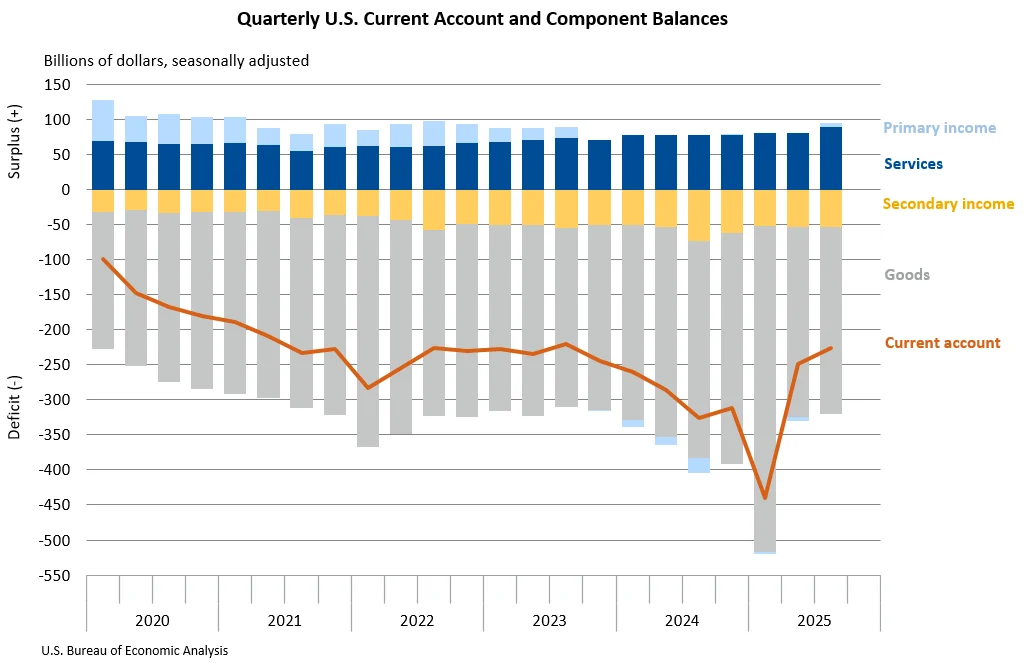
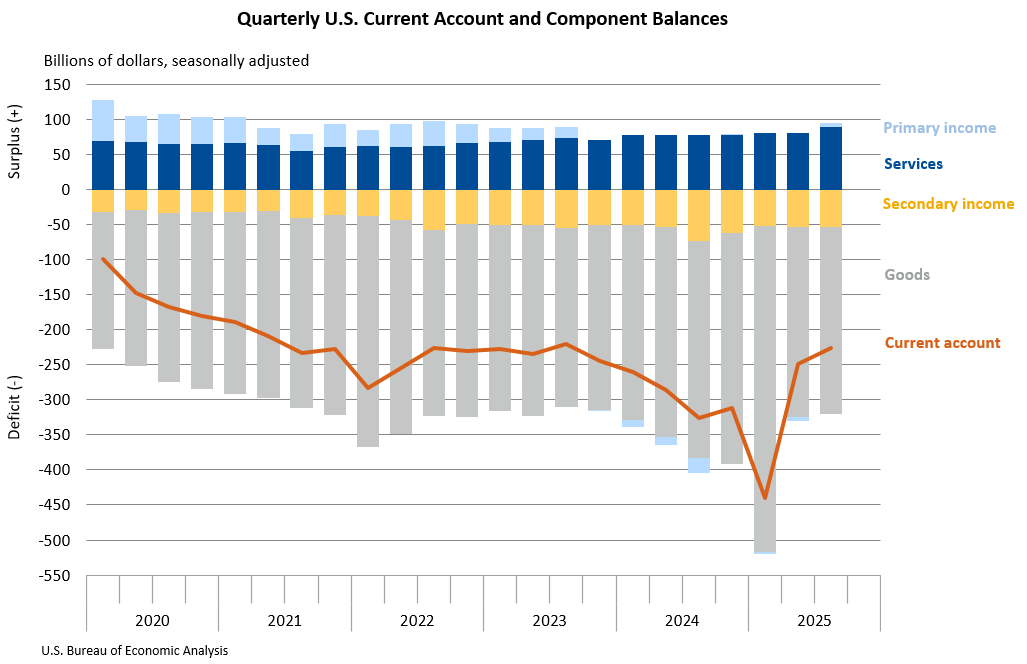
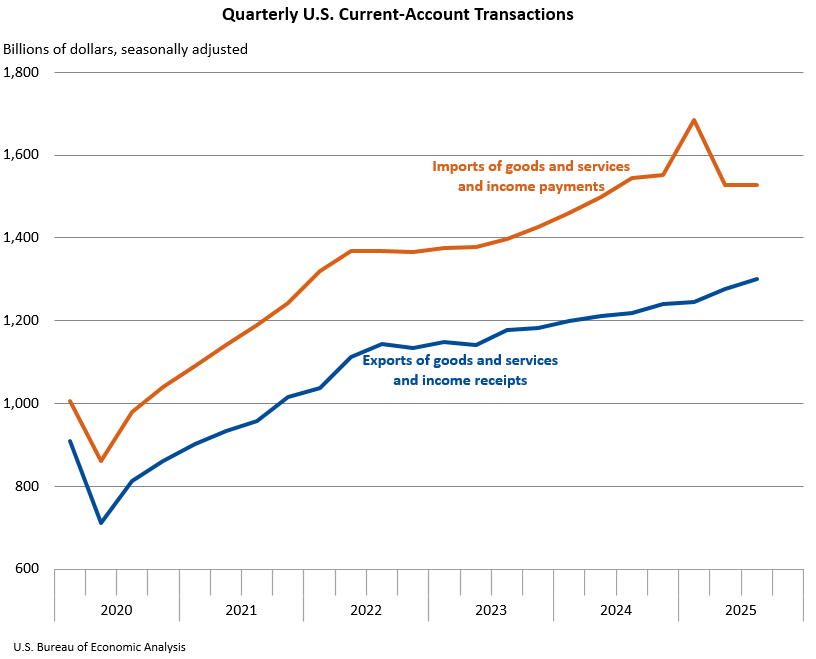
Washington D.C. – The United States experienced a significant narrowing of its current-account deficit in the third quarter of 2025, shrinking by $22.8 billion, or 9.2 percent, to $226.4 billion. This improvement, detailed in newly released statistics from the U.S. Bureau of Economic Analysis (BEA), marks a positive shift in the nation’s balance of international transactions. The deficit, which encapsulates the combined balances of trade in goods and services, as well as income flows between U.S. residents and those in other countries, stood at 2.9 percent of current-dollar gross domestic product (GDP) in the third quarter, down from 3.3 percent in the preceding second quarter.
This contraction in the deficit was primarily fueled by a notable turnaround in the balance on primary income, which shifted from a deficit in the second quarter to a surplus in the third. Accompanying this was an expansion in the surplus on services and a reduction in the deficit on goods, collectively contributing to the more favorable overall current-account position. The revised second-quarter deficit was initially reported at $249.2 billion.
Deep Dive into Current-Account Transactions
The overall increase in exports of goods and services, along with income received from foreign residents, reached $1.30 trillion in the third quarter, an increase of $24.1 billion. Concurrently, imports of goods and services from, and income paid to, foreign residents saw a more modest rise of $1.3 billion, totaling $1.53 trillion. This divergence in growth rates between exports and imports played a crucial role in reducing the deficit.
Trade in Goods: A Mixed Picture
Within the realm of goods trade, exports experienced a slight decrease of $1.9 billion, bringing the total to $548.0 billion. This decline was primarily attributed to a reduction in transactions involving nonmonetary gold. However, this decrease was partially offset by gains in capital goods and consumer goods exports. On the import side, goods imports also contracted by $5.0 billion to $815.4 billion. This reduction was largely driven by a decrease in consumer goods imports, though it was significantly counterbalanced by an increase in nonmonetary gold imports. The BEA notes that a detailed definition of nonmonetary gold can be found in their supplementary information on "Goods."
Services Sector Shows Robust Growth
The services sector demonstrated a strong performance, with both exports and imports registering increases. Exports of services climbed by $11.7 billion to $314.2 billion, while imports of services rose by $3.1 billion to $225.0 billion. The BEA highlighted that the leading contributors to these increases in both export and import categories were "other business services," with professional and management consulting services being a significant component. This growth underscores the increasing interconnectedness and reliance on intangible services in the global economy.
Primary Income Rebounds to Surplus
A pivotal factor in the current-account improvement was the dramatic shift in the primary income balance. Receipts of primary income, which represent earnings generated by U.S. residents from their investments abroad, surged by $16.3 billion to $395.2 billion. This broad-based increase spanned all major categories, with direct investment income being the most significant driver. Simultaneously, payments of primary income, representing earnings generated by foreign residents from their investments in the U.S., increased by $5.3 billion to $390.0 billion. This rise was primarily attributed to an increase in "other investment income," specifically interest payments on loans and deposits. The transition from a primary income deficit to a surplus signifies a stronger return on U.S. foreign investments relative to foreign returns on U.S. investments during this period.
Secondary Income Sees Slight Contraction
Secondary income, which comprises current transfers like foreign aid and remittances, saw a modest decline. Receipts of secondary income decreased by $2.0 billion to $44.4 billion, largely due to a reduction in private transfers. Payments of secondary income also fell by $2.1 billion to $97.9 billion, primarily reflecting a decrease in general government transfers.
Capital and Financial Account Dynamics
Beyond the current account, the BEA also reported on capital and financial account transactions. Capital-transfer receipts saw a modest increase of $164 million, reaching $181 million in the third quarter. Conversely, capital-transfer payments decreased by $659 million to $1.3 billion.
The financial account, which tracks the flow of financial assets and liabilities, registered net transactions of -$409.9 billion in the third quarter. This figure indicates a net increase in U.S. borrowing from foreign residents, reflecting the nation’s ongoing engagement in global capital markets.
U.S. Financial Assets Abroad Expand
During the third quarter, U.S. residents’ foreign financial assets increased by $403.4 billion. The BEA data indicates that "other investment assets" saw the largest increase, rising by $224.4 billion. Direct investment assets grew by $91.9 billion, portfolio investment assets by $86.2 billion, and reserve assets by $0.9 billion. This expansion suggests continued U.S. investment in overseas markets across various asset classes.
Foreign Holdings of U.S. Liabilities Rise
Concurrently, U.S. liabilities to foreign residents saw a substantial increase of $797.2 billion in the third quarter. Portfolio investment liabilities accounted for the largest portion of this growth, increasing by $486.8 billion. "Other investment liabilities" rose by $195.9 billion, and direct investment liabilities by $114.6 billion. This significant inflow of foreign capital into the U.S. underscores the continued attractiveness of U.S. assets to international investors.
Financial Derivatives and Net Borrowing
Net transactions in financial derivatives amounted to -$16.1 billion in the third quarter, further contributing to the overall net U.S. borrowing from foreign residents.
Revisions to Second-Quarter Data
The BEA also provided updated figures for the second quarter of 2025. The preliminary estimate for the current-account balance was revised from -$251.3 billion to -$249.2 billion. Key revisions within the second-quarter current account include a slight adjustment to the goods balance (from -$270.0 billion to -$270.4 billion), an increase in the services balance (from $79.6 billion to $80.6 billion), a narrowing of the primary income balance deficit (from -$7.7 billion to -$5.8 billion), and a slight widening of the secondary income balance deficit (from -$53.2 billion to -$53.6 billion). The net financial-account transactions for the second quarter were revised from -$406.9 billion to -$396.7 billion.
Future of BEA International Transactions Reporting
In a significant announcement regarding its reporting practices, the BEA will consolidate its quarterly U.S. international transactions and international investment position accounts into a single news release starting in March 2026. This move aims to provide a more comprehensive overview of the U.S. engagement with the global economy and will accelerate the availability of international investment position statistics by replacing two separate releases.
Furthermore, as part of its ongoing modernization efforts, the BEA will transition from embedding tables within its news releases to providing dynamic links to featured data within its Interactive Data Application. This streamlined approach is intended to reduce duplication, enhance efficiency, and direct users to the most complete and flexible data tables, which can be customized and downloaded in various formats.
The next release, scheduled for March 25, 2026, at 8:30 a.m. EDT, will cover the 4th Quarter and Year 2025 for U.S. International Transactions and Investment Position. Subsequent releases for 2026 are planned for June 24 (1st Quarter and Annual Update), September 24 (2nd Quarter), and December 18 (3rd Quarter).
The BEA’s commitment to providing timely and accessible data on the U.S. international economic landscape remains a cornerstone of its mission, offering critical insights for policymakers, businesses, and the public alike. The reported narrowing of the current-account deficit in the third quarter of 2025 suggests a potentially strengthening U.S. economic position relative to its global trading partners, driven by improvements in income flows and services trade. However, the continued net borrowing reflected in the financial account highlights the ongoing reliance on foreign capital to finance domestic activities and investments.