Lana Rhoades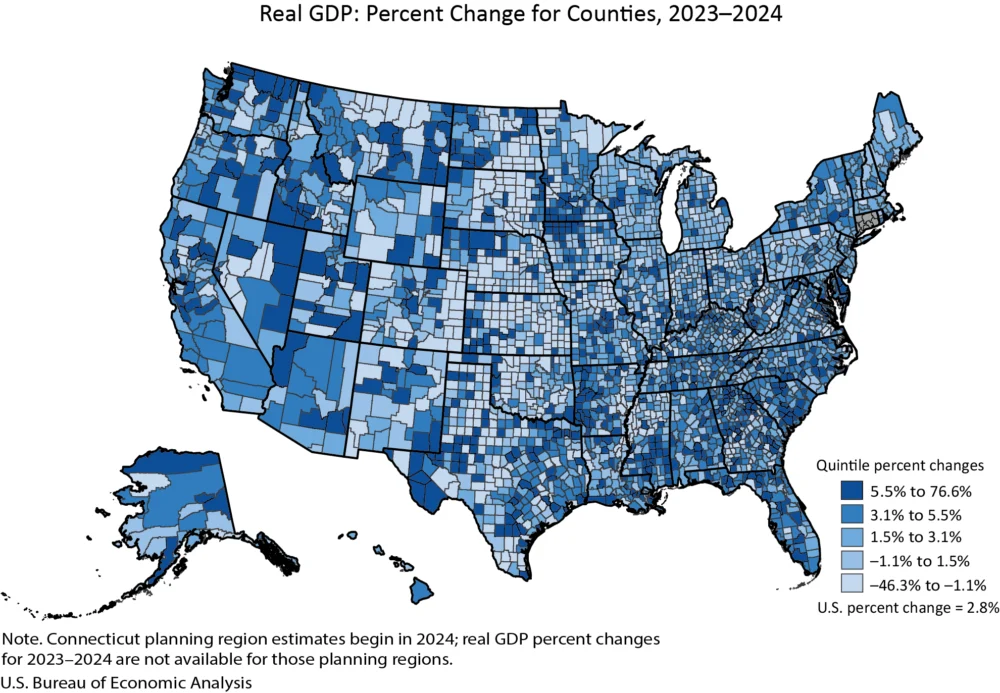
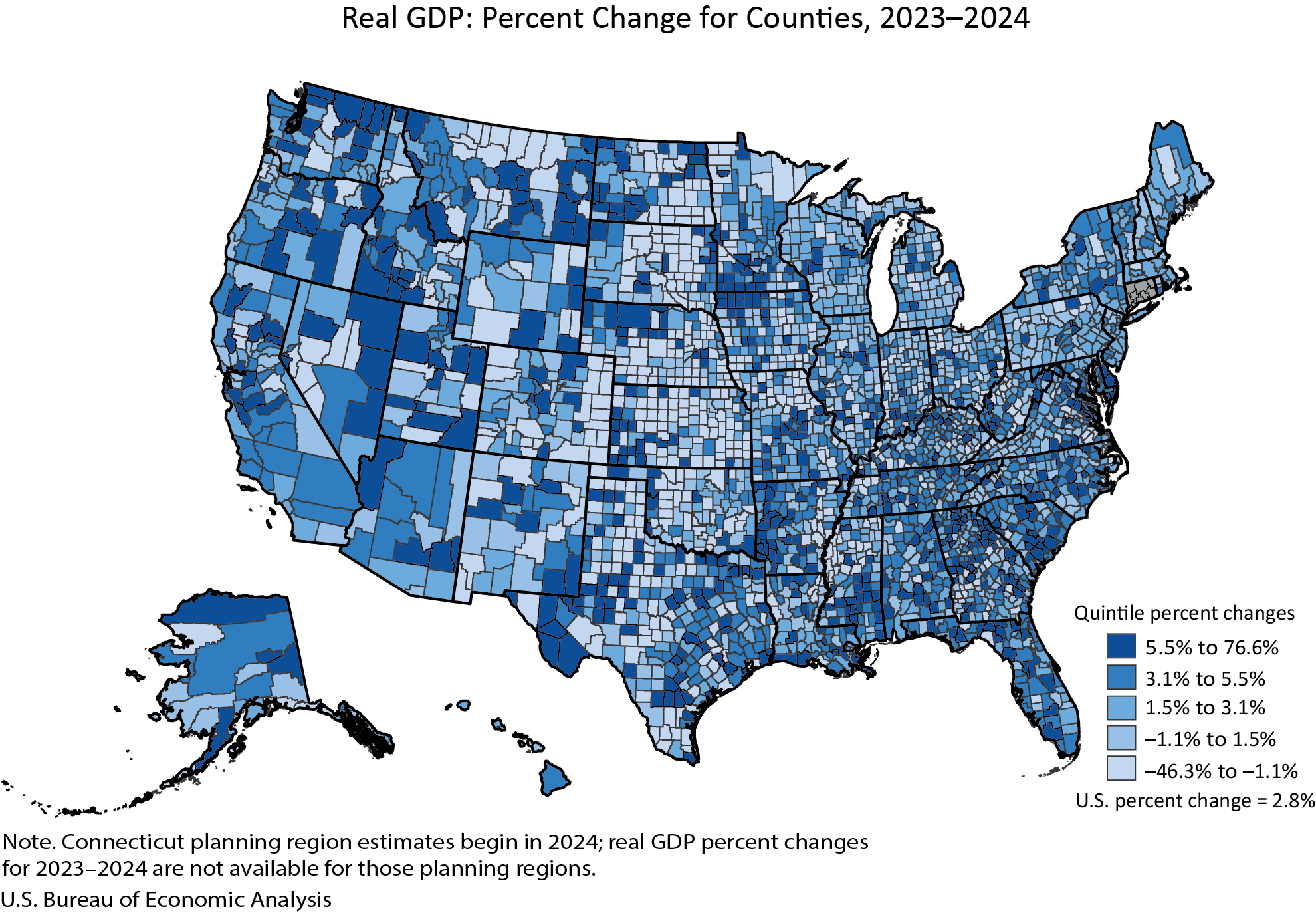
The U.S. Bureau of Economic Analysis (BEA) has released its comprehensive 2024 estimates for real gross domestic product (GDP) and personal income at the county level, painting a complex picture of economic activity across the nation. The data reveals a landscape of diverse growth and decline, with a significant number of counties experiencing economic expansion while others grapple with contractions. In 2024, real gross domestic product (GDP) increased in 2,273 counties, decreased in 809 counties, and was unchanged in 24 counties. The percent change in real GDP ranged from a remarkable 76.6 percent increase in Carter County, Montana, to a substantial 46.3 percent decline in Baca County, Colorado.
This latest release marks a significant shift in how the BEA presents county-level economic data, consolidating previously separate reports on GDP and personal income into a single, combined news release. This integration aims to provide a more holistic view of local economies and streamline access for data users. The BEA also noted changes in its reporting structure, including the discontinuation of statistics for metropolitan and micropolitan areas, focusing instead on county-level data. Furthermore, Connecticut’s economic statistics will now reflect planning region definitions rather than county boundaries, a change that will impact future comparative analyses for that state.
County Economic Performance: A Snapshot of Growth and Contraction
The BEA’s 2024 estimates underscore the heterogeneity of economic performance across the United States. The majority of U.S. counties, totaling 2,273, experienced an increase in their real GDP during the year. This broad-based growth suggests a generally positive economic environment for a significant portion of the country. However, the data also highlights areas facing economic headwinds, with 809 counties reporting a decrease in real GDP. A small number of counties, 24, saw their real GDP remain unchanged.
The magnitude of these changes varied dramatically. The stellar growth in Carter County, Montana, at 76.6 percent, indicates a period of significant economic expansion, likely driven by specific industry booms or resource development. Conversely, the sharp decline in Baca County, Colorado, at 46.3 percent, points to substantial economic challenges within that region. These outliers underscore the localized nature of economic forces and the diverse factors influencing county-level prosperity.
The BEA’s data also provides insights into the scale of county economies. In 2024, the total level of real GDP varied immensely, from the economic powerhouse of New York County, New York, which recorded $813.7 billion, to the much smaller economy of Issaquena County, Mississippi, with $15.7 million. This vast disparity in economic size means that percentage changes can have vastly different absolute impacts on local economies. A 10% increase in a large metropolitan county can represent billions of dollars in economic activity, while a similar percentage change in a small rural county might amount to only a few million.
Personal Income Trends Mirror Economic Activity
Complementing the GDP figures, the BEA’s personal income data for 2024 further illustrates the economic dynamics at the county level. Personal income, a measure of income received by households from all sources, increased in a substantial 2,768 counties, indicating widespread improvements in household earnings. Conversely, 331 counties experienced a decrease in personal income, and 7 counties reported no change.
The range of personal income growth was also considerable. Harding County, South Dakota, saw a significant increase of 22.6 percent, suggesting a strong year for its residents’ earnings. In contrast, Issaquena County, Mississippi, faced a decline of 23.3 percent in personal income, mirroring its economic struggles reflected in the GDP data.
Similar to GDP, personal income levels exhibit significant variation across counties. Los Angeles County, California, stands out with a total personal income of $818.5 billion, highlighting its status as a major economic hub. At the other end of the spectrum, Loving County, Texas, reported a personal income of $10.6 million. The relationship between GDP and personal income is generally strong, as economic output often translates into higher wages and other forms of household income. However, divergences can occur due to factors such as industry composition, labor market conditions, and the presence of large corporate headquarters or investment income.
County Economies by Population Size: A Deeper Dive
The BEA’s detailed tables offer a breakdown of economic trends by county population size, providing crucial context for understanding the data.
Large Counties (Population > 500,000)
In 2024, 145 large counties experienced GDP growth, while none saw a decline, and one remained unchanged. This indicates a robust economic performance among the nation’s most populous areas. The trend range for these counties was from a 10.7 percent increase in Pinal County, Arizona, to a 0.0 percent change in Johnson County, Kansas. The size of these economies is immense, with New York County, NY, leading at $813.7 billion, and Pinal County, AZ, at $12.7 billion, representing substantial economic activity.
For personal income, 146 large counties reported growth, with a trend range from 9.7 percent in San Joaquin County, California, to 2.7 percent in Philadelphia County, Pennsylvania. The largest personal income levels are found in these counties, with Los Angeles County, CA, at $818.5 billion and Pinal County, AZ, at $26.1 billion.
Medium Counties (Population 100,000 to 500,000)
Medium-sized counties also demonstrated predominantly positive economic trends. A total of 451 medium counties saw their GDP increase, while 20 experienced a decline, and 3 remained unchanged. The GDP trend range here was from 12.4 percent in Jefferson County, Texas, to a decline of 2.6 percent in Black Hawk County, Iowa. In terms of economic scale, Mercer County, New Jersey, reported $46.6 billion in GDP, while Liberty County, Texas, was at $2.6 billion.
Personal income trends in medium counties were also largely positive, with 474 counties reporting growth. The trend range for personal income was from 10.9 percent in Merced County, California, to 1.6 percent in Genesee County, Michigan. The economic footprint of these counties is significant, with Collier County, Florida, at $62.5 billion in personal income and Floyd County, Georgia, at $4.9 billion.
Small Counties (Population < 100,000)
The economic picture in smaller counties was more varied, with a larger proportion experiencing declines compared to their larger counterparts. In terms of GDP, 1,677 small counties grew, while a significant 789 counties saw a decrease, and 20 remained unchanged. The extremes in GDP change were most pronounced in this category, with Carter County, Montana, at a 76.6 percent increase, and Baca County, Colorado, at a 46.3 percent decline. The economic scale here ranges from $15.1 billion in Martin County, Texas, to $15.7 million in Issaquena County, Mississippi.
Personal income trends in small counties also showed a greater degree of contraction. A total of 2,148 small counties experienced growth, while 331 declined, and 7 remained unchanged. The personal income trend range for small counties mirrored the overall extremes, with Harding County, South Dakota, at 22.6 percent growth, and Issaquena County, Mississippi, at a 23.3 percent decline. The economic significance varies greatly, from $12.4 billion in Teton County, Wyoming, to $10.6 million in Loving County, Texas.
Context and Methodology: BEA’s Annual Updates
The release of these 2024 estimates is part of the BEA’s ongoing commitment to providing timely and accurate economic data. The annual updates incorporate revised source data that are more comprehensive than previously available. This year’s release aligns county data with the BEA’s national income and product accounts (NIPA) update and state-level statistics, ensuring consistency across different levels of economic measurement.
The BEA uses a detailed methodology to compile these county-level statistics. For GDP, this involves estimating value added by industry within each county. For personal income, the process includes tracking various sources of income, such as wages and salaries, proprietors’ income, dividends, interest, rent, and transfer payments. The use of U.S. Census Bureau population figures is crucial for calculating per capita personal income estimates, providing another dimension to understanding economic well-being.
The BEA has also implemented significant changes in the presentation of its data. The consolidation of GDP and personal income by county into a single news release marks a move towards greater efficiency and a more integrated approach to economic reporting. Furthermore, the discontinuation of metropolitan area statistics signals a strategic shift in focus towards county-level analysis, recognizing the increasing importance of granular economic data for policy and research. This change also means that users will need to rely on county-level data to reconstruct estimates for broader geographic regions if needed.
Implications and Future Outlook
The BEA’s county-level data provides an invaluable resource for policymakers, businesses, researchers, and the public. Understanding these economic trends at a granular level allows for more targeted policy interventions, informed business investment decisions, and a clearer picture of regional disparities.
The wide range of economic performance observed in 2024 suggests that national economic trends do not uniformly impact all regions. Factors such as industry diversification, access to infrastructure, labor force characteristics, and local policy environments likely play a significant role in determining a county’s economic trajectory. For counties experiencing declines, this data can serve as an early warning signal, prompting local leaders to investigate the underlying causes and develop strategies for economic revitalization. For counties showing strong growth, understanding the drivers of this success can inform efforts to sustain and expand economic opportunities.
The BEA’s commitment to revising historical data ensures that these estimates provide a consistent and reliable basis for long-term economic analysis. The move to a combined news release and the integration of data with national and state accounts will enhance the usability and comparability of these statistics.
The discontinuation of metropolitan area statistics, while a change, emphasizes the BEA’s focus on the county as the primary unit for detailed economic analysis. This shift acknowledges that economic activity and challenges are often more precisely captured at the county level, where specific local conditions can be more readily identified and addressed.
Looking ahead, the BEA will continue to release these comprehensive county-level economic statistics. The next release, scheduled for December 2, 2026, will cover 2025 data. These regular updates are critical for tracking evolving economic landscapes and informing crucial economic decisions across the United States. The availability of historical data through BEA’s Data Archive will allow for in-depth analysis of long-term economic trends and the impact of various economic events and policies on different regions of the country.